Told to keep quiet, they wrote a letter

They couldn’t vote, and they had been told to keep quiet in church.

The year was 1837 and they were women of Stoneham. Passionate about their cause, however, they found a way to make their voices heard. Led by the widow, Sarah Gerry, they wrote a letter.

There were 14 of them—married, single, mothers, grandmothers, wives of prominent men and workers in shoe factories. When they signed their names, addressed to the elders of the Congregational Church, they used their own first names, not their husbands, bucking the current custom. Sarah Buck, Mary Bryant, Abigail Green, Sally Richardson, Nabby Richardson, Mary Newhall and others.

Friends Freedman Association teachers in Norfolk, Virginia, in 1863.

What they were so upset about was slavery, practiced in the South and supported by many in the North. What particularly galled them was the fact that so many Christians supported it.

We are “deeply aggrieved,” they wrote, “that such an utter abomination in the sight of Heaven . . . is now sustained and defended by almost the entire Christian church in the South, with whom we are in fellowship.”

They continued. “By refusing to rebuke and remonstrate,” they wrote, “we do in fact participate in their guilt.”

Silence is complicity, the women were saying, and if we do not speak, we, too, are guilty.

The women closed with an appeal to church leaders: “We entreat you to take such action … that will show plainly that our influence is on the side of justice and humanity.”

For the church and the town, the letter was the start of something. Although it took years of conflict and violence, the abolitionist movement took root and bore fruit in Stoneham.

In 1838 twenty-seven women, again led by Sarah Gerry, formed the Female Anti-Slavery Society of Stoneham. The men formed a chapter a year later.

In 1840, church members passed a resolution calling on their pastor “to bear faithful pulpit testimony against the sin of slavery.”

Then in 1850, after passage of the Fugitive Slave Act, the new minister, the Rev. William Whitcomb,  gave a fiery sermon calling on parishioners to ignore the federal law mandating the capture and return of fugitive slaves. Instead, Whitman urged, “Hide the outcast or help him on his journey to a safer place, even though you may risk personal security, property and life.”

Recalling the brave men and women of Stoneham is fitting as we celebrate the Tricentennial of our town. It reminds us that those who came before us were faced with daunting challenges to what they believe and how they should act.

As in the decades before the Civil War, Christians today are also divided. Some believe that our President was saved by God to “make America great again.” Others cringe at the threats and actions harming vulnerable people among us. Like Bishop Mariann Edgar Budde in her sermon last week at the National Cathedral, they call for mercy and tolerance and justice—for immigrants, for LGBTQ+, for all those on the margins of our society.

Now it’s our turn. How and where will we make our stand?
‘Thee and Thou’ and the language of love

Romeo and Juliet used it. So did Ruth, David and Jesus, according to the early Bible translators. So, in the centuries that followed, poets, lovers and preachers have slipped back into this archaic dialect. Even Langston Hughes, who loved the American vernacular, chose it when he wrote to his “Black Beloved.”

I’m talking about the use of “thee and thou.” Although almost no one uses this dialect any more—that is, except some Quakers, and I’ll get to that later. We teach it to our children every time we have them say, “Our Father, who art in Heaven, hallowed be thy name.”

To get a handle on this dialect, let me tell you why we English speakers find it quaint. First of all, it’s because modern English, unlike many other languages, has left us with only one word for “you.” That’s right. English, with its massive vocabulary, is so poor that it now only has one word.

It wasn’t always like that. In the Middle Age and Renaissance, English had more than one word for the second-person pronoun. There were three subject pronouns—the familiar “thou,” the formal “you,” and the plural “ye.”

First, let’s distinguish between singular and plural. In William Tyndale’s 1526 translation of the New Testament, we read: Ye are the salt of the erthe, and ye are the light of the worlde. Here, Jesus uses the plural ye when he is talking to more than one person.

On the other hand, when he is talking with one person, as to the woman at the well, he says, from the King James Bible: If thou knewest the gift of God, and who it is that saith to thee, Give me to drink; thou wouldest have asked of him, and he would have given thee living water.

Nice thing, that ability in language to know if the speaker is addressing just one, or many people, by the pronoun he or she uses. Unfortunately, today’s Standard English leaves us stranded. We make up for it, however, with our own vernacular for the plural you. “You guys, y’all, youse,” etc. Not “proper” English, but it gets the job done.

But there’s something else going on in Jesus’ use of the “thou,” suggestive of his relationship with the woman.

In Shakespeare’s time, you had the option—as you still have in modern French, Spanish or German—of using “thou” or “you.” Common practice was to use “you” with your superiors, strangers, or in formal situations. But to your peers, your close friends, or with those below your social level, servants included, you would use the familiar “thou.”

In Romeo and Juliet, we first see this distinction in a conversation between Juliet’s nurse and Lady Capulet. Reminiscing on Juliet’s childhood, the nurse addresses Lady Capulet as “you,” showing respect, while Juliet’s mother responds using the familiar “thou.”

“You” was polite and formal. “Thou” was familiar. It was personal. But—and this is important—it was also the language of intimacy, the language of lovers.

Both Romeo and Juliet, when they first meet, without even knowing each other’s names, use the “you” form of address. At their next encounter, however, now love-struck, they slip into the language of intimacy: “O, speak again, bright angel! for thou art as glorious to this night, being o’er my head as is a winged messenger of heaven.”

And Juliet: “O Romeo, Romeo! wherefore art thou Romeo?” Why, my love, she is asking, must you have the name of my family’s enemy?

Whether the speaker uses “you” or “thou” is an indicator of their relationship, and this carries through in Shakespeare’s sonnets as well. To his beloved, as he is now an old man, Shakespeare writes in Sonnet 73:

“This perceiv’st thou, which makes thy love more strong/ To love that well, which thou must leave ere long.”

It’s still that way in other languages today. When addressing someone in Spanish, you use tu or Usted. In French, tu or Vous. In German, du or Sie. Using the wrong word, however, can get you into trouble. Which it did when I was a teenager in Germany, when I addressed Frau Liebig, the mother of my friend, with the familiar du rather than Sie.

“Do you address your elders like that in America?” she asked. When I explained that in America we spoke to everyone in the same way, she smiled. “But you shouldn’t here,” she said.

I learned that I could use du with my friends and my immediate family. But with other adults, teachers, employers, seniors, strangers—be sure to use the Sie form, she explained, along with its appropriate verb conjugations and the correct objective and possessive pronouns. In all, I would learn, there are seven words in German for “you.”

At the same time, however, when I attended the local Lutheran church, I heard the pastor pray using the familiar form of speech with God. Wow, I thought. I could use du with God! And so I learned: Vater unser, du der bist in Himmel, dein Name werde geheiligt….

So it once was in English. What we think of as church talk, or high talk, was the opposite. Thee and thou was the language of low talk, used with those we were “down with,” with those we love, and, remarkably, with our Father in heaven.

That’s why Quakers, those radical reformers from England, chose to use “thee and thou” even when everyone else had stopped using it. And, in so doing, they were making a statement about the equality of all people.

So here’s to the “Thee and Thou” of the Lord’s Prayer, and to all the funny verbs and pronouns that go along with them, Here’s to our freedom to talk to God as if we are speaking with our closest friend—whether we use archaic or modern English, formal grammar or street dialect. It’s all there in the words we choose.

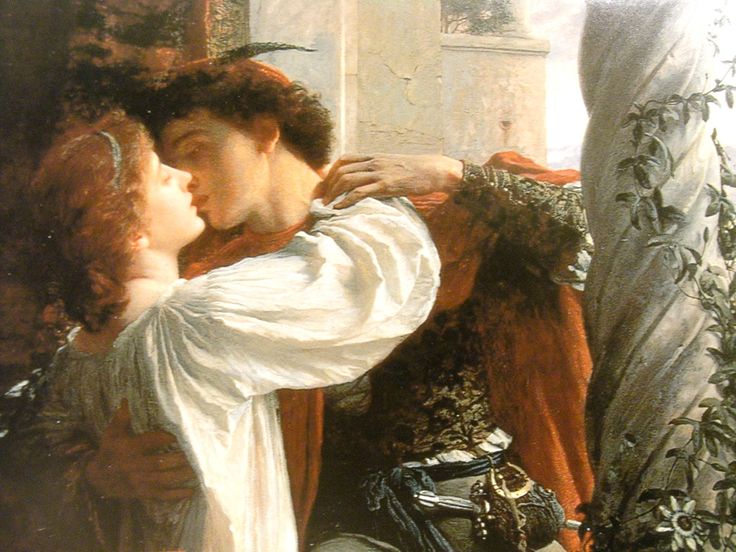
Art: detail of 1884 painting of Romeo and Juliet by Frank Bernard Dicksee

How will we respond?

It was a gray day in Moscow, and a 7-year-old girl was on the way to the train station. Her mother had gone to the hospital to deliver, and the girl was being sent to her aunt.  In the streets, she remembers, were soldiers with rifles, and everywhere people in shock, some openly weeping.

Why are they crying,” she asked her father. It was March 5, 1953.

“Stalin has died,” her father said.

A friend and colleague told me this story. She also said that in a little bag her father took with him to work each day he packed a toothbrush, razor and extra underwear, in case he didn’t return.

I could relate. Also having Russian heritage, I knew of the Soviet dictator’s reign of terror. My relatives, German-Russian farmers on the Kuban steppe in Southern Russia, were exiled to Siberia and Kazakhstan. One died in a gulag. Another was shot. My Tanta Anna as a teenager was forced to work in a logging camp.

Meanwhile, my friend grew up under Stalin’s successor, Nikita Khrushchev. In a famous speech, Khrushchev had shocked the party by condemning Stalin’s crimes, coining the phrase, “cult of personality.”

In the following years, she excelled at the university, earning a doctorate. and began a career teaching math. After the breakup of the Soviet Union, she, her husband and their parents left Moscow and settled in New England. We taught together in Massachusetts.

As I had tea with her one day between classes, we talked about Stalin and the power he had over people. I recalled a passage in Alexander Solzhenitsyn’s Gulag Archipelago describing a Communist party meeting in the 1940s, where, after Stalin had spoken, the audience jumped to its feet to applause. The applause continued. It didn’t stop. Looking around, members were afraid to stop clapping. Would someone notice? Would they be on the slow train to Siberia?

Similar scenes occurred in Nazi Germany. In a 1936 photograph of a rally held at a shipyard, one German worker stands in a crowd with his arms folded. He is the only one not giving the Nazi salute. Once a loyal member of the Party, August Landmesser had fallen in love with a Jewish woman. After his engagement was discovered, he was expelled from the Party, and his marriage application denied. They had a daughter.

In 1937 Landmesser attempted to flee Germany with his family, but was arrested at the border. The Gestapo also arrested his wife, who delivered their second child in prison. Sent to the Bernburg Euthanasia Centre, she was murdered along with 14,000 others.

After three years in a concentration camp, Landmesser was forced into the German Army. He went missing in Croatia.

Many are the lessons we can draw from history. One we cannot ignore, however, is that authoritarian, autocratic governments cause great harm, not only to democratic institutions, but to vulnerable people.

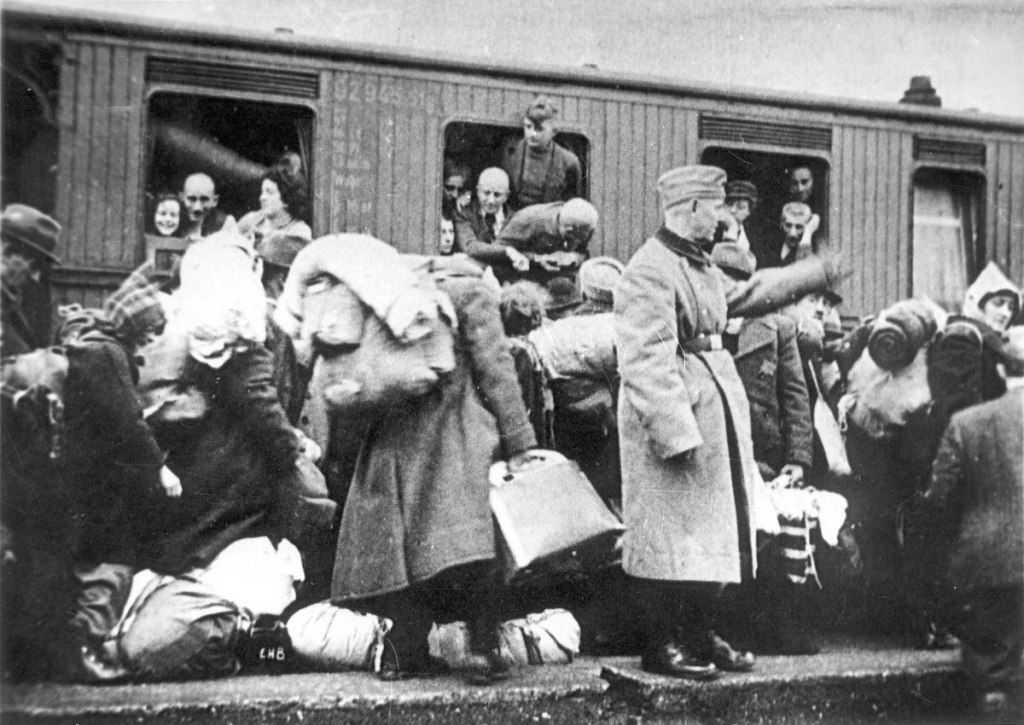
Deportation of Jews from Muenster, Germany, Dec. 13, 1941.

As we begin life under a second Trump administration, millions of our neighbors are threatened with deportation. These include hundreds of thousands of DACA students and millions under temporary protected status (TPS) or awaiting action on their requests for asylum.

In the coming days, how shall we respond. Will we clap? Will we fold our arms? Will we speak what we believe? Will we act to safeguard the lives and liberties of others?

Who would you honor?

January 4, 2025

Today President Joseph Biden honored 19 Americans with the highest civilian award, the Medal of Freedom. The recipients ranged from human rights workers to basketball stars, philanthropists to actors.

Although critics will snipe that some of the names were political choices, who among us did not cheer when our nation’s highest civilian award went to the José Andrés, World Kitchen chef, or Jane Goodall, animal biologist, or Michael J. Fox, actor and voice for Parkinson’s research.

Who didn’t chuckle when a towering Earvin “Magic” Johnson stooped down so the president could fasten the pendant around his neck? Or cheer when Bono, the U2 rock star who has fought for debt relief for poor nations, got the award.

The ceremony got me to thinking about the word “freedom” itself. What is freedom? Are there more than one? What freedoms are we talking about?

In a State of the Union address given 84 years ago, President Franklin D. Roosevelt said, “we look forward to a world founded upon four essential human freedoms.”

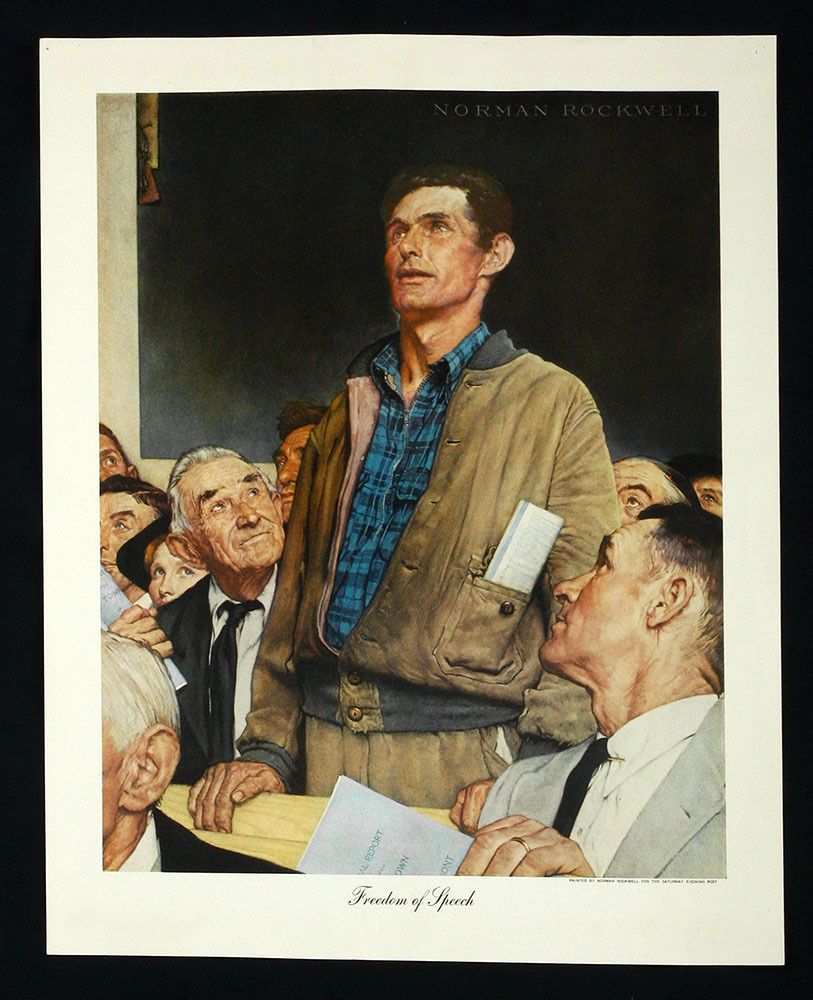
He continued: “The first is freedom of speech and expression—everywhere in the world. The second is freedom of every person to worship God in his own way.”

He defined the third as “freedom from want” and called for “economic understandings that will secure to every nation a healthy peacetime life for its inhabitants.”

The fourth freedom, Roosevelt stated, was “freedom from fear.” He called for a reduction in global armaments to the degree that that “no nation will be in a position to commit an act of physical aggression against any neighbor.”

Articulated eleven months before the attack on Pearl Harbor, the Four Freedoms theme was incorporated into the Atlantic Charter and later became part of the Charter of the United Nations.

Although the three-term president was now defining freedom in global terms, his administration had from the start applied them to domestic policy and public programs.

In 1943 in four Saturday Evening Post covers painted by Normal Rockwell, the Four Freedoms showed us what freedom looks like at home, at the table, in moments of worship, and at a town meeting. You can see the original paintings today at the Norman Rockwell Museum in Stockbridge.

Thinking about the recent Medal of Freedom ceremony, I realized that each person honored had in some way contributed to expanding one of the Four Freedoms.

And that got me to wondering, if I were to pick individuals in Stoneham who exemplified these freedoms, who would they be?

What my choices would have in common is the desire to realize freedom not only in their own lives, but in the lives of others as well. I would look for people who lift others up. A teacher who teaches compassion as well as calculus. A banker who helps small businesses gain a foothold. A town moderator who keeps democracy on track. An artist who teaches seniors to paint. A tutor who helps immigrants learn English. A food bank or community dinner director. A legislator, coach, librarian, nurse, police or fire fighter, pastor, and more.

Who would you choose? Look around you. In the New Year, we will be challenged to honor and uphold the freedoms we cherish. It’s something each of us, in our own way, can do.