News and updates continue to stream from Delaney Hall, the troubled detention center in New Jersey holding some 1,000 immigrants the Trump regime considers illegal.
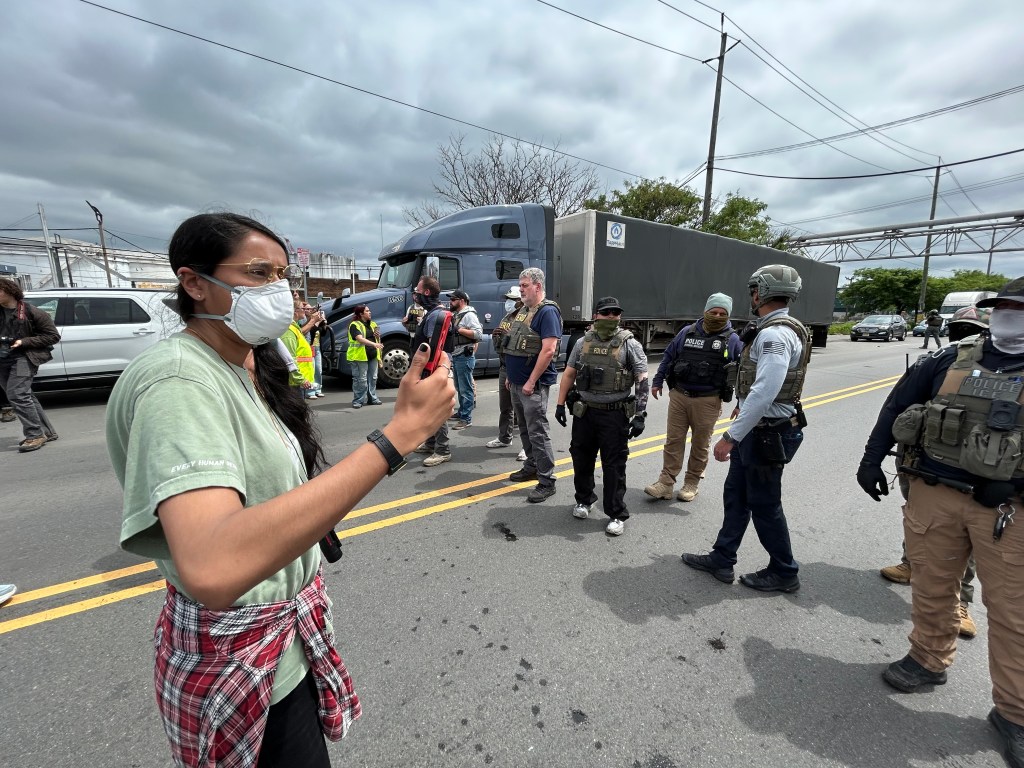
A protester confronts ICE agents outside Daleney Hall.
Becky and I were there last weekend to meet with families of detainees and the wonderful crew of volunteers, including our daughter and son-in-law, who provide support to families with loved ones inside.
Although the NY Times’ coverage is at best meager, several New Jersey mainstream and independent media are covering what’s happening at Delaney Hall. Their coverage includes the hunger/labor strike, violent reaction by ICE officials, removal and isolation of inmates, and the strong presence and advocacy of Senator Andy Kim, Rep Robert Menendez and others.
Meanwhile, messages of solidarity are coming in from around the country, including from Rabbi Susan Abramson of Temple Shalom Emeth, a principal organizer of the protests at the ICE headquarters in Burlington.
Here’s what she posted on FB, reporting on the continued weekly protests in Burlington: “400 of us stood against the policies and injustices of ICE this week at Bearing Witness At The Burlington ICE Office. Thanks to all who donated food, snacks, diapers, and toys. We stand in solidarity with Delaney Hall!”
While at the Family Support tent at Delaney Hall, we met some amazing people–dedicated volunteers who provide personal support, food, clothes and a place for families to wait, rest, and have a hot or cold beverage.
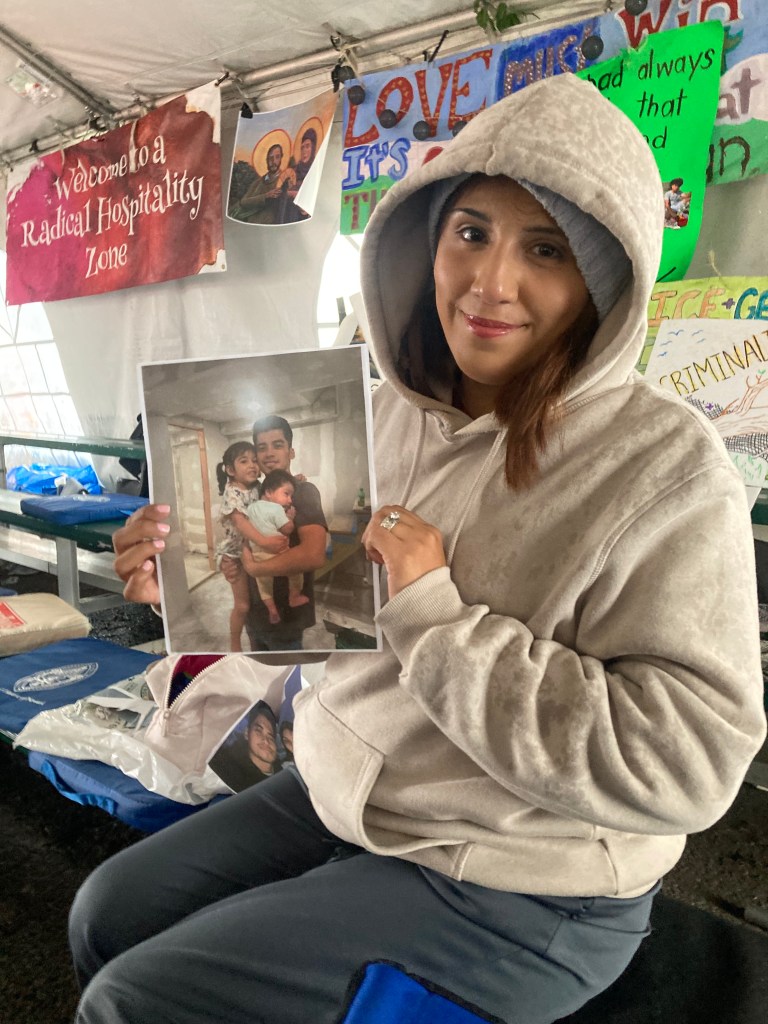
We met Gabriela, the wife of Martin, held inside the prison. Mother of two small children and expecting a third, Gabby is an American citizen, as are her children. Martin, however, is from Peru. He was in the process of filing as spouse of a citizen for legal status. He was arrested by ICE while going to the store for diapers.
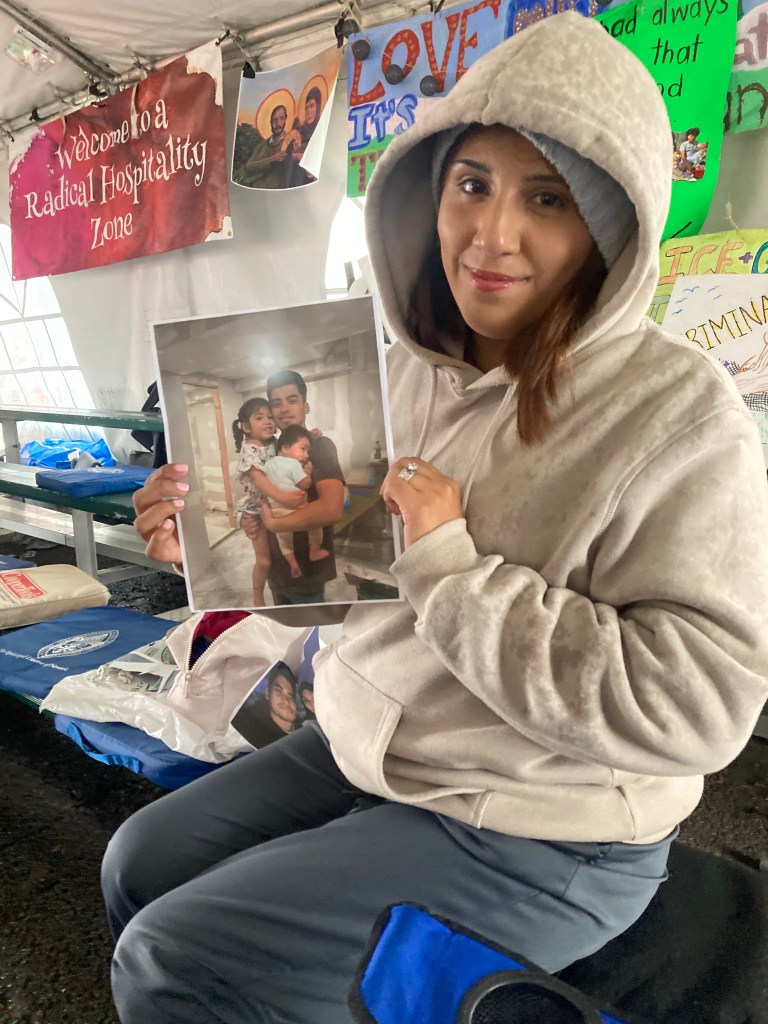
An eloquent spokesperson for families of detainees, Gabriela has spoken up with force, calling not only for an end to horrendous treatment of inmates but for their constitutional right to due process and release. We met her inside the tent as rain poured down outside. Her voice was hoarse, and she was sipping hot tea. All the same, she greeted us with warmth and proudly showed us a photo of her husband with their children.
Gabriela Soto with photo of her husband and children.
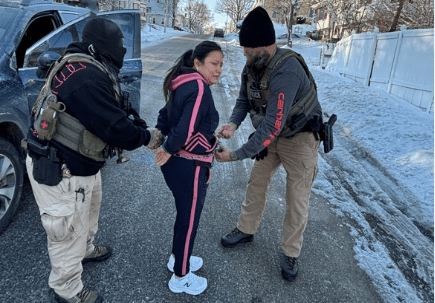
Because her husband has been considered a leader of the 300 inmates who went on hunger strike, ICE officials attempted to remove him from Delaney Hall. Protesters, however, blocked the vehicle from leaving, and it turned back. Later that night, however, ICE shackled and chained Martin and took him away in an unmarked car via a back exit. He was taken to another detention center in Elizabeth, NJ, and put in solitary confinement. Gabriela has since gone to that site. I don’t know, at this point, if she has been allowed to see him.
The other person I want to mention is a middle-aged man named Daniel. In January he was arrested while going to pay his electric bill. Taken first to Delaney Hall, he was then flown to a detention center in California. Daniel had recently been diagnosed with a brain tumor and had begun radiation treatments. Now he was held far from home and friends. Not willing to let his case go unheard, my daughter contacted a friend in California who found him an attorney willing to take his case pro bono. It took several months for the habeas corpus appeal to be heard, but in May Daniel was finally released on bond and returned to New Jersey. Met by friends and advocates, he has been able to resume medical treatments. Last week he stopped by the welcome tent at Delaney Hall to say thank you for their support.
The situation at Delaney Hall continues to escalate, and we don’t know what will become of the detainees or their families. Charges of wormy food, lack of medical treatment and brutality continue. Protesters, inlcuding Senator Kim have been pepper sprayed. Ambulances have been seen coming and going.
What’s happening at Delaney Hall is not just a local crisis. It’s a national crisis. As our daughter reminds us, the struggle is not a 100-yard dash. It’s a marathon. Courage to all as we continue, each in own way, to stand up for those being oppressed.
PS. Thanks for the encouraging responses from S4SJ network members.
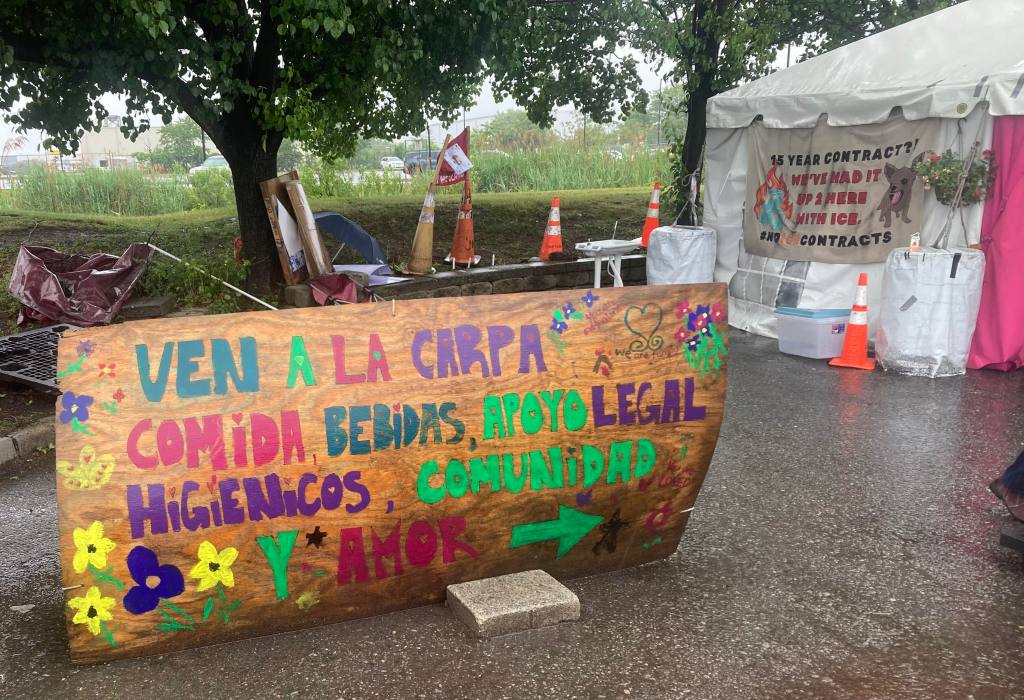
Sunday morning Becky and I walked through heavy rain to a tent set up just outside Delaney Hall, an ICE detention prison holding over a 1,000 men and women in Newark, NJ. We had driven over from our daughter’s home in a Newark suburb. She had arrived earlier, joining other volunteers to set up coffee and food along with clothing, diapers and toys for families hoping to visit their loved one inside.
“Come to the Tent” in Spanish is posted by volunteers providing support to families of detainees at the Delaney Hall Detention Center.
Situated off the turnpike in New Jersey among huge gas tanks, warehouses, depots and a state prison, Delaney Hall has been the flashpoint for protests of its inhumane treatment of inmates. On Friday, around 300 detainees began a weekend hunger and labor strike and called on Gov. Mikie Sherrill to visit Delaney Hall, a private, for-profit facility, and address their complaints.
The day before, Senator Andy Kim (Dem-NJ) had visited Delaney Hall and met with inmates and advocates. Voicing his support for the detainees, he wrote this on his Facebook page:
I rushed to ICE detention center Delaney Hall yesterday when I heard detainees began a hunger strike. Here’s what I saw:
An 18 yr-old high-school student crying and saying she just wanted to graduate senior year;
A pregnant woman unable to get full OBGYN medical support;
A woman who had a miscarriage in the detention facility and left to manage all on her own;
A mom not allowed to spend more that a few minutes with 4-month-old baby;
A husband of an American-citizen wife and kid;
A carton with the milk inside congealed solid (expiration date is tomorrow); [there were also complaints of worms in the food.]
A man there for nearly a year with no movement in his legal efforts;
A document showing next Tuesday’s court docket showing 74 cases before one judge in one day (averages about 5 minutes a case);
A man telling me ICE is trying to deport him to the Democratic Republic of Congo, where there is an active Ebola outbreak (he’s from South America originally);
Numerous people who were arrested at scheduled interviews for Green Cards (trying to follow the formal process);
A family unable to find out what hospital their family was sent to (ICE said they cannot give any medical updates to families of hospitalized detainees);
The Statue of Liberty as I left the facility to drive home. [You can see the Statue from Liberty State Park in Jersey City, not far from Delaney Hall.]
In another column, I’ll write more about what happens at Delaney Hall, and in the tent where volunteers provide support to families of detainees. Because what happens there, even if it’s not on the 6 o’clock evening news, must matter to us.
It happened at Logan as we crowded to board the Woburn Express. The gray-haired bus driver with a bad back motioned for us to stow our own luggage into the compartment below. There were huge suitcases and golf clubs and duffel bags and strollers. Then something happened: a stocky passenger, fiftyish, stepped to the curbside and, bending, grabbed and shoved every piece of luggage into the belly of the bus.
After that, we all climbed aboard, the door swished shut and we wheeled smoothly into the Sumner Tunnel to merge on the other side into I-93 rush hour traffic for the last leg home. All the time I’m thinking: in a bunch of pretty-much- all-white frequent fliers, the one stepping up was black, and you may ask why do I have to mention black and white, so I reply yes, why indeed, and what do you make of this?
At age seven I was thrilled by the Lone Ranger. We didn’t have a TV, but the family that rented above us did and invited me and my brothers up to watch on their black-and-white.
Years later, I looked forward to “Gunsmoke,” which my uncle would let us watch with him in the family room. Our hero was, of course, Marshall Matt Dillon, who kept the peace in Dodge City, along with his sidekick, Chester, Miss Kitty and Doc Adams.
Then came Wyatt Earp, Maverick, the Rifleman, Have Gun Will Travel and others. What all the characters had in common was they knew how to solve problems and settle disputes. They did this with their guns.
As did boys did across America, I imagined myself as a heroic keeper of the peace. Our parents didn’t allow us store-bought six-shooters, but we made our own versions out of wood. In my reverie, I was the quickest draw in town.
My fascination with Westerns was an early immersion in a culture wedded to guns. Guns represented power, and the destruction they caused was justified by the need to protect and establish order or to settle old scores.
If our heroes shot and killed other human beings, this was all right because they were clearly the bad guys. We enjoyed seeing their theatrical demise. “Bam, you’re dead,” one of us would yell. “You got me,” the other would respond, spinning and falling to the ground.
Over time, on TV and in movies, the weapons became more sophisticated. Colt 45s and Winchester rifles were followed by .44 Magnums and AR7s. Then came Glocks and M60 machine guns. Star Wars and Jurassic Park brought us Mauser pistols and SPAS-12 shotguns. Today, AK47s are the weapons of choice.
Beyond the arguments over gun proliferation and control in America, and whether our Constitution sanctions unfettered access, is the simple reality that we Americans are in love with our guns. We want them, we have them, and we use them— despite the horrendous suffering they inflict.
This is true on a national scale as well. Too often and too quickly we turn to our weapons—ever more sophisticated—in our cities and in the world. We choose war over defense, “death from above” over mediation and conflict resolution.
Accompanying our threats of violence to our perceived enemies is their dehumanization. Nowhere is this more evident than in the words and deeds of our current commander in chief and secretary of the War Department.
The president who labeled Somalians “garbage” and African nations “shithole countries,” has called Iranians “crazy bastards” and threatened to “bomb them back to the Stone Age.”
Hegseth has taunted Iranians as “barbaric savages” and called for “overwhelming violence of action against those who deserve no mercy.”
When you deny your opponents their humanity, it’s much easier to destroy them. You can shoot protesters in the street. You can blow up boats in international waters, summarily executing suspects. You can conduct a “precision” strike into another nation to arrest its leaders, killing 80 people in the process.
And you can start an unprovoked war, unleashing missiles, bombs and drones that you know will kill and wound not only our own soldiers, but thousands of civilians—including children—their suffering out of sight and out of mind.
After 250 years, will we ever understand the true consequences of our violent impulses, combined with our love of weapons? Will we ever learn to holster our six-shooters and commit ourselves to making peace? God help us.
Grampa Durell worked by touch and sight. A carpenter, he knew each wood’s hue and grain. He measured close so things would come out right.
To mark each piece, each board’s width and height, He used a fold-up, bass-wood rule; took pains To saw, fit, join, and sand by touch and sight.
His tools survive: hand drills that curl and bite Into the wood—chisels, squares and planes That seem today to fit my hands just right.
So, too, his gifts: tables, dressers, joints still tight, A pine doll cradle with a cherry stain, A great granddaughter’s now, for touch and sight.
In the Spanish-American War he missed the fight, Got dysentery and couldn’t avenge the Maine. But things have a way of turning out all right.
We keep his lieutenant’s sword, the blade still bright, But use his carpenter’s rule again and again, Reminding us to learn by touch and sight, Measuring well so all will come out right.
Note: I wrote this villanelle about Becky’s grandfather, a carpenter in Lowell. I knew him only through family stories and from handling his old tools “that seem today to fit my hands just right.” Villanelles are fun to write, but they ain’t easy. The most famous one is, perhaps, Dylan Thomas’ “Do Not Go Gentle into that Good Night.”
One of my favorites is Theodore Roethke’s “The Waking.” Look it up. It’s a wonderful exploration of consciousness and the interplay of feeling/thinking, motion/stillness, action/reflection, East/West, etc., full of wisdom.
Listening to Jimmy Tingle Saturday as he emceed the No Kings protest/rally on the Stoneham Common, I couldn’t help but think of a 30-year-old preacher in the white church rising up behind him. The year was 1850 and the preacher was the Rev. William Chalmers Whitcomb. On a cool morning in November, he stepped into the pulpit and preached a fiery sermon that called on parishioners to follow God’s law rather than the law of the land.
Then as now, the country was divided. Congress had just passed the Fugitive Slave Act, mandating the return of all former slaves to their owners. State governments, local law officers, and even citizens were called on to aid in its enforcement. The law imposed stiff penalties of imprisonment and fines for anyone sheltering fugitives.
The Rev. William Whitcomb
The Fugitive Slave Act tore apart families, towns, political parties and churches. The governor, most legislators and civic leaders supported it. Even Daniel Webster, the esteemed Massachusetts senator, now secretary of state, hailed the federal law as the best way to keep Southern states from bolting.
In Stoneham abolitionists had met with fierce opposition. The host of the first recorded meeting in town, attended by William Lloyd Garrison, was told his house would be burned down. In a fight after an abolitionist meeting at Town Hall, a 37-year-old man—husband and father of three—had been stabbed to death.
Although abolitionist sentiment was growing, by 1850 most ministers either remained silent or spoke in favor of the federal law. Not so the new minister in Stoneham.
“I make no apology” for speaking on this subject, Whitcomb told the people of Stoneham. He only regretted that he had not spoken out sooner.
He began by citing the Old Testament book of Deuteronomy, Chapter 23: 15-16: “Thou shalt not deliver unto his master the servant which is escaped from his master unto thee: He shall dwell with thee, even among you, in that place which he shall choose in one of thy gates, where it liketh him best: thou shalt not oppress him.”
In defiance of the federal law, Whitcomb called on his congregation to “Hide the outcast or help him on his journey to a safer place, even though you may risk personal security, property, and life.”
The Stoneham minister urged nonviolent action based on the principle of love. “Shed no blood,” he said. “Wield no weapons but those of truth and love. Use no arms but those God hath given you.”
Fast forward from the church across the street to March 28, 2026, as some two thousand citizens packed the Stoneham Common to protest the federal government’s policies and actions. It was the third national No Kings Day with massive demonstrations geared to stopping the rise of authoritarianism in the United States. Participants protested the war in Iran, the violence of ICE, interference in elections, the targeting of immigrants and LGBTQ+ and attacks on First Amendment rights.
Choirs sang, leaders rallied, a guitarist soloed, protestors chanted, while throughout Jimmy Tingle inspired and entertained the throng with his passion and wit. Pulling a harmonica from a pocket, he opened with a reedy version of the National Anthem. The harmonica reappeared later, when in closing, Tingle told the story of John Newton, the one-time slave trader who repented and became a leading abolitionist. He then played the hymn that Newton wrote, “Amazing Grace.”
I couldn’t help but think, as we left the Common, some to continue to the Boston Common for the 1 p.m. rally there, that Rev. Whitcomb would have been proud.
The gardener comes with a new red hose. He sets up the sprinklers under the pepper tree, waters the zinnias, lilies, iris, then rakes smooth the gravel in the path.
Perhaps he didn’t actually see it happen, I mean the opening of the stone. But how many of us have watched a seed open? Perhaps at the time he was touching the broken stem of a rose.
Encrypted passwords? Secret codes? Your keyboard exploding? No, these nonsensical clusters of the alphabet are the names of—you guessed it–prescription drugs in TV ads (I’ve scrambled the letters of their actual names, but you get the point).
Want to catch the evening news? But wait, isn’t it possible you have a rare disease or chronic impairment that can only be treated, or managed, with this amazing drug. So be sure to ask your doctor if ABACADABRA is right for you.
If you’re like me, you lunge for the remote—now where did I put it?—and press the mute button. Once you’ve done that, you can sit back and enjoy the show. Because without the sound, these ads are rather pleasant. You’ll see families riding bikes, fathers barbecuing, seniors playing tennis, lovers embracing. Beautiful people, beautiful lives.
Muting the sound also means you don’t have to listen to the side effects, often spoken hurriedly in a low voice. These may include–now don’t panic–nausea, headaches, heart palpitations, bleeding, disorientation, fainting, liver failure, heart failure—and so on, depending on the drug being pitched. Lord have mercy!
Did you know that the United States is one of only two countries in the world that allow direct-to-consumer marketing of prescription drugs on TV. When our cousin from Germany visited us recently, she was amazed. “That’s not allowed in Germany,” she said.
Since the 1980s, when Congress let the FDA loosen rules on direct consumer drug marketing, the airwaves have been saturated with ads. Drug companies must, however, present risks along with benefits.
Big Pharma, which used to only target doctors, now pitches its drugs directly to you. So what’s the harm in this?
First, Big Pharma is asking you to evaluate a complex medical substance and market it to your physician. I don’t know about you, but that’s not my job.
Second, the ads push costly brand names over more affordable generics.
Third, the billions drug companies pay to make and place these ads gets passed on to us in higher prices.
Fourth, the ads are driving us crazy.
How I long for an evening at home watching TV without being battered by drug ads. Ads for heart murmer, incontinence, diabetes, erectile dysfunction. The worst is the one featuring a bent carrot. That’s right, a carrot!
Like millions of other Americans—and people around the world—I’m convinced that TV drug ads are bad for our health. It’s time we asked Congress to stop them.
At the crosswalk a blind woman offers you her arm as you cross she says she has looked into heaven for you you cup your hand to your ear but all you hear is the turning of keys
She steps into a shop and you think I should have said something
You walk on promising yourself that next time you will know whether to use the polite or familiar that next time you will join the seniors doing tai chi in the park
that next time you will lift up the toddler in the doorway the one that won’t stop crying and sing him all the verses of the song you remember now for the first time
Note: art by Kenneth Patchen from the cover of Panels for the Walls of Heaven, Berkeley, 1946.