1936 & 2026–What will we remember?

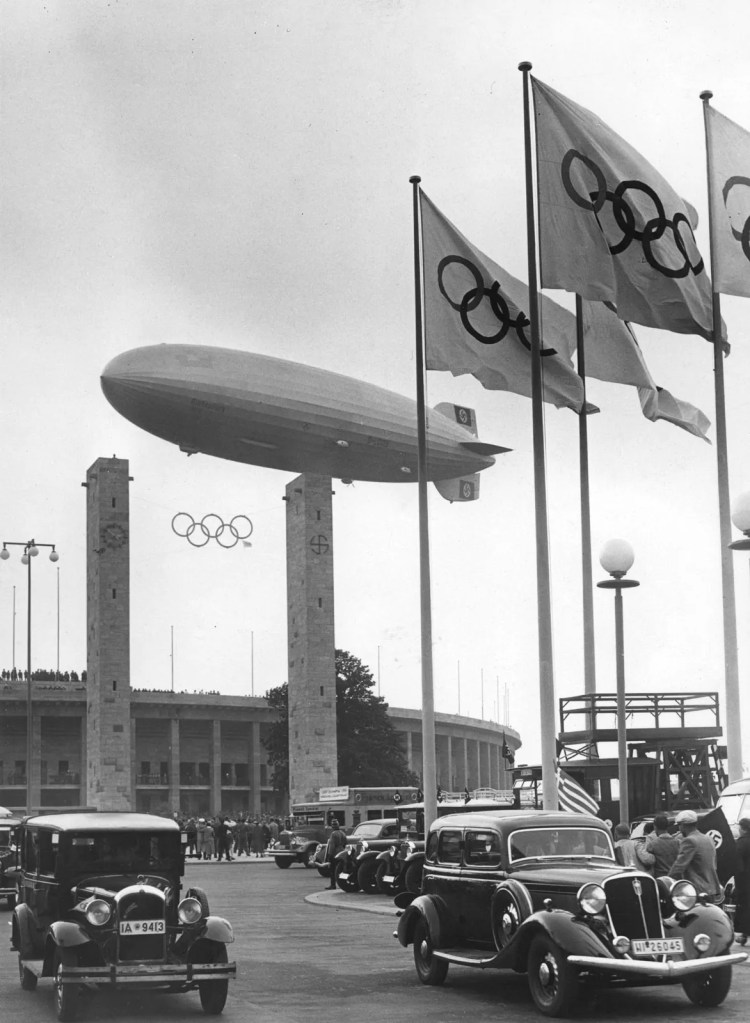
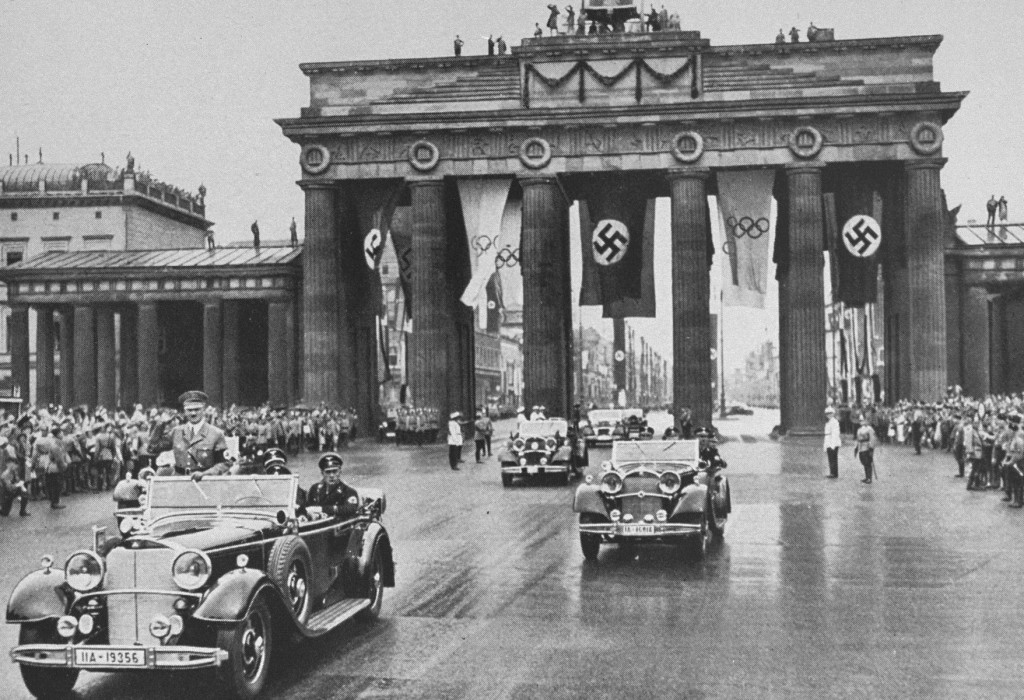
The black-and-white photos are eerily compelling. A giant airship, the Hindenburg, hovers above the stadium. In another, a runner in white, carrying a torch, leads other runners through the streets. A third shows Adolf Hitler and his entourage as they pass through the Brandenburg Gate. The Führer is standing in his open Mercedez Benz. A fourth shows him arriving in the massive Olympic stadium as 120,000 Germans raise their arms in Nazi salute.

We remember the 1936 Olympics as a pivotal event, showcasing the glory and the infamy of the Third Reich. It took place three years after Adolf Hitler came to power and three years before Germany invaded Poland and World War II began. I think of these games with all their ceremony as I watch the final games of the World Cup, hosted by the United States, Mexico and Canada.

When the Olympics opened in 1936, anyone who was paying attention knew of Germany’s persecution of Jews, Roma and others. As early as 1933, the Nazis had instituted an Aryan-only policy in all athletic organizations. Jews were excluded from sports facilities and associations. Other actions were more sinister.

In April of ’33, the government barred Jews from holding civil service, university, and state positions. That same month it instigated boycotts of Jewish businesses and shops. In May, across the street from the University of Berlin, mobs burned over 20,000 books. That spring, the Nazis opened the first of 23 main concentration camps near Dachau.
In the next two years Hitler pushed through a series of “Nuremburg Laws,” stripping Jews of their citizenship and prohibiting intermarriage. Germany also began compulsory sterilization of the “unfit,” mentally and physically disabled persons in nine categories. Euthanasia would come later.

In the summer of 1936, in preparation for the Olympic games, the Nazi government put on a kinder face for the world. Antisemitic signs and posters were taken down and government pronouncements muted. To show its racial tolerance, Germany included in its Olympic team of 433 athletes one Jew, the star fencer, Helene Mayer, whose father was Jewish.

Considered a triumph of propaganda, the 1936 Olympics showcased Germany as a respectable and welcoming member of the international community, a nation built by hard work, family values and patriotism.

What most Americans remember about the Berlin games, however, was the brilliance of Jesse Owens, who won four gold medals, defying the Hitler’s racial ideology. With his stunning victories, Owens became a household name, with little thought to the racial prejudice he and other African Americans faced back home.

There were 359 athletes in the American team, including 18 African Americans and two Jews. The Jews were Marty Glickman and Sam Stoller, both talented sprinters. Controversy would later erupt when it was learned that on the day of the 4×100-meter relay, for which they had trained, they were pulled from the race, many believe, to spare Hitler further embarrassment.

Despite the success of the Americans, the Germans won the lion’s share of Olympic medals, 38 gold and 101 total, bolstering the Nazis’ claims of Aryan superiority.

As we watch the finals of the World Cup on Sunday in New York, we close one of the most successful international sports events of our time. Sixteen cities in three North American countries have hosted 102 games, rich in ceremony and bonhomie. The 46 teams came from five continents, thrilling fans and spectators with their passion, pride and skills on the pitch.  

I’m wondering, though, how we will look back on the 2026 World Cup, and particularly, our country and what was going on out of sight. In writing this, I am not saying things in America are the same as in Germany in 1936. They are not. But there are similarities.

While athletes from around the world have been chasing soccer balls, the government has been chasing immigrants in what it promised would be the largest mass deportation project in American history. The slogan for ramped up enforcement in Maine was titled “Catch of the Day.” Arresting thousands a day in streets and job sites around the country, the government is holding some 70,000 men, women and children in 212 detention centers, where they await deportation. Thousands more are being flown every day to countries they had fled or other unsafe destinations.

Fathers and mothers have been taken from children. Wage-earners arrested have left families stranded. Men and women have been shot and killed, leaving their blood in the streets.

Targeting not only those without documentation, but 1.3 million here legally under the Temporary Protected Status, the government has in effect instituted ethnic cleansing, considered a crime against humanity. Most of those arrested are black or brown.

Before mass deportation began, the President and others engaged in persistent slander of people from Haiti, Africa and Latin America. Is this not reminiscent of the Nazis’ decades-long efforts to dehumanize Jews, necessary before action can be taken against them? Necessary before “the final solution”?

Years from now, we will recall the glorious World Cup games of 2026, a time when athletes and fans from around the world joined us, competed against us and celebrated with us. Yet so much has been going on behind the curtain.

What will we remember?

Photos from the National Archives

DU BOIS, JUNETEENTH AND THE SOUL OF AMERICA

At the dawn of the century, 123 years ago, W. E. B. Du Bois published a remarkable book, titled The Souls of Black Folk. Drawing back the veil that separated black and white Americans, he portrayed in lyrical prose a people of separate and unequal status.

Born in Great Barrington, Massachusetts, just three years after the Civil War, Du Bois studied at Fisk University, then became the first African American to earn a doctorate at Harvard. Sociologist, teacher, activist and author, he fought a resurgent racism that relegated African Americans to the lowest rung of society, denied them voting, and terrorized them with violence.

In his introduction, Du Bois wrote: “The problem of the Twentieth Century is the problem of the color-line.”  I submit that it is still true today.

W. E. B. Du Bois

Tomorrow, as we celebrate Juneteenth, the day enslaved folk in Texas finally learned they were free, we must look again at race as the defining marker in President Trump’s campaign to remove millions of black and brown people from America.

In the 21st century, as in Du Bois’ time, we are witness to the orchestrated dehumanization of people of color. Consider the slander coming out of the White House against Haitians, Mexicans and Somalis. Consider the targeting of minority officials, judges and politicians. Consider the redistricting of voting maps to exclude African Americans.

Consider the daily arrests of our immigrant neighbors—the vast majority who are black or brown. Taken from their families, they are flown to detention prisons to await deportation.

The Brookings Institute reports that in Trump’s second term, well over 100,000 children have been separated from their parents. (Remember the outcry in 2018 when about 5,500 children were removed from their parents?)

There are now some 70,000 immigrants held in 371 detention centers in the United States, and the Trump administration wants more. An estimated 290,000 have already been flown to other countries, the most going to Mexico. But not all are sent to their countries of origin. The New York Times reports plans to send 1,100 Afghan refugees, who aided the United States during the war, to the Congo.

At the same time President Trump has opened the door to 10,000 white South Africans to re-settle in America.

Some 13 million of our neighbors are still vulnerable to deportation, either because they are undocumented or have had their temporary protective status (TPS) removed. Besides revoking their TPS, Trump is now targeting immigrants applying for Green Cards. He is also targeting Dreamers, young adults who came here as small children. As he said in his campaign rallies, he wants them all gone.

A detainee’s wife holds a photo of her husband, held in detention in New Jersey, and their two children.

Under the guise of immigration enforcement, the federal government is waging what can only be described as ethnic cleansing, the term used when a country systematically attempts to remove residents of a certain race, ethnicity or religion. This is a crime.

In his landmark book, Du Bois hoped white folk would come to know black folk, that they would take to heart their essential humanity and intrinsic value as full members of the American community. The same is true about the millions of immigrants, the majority black and brown, who want nothing more than freedom to live in safety, raise their families, work and be a part of the American dream.

America needs immigrants, families, hard workers, builders, care providers, entrepreneurs. But more than that, we need to know the Soul of Immigrants and affirm their humanity. As in 1903, America needs a change of heart.

What Happens There Matters Here

Sunday morning Becky and I walked through heavy rain to a tent set up just outside Delaney Hall, an ICE detention prison holding over a 1,000 men and women in Newark, NJ. We had driven over from our daughter’s home in a Newark suburb. She had arrived earlier, joining other volunteers to set up coffee and food along with clothing, diapers and toys for families hoping to visit their loved one inside.

“Come to the Tent” in Spanish is posted by volunteers providing support to families of detainees at the Delaney Hall Detention Center.

Situated off the turnpike in New Jersey among huge gas tanks, warehouses, depots and a state prison, Delaney Hall has been the flashpoint for protests of its inhumane treatment of inmates. On Friday, around 300 detainees began a weekend hunger and labor strike and called on Gov. Mikie Sherrill to visit Delaney Hall, a private, for-profit facility, and address their complaints.

The day before, Senator Andy Kim (Dem-NJ) had visited Delaney Hall and met with inmates and advocates. Voicing his support for the detainees, he wrote this on his Facebook page:

I rushed to ICE detention center Delaney Hall yesterday when I heard detainees began a hunger strike. Here’s what I saw:

An 18 yr-old high-school student crying and saying she just wanted to graduate senior year;

A pregnant woman unable to get full OBGYN medical support;

A woman who had a miscarriage in the detention facility and left to manage all on her own;

A mom not allowed to spend more that a few minutes with 4-month-old baby;

A husband of an American-citizen wife and kid;

A carton with the milk inside congealed solid (expiration date is tomorrow); [there were also complaints of worms in the food.]

A man there for nearly a year with no movement in his legal efforts;

A document showing next Tuesday’s court docket showing 74 cases before one judge in one day (averages about 5 minutes a case);

A man telling me ICE is trying to deport him to the Democratic Republic of Congo, where there is an active Ebola outbreak (he’s from South America originally);

Numerous people who were arrested at scheduled interviews for Green Cards (trying to follow the formal process);

A family unable to find out what hospital their family was sent to (ICE said they cannot give any medical updates to families of hospitalized detainees);

The Statue of Liberty as I left the facility to drive home. [You can see the Statue from Liberty State Park in Jersey City, not far from Delaney Hall.]

In another column, I’ll write more about what happens at Delaney Hall, and in the tent where volunteers provide support to families of detainees. Because what happens there, even if it’s not on the 6 o’clock evening news, must matter to us.

Delaney Hall Detention Center in Newark, NJ

“Bam, you’re dead!”

At age seven I was thrilled by the Lone Ranger. We didn’t have a TV, but the family that rented above us did and invited me and my brothers up to watch on their black-and-white.

Years later, I looked forward to “Gunsmoke,” which my uncle would let us watch with him in the family room. Our hero was, of course, Marshall Matt Dillon, who kept the peace in Dodge City, along with his sidekick, Chester, Miss Kitty and Doc Adams.

Then came Wyatt Earp, Maverick, the Rifleman, Have Gun Will Travel and others. What all the characters had in common was they knew how to solve problems and settle disputes. They did this with their guns.

As did boys did across America, I imagined myself as a heroic keeper of the peace. Our parents didn’t allow us store-bought six-shooters, but we made our own versions out of wood. In my reverie, I was the quickest draw in town.

My fascination with Westerns was an early immersion in a culture wedded to guns. Guns represented power, and the destruction they caused was justified by the need to protect and establish order or to settle old scores.

If our heroes shot and killed other human beings, this was all right because they were clearly the bad guys. We enjoyed seeing their theatrical demise. “Bam, you’re dead,” one of us would yell. “You got me,” the other would respond, spinning and falling to the ground.

Over time, on TV and in movies, the weapons became more sophisticated. Colt 45s and Winchester rifles were followed by .44 Magnums and AR7s. Then came Glocks and M60 machine guns. Star Wars and Jurassic Park brought us Mauser pistols and SPAS-12 shotguns. Today, AK47s are the weapons of choice.

Beyond the arguments over gun proliferation and control in America, and whether our Constitution sanctions unfettered access, is the simple reality that we Americans are in love with our guns. We want them, we have them, and we use them— despite the horrendous suffering they inflict.

This is true on a national scale as well. Too often and too quickly we turn to our weapons—ever more sophisticated—in our cities and in the world. We choose war over defense, “death from above” over mediation and conflict resolution.

Accompanying our threats of violence to our perceived enemies is their dehumanization. Nowhere is this more evident than in the words and deeds of our current commander in chief and secretary of the War Department.

The president who labeled Somalians “garbage” and African nations “shithole countries,” has called Iranians “crazy bastards” and threatened to “bomb them back to the Stone Age.”

Hegseth has taunted Iranians as “barbaric savages” and called for “overwhelming violence of action against those who deserve no mercy.”

When you deny your opponents their humanity, it’s much easier to destroy them. You can shoot protesters in the street. You can blow up boats in international waters, summarily executing suspects. You can conduct a “precision” strike into another nation to arrest its leaders, killing 80 people in the process.

And you can start an unprovoked war, unleashing missiles, bombs and drones that you know will kill and wound not only our own soldiers, but thousands of civilians—including children—their suffering out of sight and out of mind.

After 250 years, will we ever understand the true consequences of our violent impulses, combined with our love of weapons? Will we ever learn to holster our six-shooters and commit ourselves to making peace? God help us.

Jimmy Tingle, No Kings and Amazing Grace


Photo credit: Concord Bridge

Listening to Jimmy Tingle Saturday as he emceed the No Kings protest/rally on the Stoneham Common, I couldn’t help but think of a 30-year-old preacher in the white church rising up behind him. The year was 1850 and the preacher was the Rev. William Chalmers Whitcomb. On a cool morning in November, he stepped into the pulpit and preached a fiery sermon that called on parishioners to follow God’s law rather than the law of the land.

Then as now, the country was divided. Congress had just passed the Fugitive Slave Act, mandating the return of all former slaves to their owners. State governments, local law officers, and even citizens were called on to aid in its enforcement. The law imposed stiff penalties of imprisonment and fines for anyone sheltering fugitives.

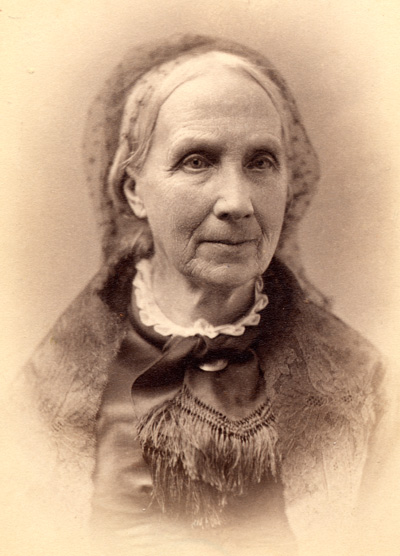
The Rev. William Whitcomb

The Fugitive Slave Act tore apart families, towns, political parties and churches. The governor, most legislators and civic leaders supported it. Even Daniel Webster, the esteemed Massachusetts senator, now secretary of state, hailed the federal law as the best way to keep Southern states from bolting.

In Stoneham abolitionists had met with fierce opposition. The host of the first recorded meeting in town, attended by William Lloyd Garrison, was told his house would be burned down. In a fight after an abolitionist meeting at Town Hall, a 37-year-old man—husband and father of three—had been stabbed to death.

Although abolitionist sentiment was growing, by 1850 most ministers either remained silent or spoke in favor of the federal law. Not so the new minister in Stoneham.

“I make no apology” for speaking on this subject, Whitcomb told the people of Stoneham. He only regretted that he had not spoken out sooner.

He began by citing the Old Testament book of Deuteronomy, Chapter 23: 15-16: “Thou shalt not deliver unto his master the servant which is escaped from his master unto thee: He shall dwell with thee, even among you, in that place which he shall choose in one of thy gates, where it liketh him best: thou shalt not oppress him.”

In defiance of the federal law, Whitcomb called on his congregation to “Hide the outcast or help him on his journey to a safer place, even though you may risk personal security, property, and life.” 

The Stoneham minister urged nonviolent action based on the principle of love. “Shed no blood,” he said. “Wield no weapons but those of truth and love. Use no arms but those God hath given you.”

Fast forward from the church across the street to March 28, 2026, as some two thousand citizens packed the Stoneham Common to protest the federal government’s policies and actions. It was the third national No Kings Day with massive demonstrations geared to stopping the rise of authoritarianism in the United States. Participants protested the war in Iran, the violence of ICE, interference in elections, the targeting of immigrants and LGBTQ+ and attacks on First Amendment rights.

Choirs sang, leaders rallied, a guitarist soloed, protestors chanted, while throughout Jimmy Tingle inspired and entertained the throng with his passion and wit. Pulling a harmonica from a pocket, he opened with a reedy version of the National Anthem. The harmonica reappeared later, when in closing, Tingle told the story of John Newton, the one-time slave trader who repented and became a leading abolitionist. He then played the hymn that Newton wrote, “Amazing Grace.”

I couldn’t help but think, as we left the Common, some to continue to the Boston Common for the 1 p.m. rally there, that Rev. Whitcomb would have been proud.

The Midnight Ride of . . . Shadrach Minkins?

On the road to Concord, three Black men in a wagon make a daring escape

It had rained that day in Boston, and now, even though the moon was full, there was little light in the sky as three men left Cambridge and headed for Concord. No, it wasn’t the midnight ride of Paul Revere, but another of unusual significance. For riding in a dark wagon was a fugitive from justice and two conspirators, unwilling to let another human being be returned to slavery. It was Saturday, Feb. 15, 1851.

The morning had started out as any other. Shadrach Minkins, a waiter at the Cornhill Coffee Shop in Boston, had put on his apron and started work. What he didn’t know was that he would soon become a test case for the Fugitive Slave Act, a law enacted by Congress to keep Southern states from bolting. The story has been told beautifully by Gary Collison in his book, Shadrach Minkins: from Fugitive Slave to Citizen, from which I have drawn here.

Born into slavery in the port city of Norfolk, Virginia, Minkins had worked for various masters, having been sold three times. In the spring of 1850, around 30 years of age, he disappeared, escaping most likely as a stowaway on a merchant ship headed north. Arriving in Boston, he joined a community of some 2,500 free blacks and former slaves. Considered a haven for those seeking their own emancipation, Boston would soon become the focus of federal agents and bounty hunters.

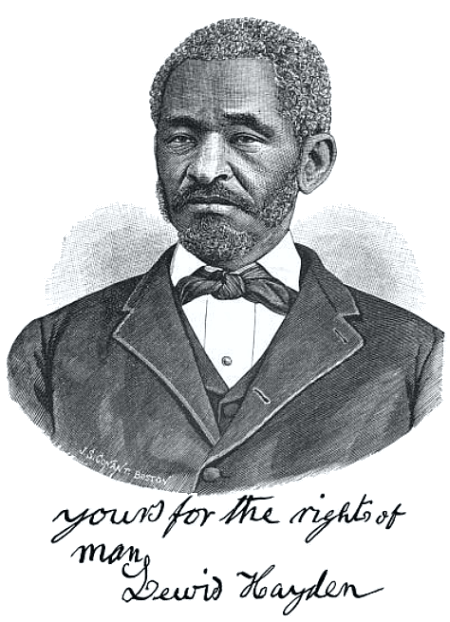
David Hayden was a leader in Boston’s abolitionist community.

Mandating the return of all former slaves to their owners, the Fugitive Slave Act imposed stiff penalties of imprisonment and fines to anyone sheltering fugitive slaves. Further, state governments, local law officers, and even citizens were called on to aid in its enforcement.

If Minkins could be arrested in Boston, the hub of the abolitionist movement in the North, and returned to his owner, Southern states would see that Washington was protecting their interests, muting talk of succession. Even President Millard Fillmore and Secretary of State Daniel Webster had approved Minkins’ capture.

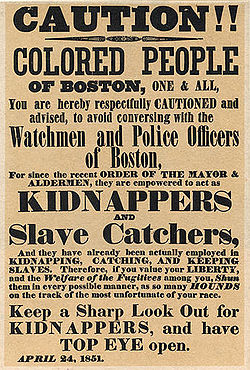
Enacted in September of 1850, the Fugitive Slave Act divided families, towns, political parties and churches. As most governors, legislators, and clergy fell in line with the law, New England abolitionists voiced their opposition. In Boston, the Vigilance Committee, made up of Black and white abolitionists, warned of arrests and planned counter measures.

Poster urging fugitive slaves in Boston to watch out for slave catchers.

Now, as Minkins waited tables in the restaurant, a federal marshal and eight officers took up positions outside the restaurant. After a considerable delay, waiting for the man who would identify their suspect, the marshal and one of his men entered the restaurant and ordered coffee. They were served by a “stout, copper-colored man,” no other than the fugitive they sought, writes Collison.

When Minkins took the marshal’s payment to get change, two officers grabbed him under the arms, rushed out a back door and dragged him into the Court House, a block away. They had been seen, however, and word quickly spread. Within minutes a crowd of abolitionists and onlookers filled Court Square. One of them was a former slave from Kentucky, Lewis Hayden, now a clothing merchant and owner of a boarding house on Beacon Hill.

For several years, Hayden had been owned by Henry Clay, the senator and future architect of the Fugitive Slave Act. After seeing his siblings, then his wife and child sold, Hayden had fled with his second wife and her son to Philadelphia, then on to Canada. In 1846 Hayden brought his family to Boston. Lewis and Harriet Hayden became leaders in the abolitionist community, and their home on Southac Street a station on the Underground Railroad.

As Shadrach Minkins awaited arraignment, abolitionists packed into the stairway and hallway outside the upstairs courtroom. After the judge arrived, federal officers presented evidence that the suspect was in fact a fugitive from Virginia and the property of a Norfolk businessman.

Meanwhile, the crowd inside and out became more agitated. Defense attorneys, including Richard Henry Dana, Jr., presented petitions for Minkins’ release. When they were denied, black activists led by Hayden forced their way into the courtroom, surrounded Minkins and carried him “by the collar and feet” out to the street. Then, mixing in with the crowd, Hayden and Minkins scurried off towards Charles Street.

Turning quickly into a side street, Hayden took Minkins to the widow Elizabeth Riley, who hid him in her attic. Returning after dark, Hayden then took Minkins across the bridge to Cambridge and the home of the Rev. A. J. Lovejoy. HHe knew, however, that the fugitive could not stay there for long.

Later that night, Hayden returned to the minister’s home. This time he came in a wagon drawn by two horses, one black and one white. The wagon was driven by John J. Smith, a barber and fellow abolitionist. Picking up Minkins, they headed west.

My guess is Hayden and Smith, dressed in oil-cloth and sou’esters, sat up front, while Minkins lay covered by a tarpaulin in the bed of the wagon. They may have traveled on the Concord Turnpike, which was the most direct route, but which had several steep hills. Or they may have taken the old route through Lexington along Battle Road to Concord. Perhaps the rain had stopped by then and the moon was penetrating the cloud cover with faint light. Given the muddy roads, it must have been slow going.

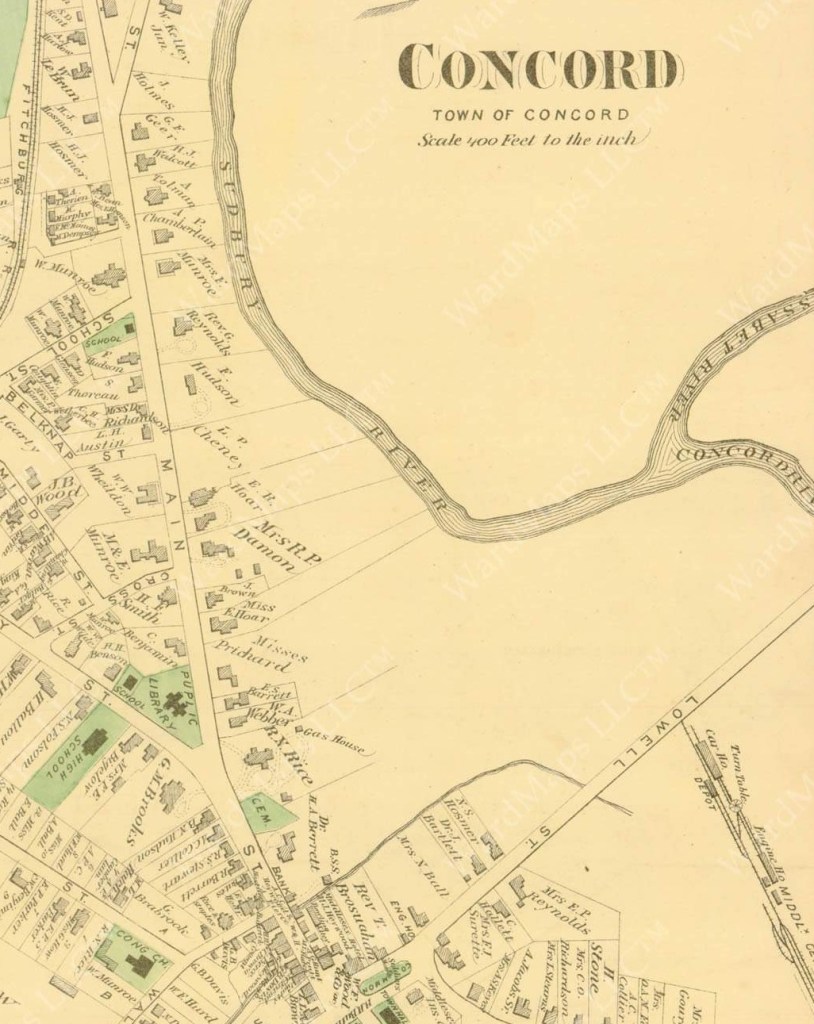
19th century map of downtown Concord.

About 3 a.m. Smith turned the horses onto Main Street in Concord. Proceeding through the sleeping town, they then angled left onto Sudbury Road and entered the yard of the blacksmith, Francis Bigelow. Hearing the wagon, Francis got out of bed and went to the door. Francis’ wife, Ann, who was unwell, may have looked out the upstairs window, for it was she who noted the color of the horses. Years later, Ann would tell the story to Edward Waldo Emerson, Harriet Robinson and others, accounts found in the Concord Free Public Library.

“Mr. Bigelow, hearing the carriage, opened his door, and let in the poor fugitive [and his escorts], though the penalty was a thousand dollars, and six months’ imprisonment, for ‘aiding and abetting’ a slave to escape. The blinds of the house were at once shut, and the windows darkened, to evade the notice of any passers-by.”

As Ann told it, the Bigelows then warmed the fugitive and brought him into their own bedroom, where Ann served breakfast, using the bureau for a table. Minkins, worn by anxiety and lack of sleep, could barely keep his eyes open. Meanwhile, the Brooks, sympathetic neighbors, arrived.

After Minkins had eaten and rested, Francis found him warm clothes, but had no hat his size. But Nathan Brooks did. He promptly left and returned with “a hat of his own with which to disguise himself—the hat of a law-abiding citizen!”

Before dawn, Francis Bigelow led Minkins to his own wagon outside, and the blacksmith and fugitive drove west again, this time to a safe house in Leominster. From Leominster, Minkins was transported to Fitchburg, where he boarded a train to Montreal.

Many years later, Ann Bigelow would retell the story of Minkin’s escape. Photo courtesty of the Concord Free Public Library

For Minkins the flight to Canada was a continuation of a life in exile. Separated from his family in Virginia, he joined a small community of former slaves in Montreal. He got a job as a waiter, saved his money and opened his own restaurant. Later, he set up a barbershop.

Over time, he married, and had four children. He never returned to the United States. He was the first runaway slave arrested in Boston under the Fugitive Slave Act, but not the last.

Meanwhile, Minkins’ rescuers returned to Boston. As Ann Bigelow recalled: “Mr. Hayden and Mr. Smith drove leisurely to Sudbury, stopped with friends there, went to church, and, after a good dinner, returned unmolested to Boston.”

Hayden did not, however, escape prosecution. One of several abolitionists charged with aiding and abetting Minkins’ escape, Hayden was acquitted after a jury—which included none other than Francis Bigelow himself—would not convict.

For years after, Lewis and Harriet Hayden continued their militant opposition to the Fugitive Slave Act, hiding and transporting fugitives and raising money. Lewis joined the black Masonic lodge created by Prince Hall, and later served in the state legislature. He also led a successful effort to integrate Boston schools and campaigned for women’s rights.

During the Civil War, Hayden helped to convince his friend, Governor John Andrew, to form a black regiment and actively recruited soldiers for the Massachusetts 54th.

Today, you can visit the Hayden home, a site on the Black Heritage Trail on Beacon Hill. And in Concord, you can still find the house on the Underground Railroad, where the Bigelows opened their doors to Shadrach Minkins and his escorts 172 years ago.

Note: This story first appeared in the magazine, Discover Concord, Summer 2024, as “A Midnight Stop on the Underground Railroad.”

Calibri, Fraktur and “Saving America”

When Marco Rubio announced recently that the State Department was switching its official typeface, I wondered what was going on. Having taught a course in typography, I am well aware of type design and the nuanced notions associated with certain fonts.

I also immediately thought of a typeface called fraktur, a Germanic font Adolf Hitler loved, then hated, and the controversy over typefaces during the Third Reich.

The typeface Rubio doesn’t like is Calibri. It’s a standard sans-serif font. For many years it was the default in Microsoft programs, most recently replaced by a similar one called Aptos.

“Sans serif” means the letters are simple strokes without serifs, the little hands and feet at the end of lines. There is also no variation in line width. Their development was part of the avant garde movement in art, meant to express simplicity and modernity.

One of many sans-serif fonts in the modernist or humanist style, Calibri was created by Dutch typographer Lucas de Groot. With clean lines and slightly rounded corners, it is easily readable online and print and is often selected for presentations. Used during the Biden presidency, it is easier to read in small sizes and considered more accessible for those with disabilities.

So, what’s wrong with it? According to Rubio, Calibri is too informal, not befitting the dignity and tradition of America. In a directive to all diplomats, Rubio mandated the use, instead, of Times New Roman, a traditional serif typeface. He called the use of Calibri by the previous administration a capitulation to DEIA–that’s diversity, equity, inclusion and accessibility. In short, Calibri is too “woke.”

But why Times New Roman?

One of many classic serif typefaces, Times New Roman was designed in 1931 as the typeface for the Times of London and has long been a go-to font for books and newspapers. Its condensed letter forms and spacing make it efficient for presenting large amounts of text. I use it occasionally, when I want a traditional look in my designs.

The hullabaloo about typefaces reminds me of what happened in Germany in the 1930s, just as the modernist typefaces were gaining popularity. It should not surprise you to learn that Adolf Hitler and the Nazis abhorred the sans serif designs. Instead, they wanted a typeface that would reflect their heritage and status as a Nordic power. They chose an old typeface called fraktur.

Fraktur is distinctly unlike both the sans serifs and traditional “romans” in use throughout the Western world. Designed in the 16th century, it’s an updated version of a German blackletter, with thick, angular forms similar to what we know as Old English. As the official Nazi typeface in the 1930s, it was used in all government documents and propaganda.

That ended abruptly in 1941, however, when the Nazis discovered that the designer of fraktur was–can you imagine their shock–a Jew. In an about-face, the Nazis then outlawed its use and instead mandated that Antiqua, an old roman typeface, be used.

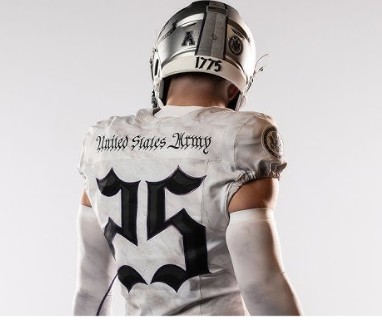
Fraktur and similar blackletter designs never disappeared, however, and since World War II have been widely used by neo-nazis as a link to the Third Reich. Appearing in banners, graffiti and tattoos, they have also crept into mainstream use, as on U.S. Army football jerseys in a recent Army-Navy football game.

In another appearance, Fraktur is used in an ICE recruitment video in which ice agents smash down doors and unleash an attack dog on a suspect. At the end of the video are three phrases: HUNT CARTELS, SAVE AMERICA, JOIN.ICE.GOV.

So, what can we say about typefaces? It’s important to know how typefaces work, why one font works better than another. It’s also important to understand that the typeface you use is part of the message. In some cases, it is the message.

The Children Know the Way

Photo courtesy of HBO

If we are to find our way through the current moral and political crisis, we should pay more attention to our children.

That’s the message I got on Monday as Becky and I watched the HBO documentary, “We are the Dream: The Kids of the Oakland MLK Oratorical Fest.”

The film was shown at the Stoneham Public Library, which opened on the holiday just for the screening in commemoration of Dr. Martin Luther King, Jr. It was sponsored by our town’s Human Rights Commission.

“We are the Dream” tells the story of the children of Oakland, California, who compete in the annual MLK Oratorical, culminating in a remarkable presentation celebrating the life of the beloved civil rights leader.

In the film, the students, K-12, bring to life the words of Dr. King and others—poets, artists and activists. Sometimes, they perform their own compositions. We see them as they prepare, rehearse and take the stage.

Oakland, California, is a city of some 440,000 residents. Like San Francisco across the Bay, it is a consortium of races and ethnicities, with no one group a majority. Hispanics comprise about 30 percent, Whites 26, Blacks 20 and Asians 15. About 10 percent are listed as bi-racial, and there are smaller numbers of American or Hawaiian natives and Pacific islanders.

Which is to say, when you walk into Oakland’s schools, you will find the America envisioned 68 years ago in Dr. King’s “I Have a Dream” speech. You’ll see Black kids holding hands with White kids and Asian kids singing with Latino kids. You’ll find immigrants from around the world–from South America to Southeast Asia, from the Middle East to Eastern Europe.

Like most urban centers in the United States, Oakland struggles with issues of poverty, housing shortages and homelessness. What Oakland has demonstrated, however, is the that all races can live and work together and that diversity, equity and inclusion are essential American values.

What the HBO film shows us is that in a country still struggling with hate and division, we can create better. That’s the message of the children, and why we must pay attention.

In Stoneham, as well, we must pay attention to our children, those in our schools, clubs and churches, those like the young people at the Boys & Girls Club who gathered on Monday to thematic mural at the Teen Center on Central Street.

Have you noticed that children don’t get tied up in political and philosophical rationalizations? Most kids are quick to tell you what is right and wrong. They have an innate sense of fairness, and they know who the bullies are. They know violence is not the answer. As one second grader in Oakland said of the late civil rights leader, “Dr. King showed us how to fight without using our fists.”

Children know you don’t steal another person’s candy or their country. Or their dignity by calling them names. And you don’t shoot people who are getting in your way.  

On this national holiday, the children call on us not to forget the dream of Martin Luther King. This dream, our children are showing us, can restore our spirit and renew our strength. It can lead us to renew our commitment to the “beloved community.”

Note: As we often spend time in Oakland during the winter, and as our son, who was director of academic programs for Oakland schools, was helping with this project, I was asked to fill in as one of the contest judges.. It just happened to be the year that HBO made the documentary above. 

A Ballad for our Time, Too

Woodie Guthrie wrote the lyrics. Martin Hoffman set them to music. Since then, it’s been sung by Bob Dylan, Joan Baez, Johnny Cash, Dolly Parton, Bruce Springsteen, Pete Seeger and Arlo Guthrie.

It’s a ballad called “Deportees” and it tells of an airplane crash in California’s Los Gatos Canyon. On board were 28 migrant farm workers from Mexico.

The lyrics are as searing now as in 1848 when Guthrie wrote them:

The sky plane caught fire over Los Gatos Canyon,
A fireball of lightning, and shook all our hills,
Who are all these friends, all scattered like dry leaves?
The radio says, “They are just deportees.”

Guthrie wrote the ballad one night after news reports listed the names of the pilots, attendant and immigration guard lost in the crash, but referred to the farm workers only as “deportees.” After the braceros’ bodies were recovered, they were buried in a mass grave without names, marked “Mexican Nationals.”
 
The roundup of the Los Gatos laborers was just one episode in several government campaigns to remove Mexicans and those with Mexican ancestry. Mass deportation began in 1930 and continued through the Great Depression. Then in 1954, the Immigration and Naturalization Service (INS) brought out “Operation Wetback.” Under this federal program, officials used strong-arm tactics to arrest tens of thousands of immigrants across the country. Caught up in the raids were farm and factory workers, including American citizens.

In July of 1955, several thousand deportees were found wandering the streets of Mexicali, a desert town bordering California. Yanked from their jobs and families, they had simply been dumped across the border. According to one account, 88 died of heat exposure in the 112 degree heat.

In Texas, thousands of deportees were crammed onto boats bound for Mexican ports. Testimony before a Congressional committee described conditions akin to those on slave ships. Other immigrants were packed into trucks. By the end of Operation Wetback, the INS claimed it had “repatriated” 1.3 million Mexicans.

Goodbye to my Juan, goodbye, Rosalita,
Adios mis amigos, Jesus y Maria;
You won’t have your names when you ride the big airplane,
All they will call you will be “deportees.”

 
Accompanying the mass deportations were media depictions of Mexicans as dirty, disease-bearing and lazy. News coverage focused on border and immigration officials conducting raids.

Only in time did most Americans come to see this as something shameful. In a 2012 ceremony in Los Angeles, Governor Jerry Brown and Mayor Antonio Villaraigosa formally apologized for California’s role in the deportations.

On Labor Day in 2013, United Farm Worker President Arturo Rodriguez joined hundreds gathered at the Holy Cross Cemetery in Fresno, California, to memorialize the 28 farm workers killed in Los Gatos Canyon. They were 25 men and three women. This time, inscribed in the headstone, was each person’s name.

Now, deportation planes are again in the sky. Planes to El Salvador, Guatemala and Honduras. Planes to India and Rwanda. Planes to Eswatini, a tiny country in southern Africa.

Through October 2025, the Department of Homeland Security operated 1,701 deportation flights to 77 countries. And it recently bought six Boeing 737s, expanding capacity.

Meanwhile, 66,000 men, women and children await deportation in detention centers. Arrested, often with brutal force, they were tracked down in streets, courthouses, parking lots, fields and construction sites.

Some of us are illegal, and some are not wanted,
Our work contracts out and we have to move on.
Six hundred miles to that Mexican border,
They chase us like outlaws, like rustlers, like thieves.

Compared to programs of the past, Donald Trump’s campaign is Operation Wetback on steroids. The president wants 3,000 arrests a day, or one million by the end of his first year in office. Each day, it seems, he expands his list of targets, Somalis, Haitians, Venezuelans, Afghans. What they have in common is their darker shades of skin.

As I listen to Woodie Guthrie’s song, I think of my children and grandchildren. I wonder, what song will they sing in years to come? Who will write the words, and who will remember the names?

Will there be, one day in the future, a public apology, a ceremonial mea culpa for the cruelty, the harm inflicted on so many? If so, what song will we then sing.

The Carpenter and the Cross-Dresser: a Christmas Story

In the darkness before dawn, a man from Georgia is riding in the baggage car of a northbound train. He is exhausted, and to keep awake, he opens the window. Cold air rushes in. Just then the engine whistle sounds, and sticking his head out the window, he sees the flickering lights of Philadelphia. It is Christmas Eve, 1848.

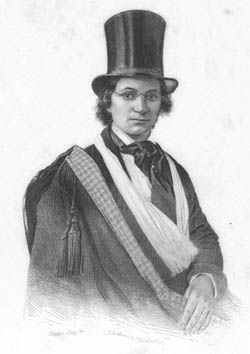
The traveler is a 24-year-old slave named William, on a journey with his master, “Mr. Johnson,” a young gentleman from Macon, traveling north for medical care. But things are not what they seem. In fact, Mr. Johnson is Ellen Craft, a tall, light-skinned African woman, cross-dressed as a plantation owner. And William is not just Mr. Johnson’s slave, he is her husband.

Allowed to marry, Ellen and William have avoided having children, shuddering at the prospect of bearing offspring who might be taken from them and sold. Their desperation has steeled them to dare an escape, despite the horrendous outcome if they are caught.

Born of a white owner and his African slave, Ellen was taken from her mother at age 11 and given as a wedding present. Now a house slave, she has been granted a few days off to visit her family. William, trained as a carpenter and rented out by his owner for wages, has also obtained permission to be absent from work. Growing up, he has seen both his parents and his 14-year-old sister sold away to pay debts.

Two weeks ago William and Ellen spent the night in Ellen’s cabin, planning their escape route. The distance from Macon to a free state is a thousand miles. For the Crafts, attempts on foot are out of the question. Instead, William and Ellen have decided to escape in plain sight, that is, in disguise. Using money saved from jobs on the side, William has been buying pieces of men’s clothing a young gentleman would wear. Ellen, a seamstress, has sewed a fine pair of trousers. She has locked the clothes in a little chest of drawers William made for her. The last thing William bought for his new “master” was a pair of green-tinted spectacles. They will leave on December 21.

The night before, William and Ellen spend the hours talking, asking, what if, and what should we do when? There is a major problem. At every train or customs station, Ellen will be required to sign a register, or to show papers. And she, like her husband, is illiterate.

Ellen has an idea. She will tie up her right arm in a sling, so she will not be asked for her signature. Further, to discourage questioning, she will have bandages with a poultice wrapped around one side of her head.

Just before dawn on Dec. 21, William takes out Ellen’s scissors. Standing behind her like a barber, he cuts her hair. Then he helps her into her gentleman’s clothes, complete with top hat. At the door they pause. No one is in the street. They slip out “quiet as moonlight on the water,” William will later recall, and they separate. They meet at the train station.

Their escape is laden with peril. On each leg there is a new challenge. Settling into her seat on the train to Savannah, Ellen is shocked to see a friend of her owner’s, who would know her, take a seat next to her. Feigning illness, she avoids his inquiries and is undetected.

From the Massachusetts Histoical Society. Not to be reproduced without permission.

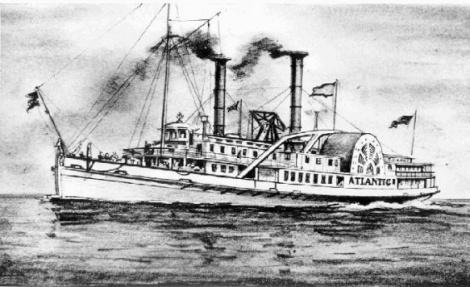
Arriving in Savannah, Mr. Johnson and his slave take an omnibus to the harbor, where they purchase tickets on a steamer bound for Charleston, South Carolina. Going aboard, William helps his master settle into his berth, then goes on deck to find a place to sleep. There are no accommodations for slaves, so he finds a warm place near the funnel on sacks of cotton, resting there until morning.

The next day, as William patiently waits on Mr. Johnson, a vulgar slave trader tries to purchase him from his master. Then a military officer scolds Mr. Johnson for speaking kindly to his slave. “Nothing spoils a slave so soon as saying, ‘Thank you,’” he warns him.

In Charleston, Mr. Johnson and his slave check into a hotel. Here the proprietor is solicitous of the young gentleman’s needs. While his master is served in the dining room, Williams eats off a broken plate in the kitchen.

The next morning, as they prepare to board a steamer to Wilmington, North Carolina, the station officer demands that Mr. Johnson sign the register, despite his apparent injury. Finally, the officer who has come on the same ship from Savannah steps up and vouches for the invalid gentleman. Overhearing this, the ship’s captain signs the register, “Mr. Johnson and slave.”

The next morning William and Ellen Craft arrive in Wilmington, and from there board a train for Richmond, riding in a section reserved for families and invalids. Here they are joined by an older man and two daughters, who insist on making Mr. Johnson as comfortable as possible, and share advice on remedies for rheumatism. “Papa,” one of the daughters says, “Mr. Johnson seems to be a fine gentleman.”

After the train stops in Richmond, the friendly father and daughters disembark, and a stout, elderly lady takes a seat beside the disguised Ellen. Glancing out the window, she sees William approaching on the platform and cries out, “Bless my soul, there goes my nigger, Ned.”

“No, that’s my boy,” Mr. Johnson replies. When William arrives, the lady confesses she was mistaken, then launches into a diatribe against her run-away slave, and all the slaves she owns. She plans to sell them away to New Orleans as soon as she can.

At Fredericksburg, the Crafts again board a steamer, this time to Washington, D. C. Once in the nation’s capital, they go directly to the train station and board a train for Baltimore.

When the train pulls into Baltimore, it is Saturday evening, Christmas Eve. Ellen and William are exhausted and their nerves frayed. They have expected detection at every step. For three days and nights they have had almost no sleep.

Stepping warily onto the station platform, Mr. Johnson and his slave go to the ticket office and purchase tickets for the final leg of their journey, the night train to Philadelphia.

But something goes wrong. Maryland is still a slave state, and it is illegal for any white man to take his slave into Pennsylvania, a free state, without authorization. After settling Ellen in her carriage, William returns to the platform, but is accosted by the station officer, who forbids him to board.

Returning to the station office, crowded with late-evening travelers, Mr. Johnson demands to know why he, a respected gentleman needing medical care, cannot take his faithful slave with him on the train to Philadelphia.

Ellen’s insistence turns to pleading, but to no avail. Have they come so far, only to be arrested as fugitives? They know well the fate that awaits captured run-away slaves. William has seen them attacked by dogs, whipped, tortured or killed as an example to others. Even if they survive, they will be forever separated, assigned to the hardest forms of labor.

As they wait in agonizing suspense, the train whistle sounds. Just then the train conductor enters the room and calls the all-aboard. Then, as if only by Providence, the station officer relents. Seeing how the young gentleman is in such poor condition, and it is Christmas Eve, he gives permission for the two to pass.

As quickly as possible, William settles Ellen into her carriage, then hops into the baggage car where he must ride. Slowly, in the early darkness, the engine picks up steam and the train pulls out of Baltimore station.

It is now almost five in the morning, and the weary fugitive with his head out the window gazes with fascination at the twinkling lights ahead of him. In the cold wind, tears are spreading on his cheeks, and something is happening he can hardly explain. His body has suddenly become lighter.

With a great hissing of steam, the train comes to a stop in Philadelphia station. William and Ellen wait until all the other passengers have disembarked, then William calls for a “fly,” a horse-drawn taxi, and hands the driver the address of a boarding house he has been told is run by an abolitionist. Here they will find refuge and support for their continued journey north.

Inside the carriage, Ellen leans her head on William’s shoulder and bursts into tears. It is Christmas Day. They are free.

Afterword: After boarding with a Quaker family outside Philadelphia, William and Ellen Craft make their way to Boston, where they are welcomed by the abolitionist community of free blacks and white allies. Here William works as a cabinet maker and Ellen as a seamstress until 1850, when the Fugitive Slave Act imperils their freedom and they flee to Nova Scotia, then England. Over the next 15 years they work, study, lecture and raise a family of four boys and one girl. After the Civil War, they return to Georgia and open a school for the children of former slaves. This retelling of their story is based on their book, published in London in 1860, titled “One Thousand Miles to Freedom.”

— Ben Jacques