Stoneham’s first employee was a “reverend”
As we celebrate our town’s 300th birthday, reflecting on our founding in 1725, you may have wondered, who was our first employee?
Well, it seems we were rather selective, because the first person we hired was a graduate of Harvard. But before I tell you who it was, here’s some historical context.
In 1725, as we broke away from Charlestown, we were just a village ten miles north of Boston in a colony called Massachusetts Bay. Massachusetts Bay was founded in 1630 by English Puritans led by John Winthrop, who became its first governor.
The Puritans, who had separated from the Church of England, were a serious lot. They based their customs and laws on English Common Law and the Bible, especially the Old Testament.
They also believed that church and state should function as one, and that’s why, as stated in the founding document, the town was required to find, install and support a minister. That person would become the first paid employee of the Town of Stoneham.
That person was James Osgood and he came from Salem. When the words “Puritan” and “Salem” are mentioned in the same breath, it is not unnatural to think of witchcraft, and the trials and executions of the late 17th century. For the Osgood family, some of whom lived in Andover, the connection was personal. In 1692 James’ paternal grandmother, Mary Clements Osgood was accused of being a witch.
Mary Osgood’s story is too long to tell here. Suffice it to say, she confessed in 1692, under considerable pressure, of making a pact with the Devil and afflicting several other women and was subsequently imprisoned in Salem. But under examination by the Rev. Increase Mather, who had been sent to Salem to reign in the witchcraft hysteria, she recanted her confession and said she had made it all up. You can read about it in the report made by Governor Thomas Hutchinson. Meanwhile, over 50 citizens of Andover had petitioned for her release, and she was freed.
One of Mary’s sons was Peter Osgood, a tanner, who did so well that he sent two sons to Harvard, the younger one being James. One other thing I should mention is that the Osgood family owned slaves. Owning slaves was not common in colonial Massachusetts, but neither was it exceptional. For an enterprising farmer, seaman, merchant or tradesman, owning a slave could make the difference between just getting by and prospering. A 1754 inventory of enslaved persons age 16 and over in Salem listed 83. There were 989 in Boston. Eight in Stoneham.
Growing up in Salem, James Osgood followed his brother to Harvard. From what we know, he did well. At one point, however, he appears to have gotten into trouble. In a biographical sketch of Harvard graduates, we read that “James found himself caught up in the student riot of 1722 at Harvard, managing to break glass to the value of 11 shillings.” My guess is, he smashed a window.
But time can make a difference, as the parents of any college student know. By the time James graduated with a master’s degree, he was described as “one of the soberest and quietest members of his class.”
Looking for Employment
When James Osgood graduated from Harvard in 1727, he must have wondered what the future would hold. The youngest son of a Salem tanner and church deacon, he had earned a master’s degree, placing him into the upper echelon of Puritan society.
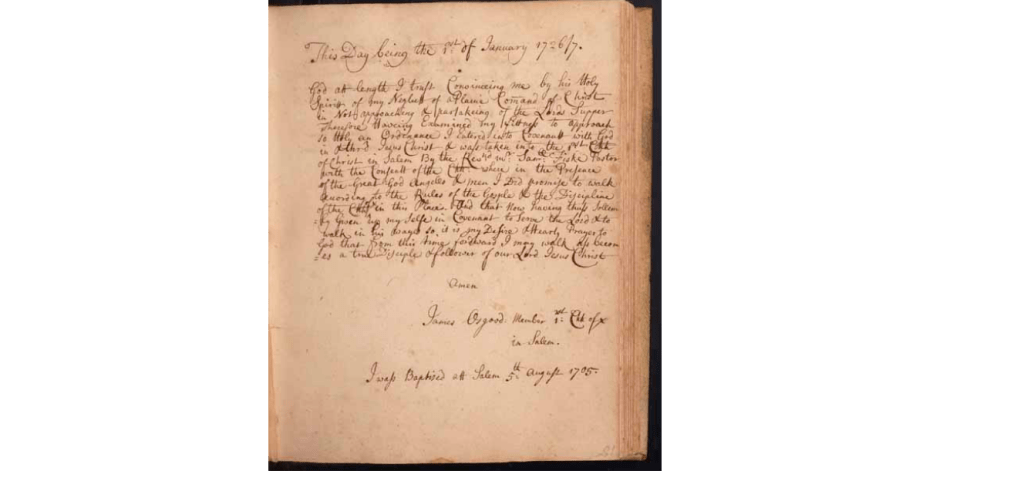
A few months before his graduation, there had been a turning point. An entry in his diary from this period stands out. It’s dated Jan. 1, 1727. It seems James had stopped taking Communion in church. Had he, a college don studying Greek and Latin, entertained doubts? Had he grown skeptical?
For whatever reason, as he now wrote, he repented his neglect of the sacrament and promised to “walk according to the Rules of the Gosple & the Discipline of the Church.” From now on, he covenanted, he would “walk as becomes a true Disciple & follower of our Lord Jesus Christ.”
After graduation, Osgood left Cambridge and returned to Salem, where he began looking for employment. One of his first jobs was teaching school in Salisbury, for which, records show, he received 30 pounds. He was also called on to fill the pulpit as a guest preacher in nearby parishes, giving him valuable experience.
In the fall of 1728 the young theologian received an invitation from the newly incorporated town of Stoneham, which was searching for its first minister. To audition for the job, Mr. Osgood would have to preach in front of the whole town, around 65 families, and get the approval of town voters, all 13 of them, men only. Other candidates would also be invited.
Meanwhile, in Stoneham “it was voted in town meeting assembled to set apart a day for prayer to ask God’s direction in the choice of a minister” (William B. Stevens, The History of Stoneham).
James Osgood was only 23 when he came down from Salem, probably on horseback, to audition for the job. What must have gone through his mind as he entered the simple structure of the Meeting House, erected by the townspeople just three years earlier, and stood before the small congregation. We can only imagine his looks and manner, and the sermon to follow. We can assume he made a powerful impression, because he got the job.
Was it a hard choice for him to make? I wonder when I read that it took him until April to formally accept. Nevertheless a few months later, on Sept. 10, 1729, he was ordained and installed in the Meeting House as Stoneham’s first minister.
All things considered, it was not a bad job. The town voted him an annual salary of 110 British pounds (about $22,000 today). It also gave him 172 pounds ($38,000) “for a settlement,” and agreed to supply him with ten cords of wood for heating and cooking.
At first boarding at the home of Peter Hay, a prominent town citizen, the young bachelor set about ministering to the families of the parish. Besides preaching two or more sermons a week, his duties included teaching, baptizing, counseling and consoling. He conducted weddings and funerals. And he began plans for a parsonage. As Stevens records: “Mr. Osgood purchased land and built him a house which was a fine one for those times.”
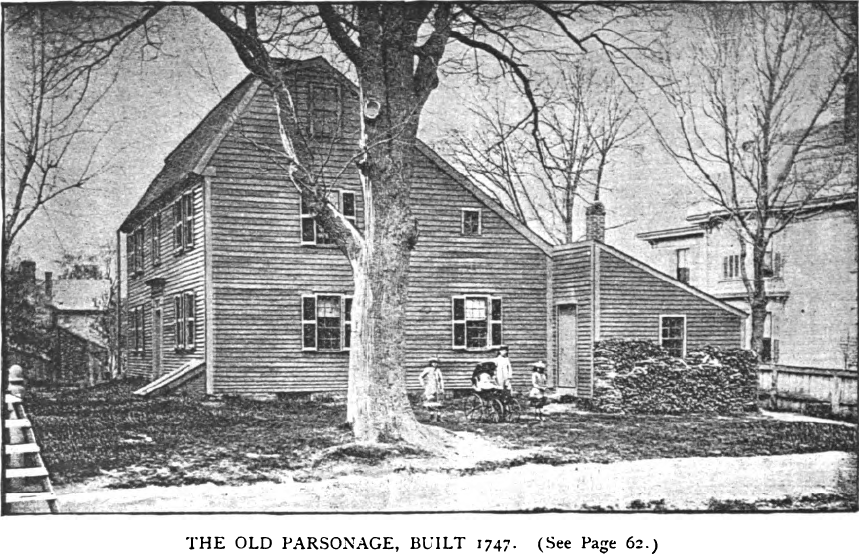
A photograph of the parsonage, taken in the 19th century, shows a large house in the traditional saltbox style. Nine windows face the street, and a storage shed is attached at the rear. Cord wood is stacked on the side, and children play in the yard.
We don’t know when the house was completed, but it may have been before 1735, when Osgood, now 30, returned from Killingly, Connecticut, with his new bride. Her name was Sarah Fiske and she was 17. In Stoneham, the couple would have two children, Abigail and John.
The Reverend’s Account Books
On August 6, 1729, James Osgood started recording his expenses in two books, preserved in the Congregational Library in Boston. These daily accounts give us clues into the 24-year-old Harvard graduate from Salem, ordained in October as Stoneham’s first minister.
The entries, made in his own hand, are various and include lists, like what books he was reading, the founding of Puritan churches in Massachusetts Bay, and commentary on historical and theological matters. They also record payments received, like one of 56 pounds from Daniel Gould, town treasurer, half of his yearly salary.
Another shows Osgood paying 49 pounds, then another 50, to “Mr. Ebenezer Phillips, yeoman,” for the purchase of land. Below that is payment made to Francis Kittridge–12 pounds, 16 shillings and 6 pence—for 1,000 board feet of lumber for construction of his house.
Most of Osgood’s purchases, however, are for daily necessities, such as 16 shillings paid to David Gould for a bushel of corn. There are also payments for rye, sugar, molasses, tea, salt, beef, veal, and fish. Also, cotton, wool, linen and eiderdown, as well as kettles, tallow and other houseware items. And there are regular purchases of rum.
We also see a stream of payments for workmen building the parsonage. Others for plowing, hauling manure, planting and mowing. There are purchases of animals, including a pig. A payment is made to have Osgood’s horse shod.
Then there are payments for services rendered, like weaving and shoemaking. In one entry, the minister pays Simon Barjona, a cordwainer, one pound for a pair of shoes.
After his marriage to Sarah and the arrival of children, we see purchases that reflect his family, such as a handkerchief, silk, a looking glass and a pair of stockings for Sarah. Also a buckle and a new hat for Johnny, and a frock for his daughter, whom he calls Nabbe.
We find regular payments made to Abigail, the household maid. To employ a household maid must have made a huge difference to the family, especially for Sarah, whose duties as the minister’s wife would have gone beyond household management and raising children. She would have been called on to support her husband’s ministry in various ways, counseling the women and children, visiting the poor and the sick.
In October of 1743, however, payments to the maid cease. From November through January, no further payments are found. For whatever reason, Abigail is no longer employed. It appears the Osgood family is without household support.
In February that is about to change in a way that we, looking back three centuries later, find disturbing. On Feb. 21, 1744, Osgood writes: “Paid away for a Negro woman named (Fibbe) to Mr. Thomas Bancroft, 20 pounds.”
Osgood’s payment of 20 pounds was just a down payment. In March he will make a second payment of 12 pounds. Then in April, as he notes in his account book, “paid for my Negro woman in full, 43 pounds”—bringing the total to 75 pounds.
Reading this, I am stunned. Yes, I’ve known that many prominent families in colonial New England owned slaves. But this feels personal. It is my church, the First Congregational Church, founded in 1729, and in my town, which this year celebrates its 300th Birthday.
How could the minister of my church be a slave owner? Next week, I will conclude my story of the Rev. James Osgood. I’ll tell of his sudden demise and what happened to his family and his enslaved servant, Phebe.

A Slave in the Parsonage
When James Osgood in 1744 brought home a Negro woman he had purchased, few in town would have questioned his actions or his ethics. Slavery had sprung up in the Massachusetts Bay Colony soon after its founding in 1630. English colonists had initially enslaved natives captured in battle, but found them too difficult to manage.
In 1637 the slave ship Desire, built in Marblehead, left for the Caribbean with 17 Pequot natives, including 15 children, to be sold to Caribbean plantations. Eight months later, the ship sailed into Boston with a cargo of cotton, tobacco and slaves from Africa.
In 1641 the Puritan community published The Body of Liberties, which spelled out rights and obligations of its members. Article 91 sanctioned the owning of slaves.
In Stoneham, as throughout New England, having slaves signaled a family’s success and status. Among owners were merchants, tradesmen, land owners and ship captains. There were also ministers, like the eminent Puritan minister, Cotton Mather, in Boston. Or like James Osgood.
The minister’s own family, his father, Peter Osgood, and uncles, owned slaves in Salem and Andover. When James Osgood arrived in Stoneham, he first boarded with Captain Peter Hays, who kept two slaves. At one time or another, at least eight Stoneham families owned slaves.
Osgood believed, as did Cotton Mather, that it was the duty of slave masters not only to treat their slaves kindly, but to Christianize them, thus to save their souls. In Stoneham, writes Stevens, “The colored people, though in a state of slavery, were admitted as brethren and sisters to the church.” Welcome in the Meeting House, they were restricted, however, to sitting in the balcony.
Church records show that Osgood “received” several slaves into full communion. Among them were “Amos, Negro servant of Deacon Green” and “Pomfrey, Negro servant of Mr. Sprague.” The minister also officiated at their weddings. In 1738 he blessed the marriage of Mingo and Moll, “servants” of Peter Hay, Jr.,” and in 1743 of “Obadiah How, Negro servant of Mr. Souther, married to Priscilla.”
The Puritans in Massachusetts had rejected the rigid hierarchy of the Church of England and instituted congregational reforms that gave the common person more say in church and society. Yet they continued to see themselves as part of the Great Chain of Being, which described their place in the natural order. At the bottom of this chain were natives and Africans.
So it was that Phebe, the woman Osgood had purchased for 75 pounds, was expected to serve the family in perpetuity. Regardless of the degree of kindness shown her, she must labor with no pay and no hope of freedom.
What would eventually happen to Phebe, however, the Stoneham minister would never know, because on March 2, 1745, a few months shy of his 40th birthday, the Rev. James Osgood suffered a fatal stroke.
James Osgood had served the people of Stoneham for 16 years, and his sudden demise must have shocked the town. William B. Stevens writes: “His body was carried to the Meeting House and there attended to grave by several ministers and a great Concourse of People.” He was laid to rest in the Old Burying Ground on Pleasant Street.
For the minister’s family, the loss was enormous. John, his son, was only 6, and his sister, Abigail, 9. Details about the family after his death are few. John Osgood grew up in Stoneham and married Lucy Torrey, and they had one daughter. He then married Jane Libby on January 2, 1781. He died in 1792 in Boston at the age of 53.
Abigail, their daughter, at age 15 married Joseph Bryant, Jr, in Stoneham. He would later fight in the Revolutionary War. They had five children. Abigail lived a long life, 89 years, and died in 1826 in Stoneham.
Sarah, town records show, remarried in 1752 to a Captain Ralph Hart of Boston. She, too, lived into the next century. When she died in 1801 at age 83, she was buried beside her first husband in the Old Burying Ground. In his Brief History of the Town of Stoneham, Silas Dean described her as “a very amiable and excellent person.”
As to what happened to Phebe, the Osgood’s household slave, I found two pieces of information. The first is her mention in the inventory of the Osgood’s belongings, made after his death. The inventory list is chilling, because tucked between items like “A looking Glass, 2 oval Tables, a Desk and Tankard board” and “A bed and furniture, a low Chest with Draws & a Table” is the entry: “A Negroe Woman, 70 pounds,” valued at five pounds less than her original purchase price.
The second is from Stoneham vital records for 1747, two years later. It noted the marriage of “Phebe, servant of Mrs. Sarah Osgood, and Quecoo, servant of Peter Hay, 3d, Mar. 12, 1747.” I could find no further information.
As we look back to our founding, we view it from afar. When Reverend Osgood arrived from Salem, Stoneham had just incorporated as a Puritan community in a British Colony. Yet it was in those times that our town was forged. What followed was earth shaking, the Revolutionary War and the creation of a republic inspired by the Declaration of Independence. Soon after, in 1780, came the Massachusetts Constitution. Authored by John Adams, it became the model for the U.S. Constitution. It was also the basis for the Massachusetts Supreme Judicial Court ruling in 1783 that ended slavery in the Commonwealth. In the first federal census of 1790, there were no enslaved persons in Stoneham.
For history to have value for us, we must do our best to tell it with honesty. We must acknowledge its complexity. This shouldn’t deter us, however, from paying tribute to the founders of Stoneham, including our first minister and first employee, the Rev. James Osgood. We also pay tribute to all those, enslaved or free, who helped build our town.

 Ben Jacques Stories