In Graves Unmarked

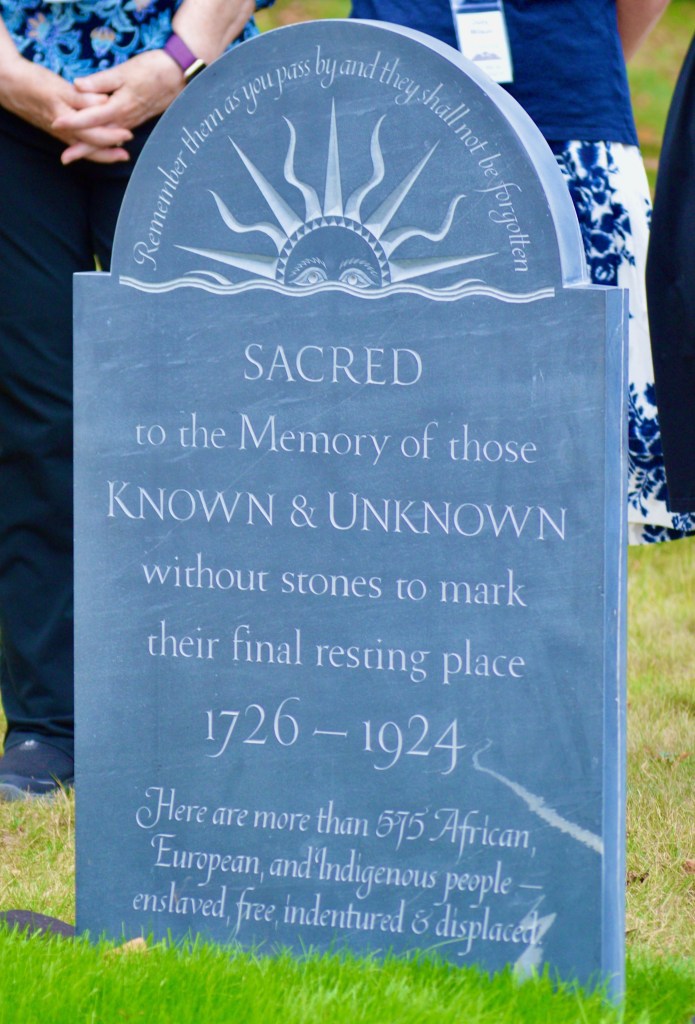
Memorial placed in the OBG

In autumn the Old Burying Ground in Stoneham changes its colors. Yellow and orange leaves fall about the gravestones of the founders of our town. The Goulds, Greens, Holtens and Hays. The Spragues, Stevens, Richardsons and Wrights.

But beyond the cluster of 18th and 19th century stones, there are open areas where no markers disrupt the gentle slope of the earth. Here lie those with no status in early Stoneham. Here are buried the town’s paupers, natives and slaves.

On a recent Saturday, thanks to the Stoneham Historical Commission, Stoneham folk gathered  in the Old Burying Ground to remember all those buried in unmarked graves. How many were there? It’s impossible to know, even with radar ground studies. But a scouring of town and church records suggests there were over five hundred.

Who were they, these men and women who, along with our better-off European ancestors, built Stoneham? Who, in the case of slaves, toiled without pay or hope of freedom. Who, in some cases, married, had children and attended church, but were prescribed to the lowest rungs of society?

The first white settlers in Stoneham, then called Charlestown End, arrived in the mid-17th century, about two decades after English colonists led by John Winthrop founded the Massachusetts Bay Colony. Not long after, came the slaves.

The earliest record I could find of slaves in the Stoneham area is in Elbridge Goss’ History of Melrose. It appears in a 1653 order from the General Court, stipulating that a slave owned by Job Lane, named Ebedmeleck, must be punished for “stealing victuals and breaking open a window on the Lord’s day.” He shall “be whipt with five stripes.”

In the century before the American Revolution, at least nine families in Stoneham owned slaves, including the Greens, who settled in the eastern and southeastern area of our town. The Green farm, extending from the Melrose line to Pond Street, would be the home of five generations of the Greens. Forty-two Greens would be buried in the Old Burying Ground.

An inventory of Captain Jonathan Green’s possessions in 1761 includes, along with 3 horses, 6 oxen, 9 cows, and 20 sheep, “2 servants for life.”

Jonathan Green’s name also shows up in the indenture contract binding a 7-year-old girl to the Green family for eleven years. My column of September 11 tells her story.
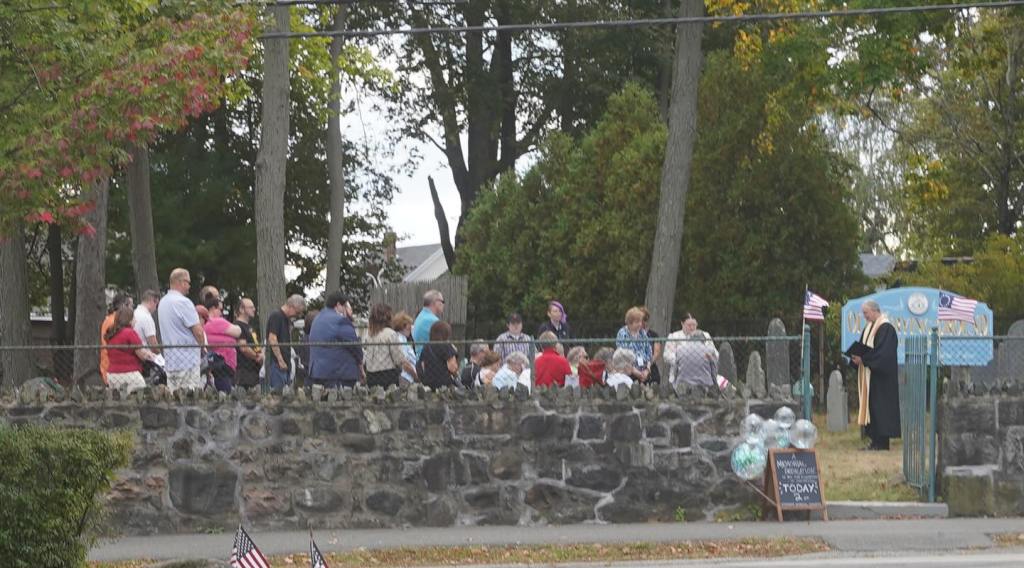
The Rev. Ken McGarry offers dedication prayer for all those buried in unmarked graves in the Old Burying Ground in Stoneham.

Indenture in New England was one way of dealing with poor, illegitimate or otherwise destitute children. If they were fortunate, they learned a trade, or, in the case of young women, found a husband after completing their term. Adults were also indentured, often as house servants.  In an inventory of the late town minister, James Osgood, is found, along with his other possessions, one Negro woman and one white servant.

Towns also had poor houses, as did Stoneham, although it was customary for officials to “warn out” paupers coming into town, so they would not become a drain on resources.

The earliest mention of an almshouse in Stoneham is a note by Silas Dean that in 1760 town leaders explored working with Reading and Woburn to establish a “work house,” a place for the poor.

The next reference I found is in William B. Stevens’ History of Stoneham, where he records the 1823 purchase of a farm in northeast Stoneham as a place for the poor. As in communities throughout New England, poor farms were funded by towns and cities at public expense. But they were also working homes for the able bodied who could either farm, cook, do laundry, or work at a trade. Here you might find a widow, a disabled or indigent worker, or an orphan.

As Stoneham’s population increased, a larger facility was needed. In 1852 the town purchased 17 acres on Elm Street and began construction of a new Almshouse. Additional acres were later purchased, and the house was enlarged and a shop added where the shoemakers in the home could work. In 1890 the Stoneham Almshouse had 30 residents. Today, it is our Senior Center.

The Old Burying Ground was also the burial place of Native Americans. We know of two because it made the papers. In February of 1813, ruffians murdered a Penobscot couple that had set up camp by Spot Pond. Their names were Nicholas and Sally Crevay. I tell their story in my book, If the Shoe Fits: Stories  of Stoneham, Then & Now.

The next time you visit the Old Burying Ground, pause a moment at the beautifully designed memorial placed there by the Historical Commission. It honors the hundreds buried there in unmarked graves, people who lived among us and helped build our town. As we celebrate our Tricentennial, it’s the right thing to do.

I hear America singing: a lamentation

Where are you, Walt Whitman, Woodie Guthrie?

I hear America singing, the varied lamentations I hear.
I hear America singing, sorrowful dirges,
Singing for the carpenter yanked from his car,
Singing for the waitress whisked out the back door,
Singing for the campesino dragged out of the field.
I hear America singing the song of deportees.

I hear America singing, the varied lamentations I hear.
I hear America singing, atonal wailing,
Singing for children packed onto airplanes,
Singing for women in cells with open toilets,
Singing for students who no longer dare dream,
I hear America singing the song of deportees.

I hear America singing, the varied lamentations I hear.
I hear America singing, keening and sobbing,
Singing for the shop keeper taken from her bodega,
Singing for the refugee hiding in a warehouse,
Singing for the dark men flown to far prisons.
I hear America singing the song of deportees.

I hear America singing, the varied lamentations I hear.
I hear America singing, mewling in her sleep,
Crying for her children set down in a strange land,
Crying for old men forever in exile,
Crying for mothers who can’t feed their babies.
I hear America singing the song of deportees.

Goodbye to my Juan, goodbye, Rosalita,
So long Jean Louis, Alim, Emmanuella
Farewell Yasmin, Noor and Amina,
Don’t go, Baghish, Esin and Ariana,
Please stay, Borislav, Alina and Dimitri,
We’ll miss you Minjun, Kwan and Dasom.

Listen now as we sing your names,
Sing the names of our dear deportees.

A Poor Girl Named Abigail

She was seven, too young to lose one parent and be taken from the other. Her name was Abigail. We know about her became Silas Dean, longtime town clerk and church deacon, wrote about her indenture in A Brief History of the Town of Stoneham, published in 1870.

Abigail’s father was Daniel Connery. He lived, according to Dean, in a house “for a long time called Connery’s Den,” the lair of, among other things, Dean comments wryly, “lion rum.”

Daniel died in or before 1776, although his death is not listed in town records. For the family, losing the breadwinner put them in grave peril. There was no safety net then, and the almshouse on Elm Street wouldn’t open until the next century.

Abigail’s mother is not named by Dean, nor is she named in the indenture agreement. She was most likely Elisabeth Phillips of Lynn, married in 1763 to Daniel Connery, as recorded in both towns.

I can only imagine what it must have been like for her, as on May 6, 1776, she prepared to deliver her seven-year-old for indentured service. Was she there as the five selectmen and two justices of the peace signed the legal papers? Did she accompany her daughter to her new family?

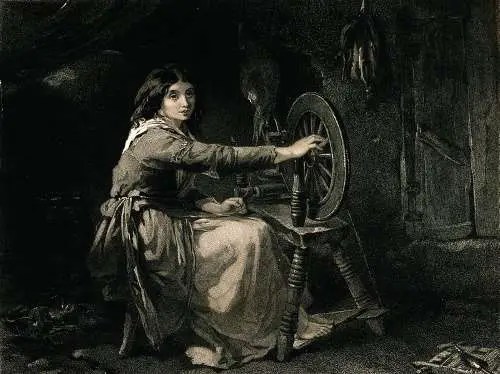
So it was that on this spring day Agibail was placed and bound “to Jonathan Green . . . and his wife . . . to learn to spin, knit and sew” and “after the manner of an apprentice to serve for the term of 10 years, 11 months, and 27 days” until she turns 18 (modernized spelling and capitalization.)

Although the document doesn’t specify which Jonathan Green is named—Captain Jonathan Green or his son of the same name—it’s reasonable to assume it is the elder, one of Stoneham’s most prominent and prosperous citizens. A fourth generation of Greens that arrived from England in the 17th century, Captain Jonathan Green was for many years town clerk and treasurer. For 20 years he was a selectman. He commanded a company of militia, and he owned slaves. An inventory of his possessions in 1761 includes, along with 3 horses, 6 oxen, 9 cows, and 20 sheep, “2 servants for life.”

Jonathan’s wife was Rebecca Bucknam, whom he married in 1749 after two previous wives had died. In the home would have been one son, Jesse, 13, and perhaps daughters Sarah, 18, and Rebecca, 21.

As we read the indenture document, it’s important to note its transactional terms. Both parties—the family and the indentured person—will get something. Likewise, each has obligations.

First, Abigail is obligated to serve her master and mistress faithfully and their “lawful commands gladly everywhere obey.” She must also keep their secrets. Today, we call that a nondisclosure agreement. Further, she must do no damage to them or their home or waste their goods. And she must not leave the premises without their consent.

Abigail is also to commit no fornication or enter into matrimony. Also, she must refrain from playing cards or dice. Finally, she must not “haunt ale houses taverns or playhouses, but in all things behave herself as a faithful apprentice ought.”

On the other side, Captain Green and his wife “hereby covenant and promise to teach and instruct … in the art of spinning, knitting and sewing.” They must also provide “sufficient meat, drink, washing and lodging both in sickness and health.” They are also required to teach her to read, although nothing is said about writing or mathematics.

These terms extend through the 11-year-term. Then, when Abigail turns 18, they must give her what were known as “freedom suits.” In this case, “two suits of apparel both wool and linen, fitting for all parts of her body”—one suit for work days and the other for “the Lord’s day.”

As in England, indenture was common in the Massachusetts Bay Colony, involving children as well as adults. Records show that between 1735 and 1805, over 1,400 children were bound over as indentured servants. Hundreds were below the age of 10 and three dozen below the age of 5. Poor, abandoned, orphaned or illegitimate, they would grow up in the households of better-off families. They would eat at their table, take on chores, and assist in the business of the home. The most fortunate would learn a trade, or, in the case of girls reaching adulthood, find someone to marry.

What happened to Abigail we don’t know. Her name doesn’t show up in any other town records. Was she treated well? Did she complete her indenture, perhaps become a seamstress? Did she marry and move away? Thinking of her, I think of my daughter and granddaughter at that age. It must have been heartbreaking for Abigail and her mother.

Nor do we know any more of Elisabeth Connery. Her name doesn’t appear again in either Stoneham or Lynn vital statistics. Did she visit her daughter from time to time? Did she move away.

Meanwhile, Abigail would have grown up in the new Republic, as Massachusetts went from a colony to statehood. What would the changes sweeping through society have meant to her? I only wish we knew more.

Notes:

  1. I found only one reference to indentured service involving an adult in Stoneham. In the 1746 probate inventory of the late Rev. James Osgood’s possessions is this line: “a white servant for a term £25.” The unnamed servant must have had time left on his or her indentured service, valued at 25 pounds. With this entry was also “a Negro woman £70.” She had been purchased by the minister in 1744 and was “a servant for life.”
  2. There is also reference made to the indenture of one of Stoneham’s early settlers, Patrick Hay. Silas Dean tells of a young Scottsman who fled his apprenticeship in Edinburgh, boarded a ship to Salem, then was again indentured “for six or seven years” to a Lynnfield farmer to pay for his passage. Completing his term, he came to Stoneham “with his axe and gun” to clear land for a homestead.

Ben Jacques is the author of In Graves Unmarked: Slavery and Abolition in Stoneham, Massachusetts, and If the Shoe Fits: Stories of Stoneham, Then & Now.