The long summer’s over, Lord. Time to turn our clocks back. Time for cold winds to blow.
But wait. So the last fruits may ripen give us two more warm days. push the pears to plumpness, chase the sugar in the heavy vine.
If you have no house, too late to build. If you’re alone now, get used to it. You’ll wake up, read a little, write long letters, then wander in side streets here and there, restless as a falling leaf.
HERBSTTAG
Herr: es ist Zeit. Der Sommer war sehr gross. Leg deinen Schatten auf die Sonnenuhren, und auf den Fluren lass Winde los.
Befiehl den letzen Früchten voll zu sein; gib ihnen noch zwei südlichere Tage, dränge sie zur Vollendung hin und jage die letze Süsse in den schweren Vein.
Wer jetzt kein Haus hat, baut sich keines mehr. Wer jetzt allein ist, wird es lange bleiben wird wachen, lesen, lange Briefe schreiben, und wird in den Alleen hin und her unruhig wandern, wenn die Blätter treiben.
Cleve would forget he’ d told me about the squaretail, the brook trout he’d caught as a boy on the farm in Wiscasset, Maine, and tell me the story again. He must have told me twenty times. But I’d let him tell it again. I didn’t mind. He had given me my first fly rod, and I figured I could spare the time.
I never fished much as a boy. But soon after I married Cleve’s daughter, I started going with him and Morrill, my brother-in-law. My job was to run the boat, to put it where my in-laws could cast.
We often fished the Rangeley Lakes region, from Beaver Mountain to the Little Kennebago River. On any given day, while fishing we might see deer, otters or a beaver. Or a heron, osprey or kingfisher. Sometimes a pair of loons would surface and we’d be serenaded by their throaty calls. Once, in a stream, we heard splashing ahead. Pretty soon a young bull moose came around the bend and walked past us, not ten feet away.
The thing about brook trout is that once you catch one, other fish look ugly. Brookies, or squaretails, are small trout in general, but their sides are prettier than a church window. Their minute scales are flecked with yellow and red spots, sometimes with blue haloes. When spawning, males have orange-red sides and bellies.
Eventually, I got tired of steering the boat so my in-laws could fish, and I picked up a spare fly rod. “Put on a number 12 Hornberger,” Cleve said. That done, I started whipping the line back and forth. First I snagged it in the alders, then on Morrill’s hat. “Easy, now,” he said.
After a good deal of practice, I dropped the fly gently down on the surface and got a hit, then lost it. But at the mouth of the brook, now fishing the Hornberger wet, I brought in my first catch. I stared in amazement at the eight-inch brookie in my hand.
That autumn, after the fishing season, Cleve had a massive stroke. He lay on the hospital bed in Maine Medical Center, unable to move. Then one day I saw his thumb twitch. Miraculously, and with intense will, not to mention speech and physical therapy, he came back, but not all the way.
In the winter months I played Cribbage with him, making small talk as he struggled to shuffle and deal. By spring he was doing much better. He had learned to sign his checks with his left hand. He was also learning to drive again. He never got his fine-motor movement back, so important to fly fishing, but that didn’t keep him from trying.
In July we I asked Cleve if he was ready to go fishing again. Morrill and I helped Cleve off the dock into the boat. We crossed the lake, entered the stream, then drifted toward our favorite spot. All three of us began casting, but when Cleve hooked one, I quickly reeled in and turned to assist. He brought his fish slowly to the boat, just the way you’re supposed to. “Get the net,” Morrill called out. But I didn’t like using nets, and I reached down to gently lift the brookie in for him. Coming out of the water, the trout leaped in an arc and was gone. If it had been my fish, I would’ve cursed. “There’ll be another one,” was all Cleve said.
In later years, the fish Cleve liked to talk about, more than the salmon or togue, more than the grayling and pike he had caught out in Minnesota, was the 15-inch squaretail he caught when he was a boy, in the stream that wound through the farm before dropping into the Sheepscot River.
At dawn one Sunday morning, he had grabbed his rod and a few night crawlers and headed for the bend where the stream pooled deep. His timing was right. He caught a couple of nine-ten-inchers. Then he crawled out on a tree that bent over the pool and dropped his line straight down where the water was black.
The sudden tug almost pulled him off balance. He inched back down the trunk, then patiently tired the fish before sliding him up on the bank.
It was a beautiful trout, deep in color and thick as a man’s fist. He gathered his trophy and the other two on a string, ran up to the house, knocked on his father’s bedroom door and walked over beside the bed. Tapping his father on the shoulder, he first held out the two smaller trout.
His father squinted at the fish, then rolled over. “Now, how ‘bout this one?” the boy held out the large brook trout. This time his father in one motion swung his legs out from under the bed covers. This was a squaretail worth looking at.
Word got out at church that morning about the boy’s fish, and that afternoon Cleve’s uncle drove over from Damariscotta. “Show me your trout,” he told his nephew. “Too late,” Cleve said. “We et him for lunch.”
Over the next few years, Cleve had a series of smaller strokes and setbacks. But often, when the talk died down, or our thoughts turned to the upcoming season, Cleve would ruminate on that trout. He’d say, “Did I ever tell you about the squaretail I caught in the stream on the farm?”
I figured that trout—rich in symbol and pride—had helped my father-in-law through the hard times , the heart attack, the strokes, the long hours of therapy, the loss of his wife, the loneliness of hospital nights.
A year later, Cleve started losing his memory, or rather began returning to another time. Sometimes he’d get up a 3 a.m., get his things together and announce it was time to go home. One day when we took him out for a drive to town landing, he said he wanted to go home. But when we headed for home, he said it wasn’t the right way.
Eventually he had to go to a nursing home. One of the last times I visited with him, he was waiting for his parents to pick him up.
It’s hard having a conversation with someone with dementia. You want so bad to connect, for yourself as well as for them.
As I sat beside him in his wheelchair, there were no more words. Then I thought of asking him about the brook trout. “Do you remember the squaretail, Dad? The one you caught when you were a boy on the farm?”
He looked at me for a moment, patiently, I thought. Then he said, simply, quietly, “No.”
I was stunned. Something inside him had let the fish go. I grabbed desperately for the net. It was too late. That magnificent trout, beautiful as a Monet, had simply snapped the leader drawing it to the surface and turned back in a silent rush to the pool’s depths.
A month later, Cleve, too, entered that dark pool. I like to think he found the squaretail again. That his eyes once again lit up at the beautiful colors. But I don’t know. These things are hard to tell.
As autumn wanes into winter, the voice of the greatest of poets comes again to me. “That time of year thou mayst in me behold.”
It’s not just the coming of winter, but also the accumulation of years. I will soon turn 79. William Shakespeare must have felt a similar melancholy when he wrote Sonnet 73.
Wonderfully crafted, Sonnet 73 is an appeal to the poet’s beloved, written in his later years. Setting the stage, so to speak, Shakespeare creates three scenes, one quatrain for each. The first is late fall. Most of the leaves are gone. Trees, where once birds sang, are “bare ruined choirs.”
The second is the sky just after the sun has gone down. A faint wash of color remains. For the third scene, the poet brings us indoors. He is now sitting by the hearth, before the “glowing of such fire that on the ashes of his youth doth lie.”
This is what you see in me, he tells his beloved–the last fall colors, the fading sunset, the low flames of an almost-spent fire. Perceiving all this, the poet closes in a couplet, “makes thy love more strong.”
The sonnet ends with a call to his beloved “to love that well which thou must leave ere long.”
So are we all called, as we turn the clocks back, as we approach yet another New England winter, to love well those around us, young and old.
Here, now, is Sonnet 73, a poem for the ages:
That time of year thou mayst in me behold When yellow leaves, or none, or few, do hang Upon those boughs which shake against the cold, Bare ruin’d choirs, where late the sweet birds sang. In me thou see’st the twilight of such day As after sunset fadeth in the west, Which by and by black night doth take away, Death’s second self, that seals up all in rest. In me thou see’st the glowing of such fire That on the ashes of his youth doth lie, As the death-bed whereon it must expire, Consum’d with that which it was nourish’d by. This thou perceiv’st, which makes thy love more strong, To love that well which thou must leave ere long.
Art by Florence and Margaret Hoopes, from The Wonder Story Books – They Were Brave and Bold – Beowulf .
Denmark needed a superhero. A treacherous monster named Grendel was savaging them at night, slaughtering their best as they bedded in Heorot, the great hall of the king. Thus the stage was set for Beowulf, a brawny prince who crossed the sea from Geatland to rid the Danes of evil.
The prototype of the Western superhero, Beowulf does what neither King Hrothgar nor his warriors can do. He vanquishes both Grendel and the slayer’s vindictive mother, diving into a black sea, writhing with snakes, to bring an end to oppression.
Yet in the end, fifty years later, neither Beowulf’s strength nor courage can protect the people from the evil destroying their cities. It takes the wisdom of a thane, an underling named Wiglaf, to see that it is not enough to have heroes if the people’s hearts have grown cold.
We know the story as the first great epic in our language, not English as we know it, but Anglo-Saxon. Sung then written down around 900 CE, it was crafted by a descendant of the Angle, Saxon, Jute and Frisian invaders who overwhelmed Celtic Britain in the 5th and 6th centuries. The translation I like best is by the late Irish poet, Seamus Heaney.
A pagan saga with a Judeo-Christian overlay, Beowulf portrays a world in flux. Most modern tellings focus on our hero’s two great victories in Denmark. By the time we get to Beowulf’s last battle, however, things have changed. In several passages, blending Biblical narrative with a pagan’s rumination on the transitory nature of life, the poet reveals a shift in values.
In Beowulf’s world—as today—men seek gold, weapons and treasure. These give them status. With them, kings and queens gain allegiance, reward subjects and build alliances. Treasure shared holds the community together. Treasure hoarded leads to treachery. Hrothgar showers Beowulf with fine gifts: horses, fine armor “and a sword carried high, that was both precious object and token of honour.”
At the same time the king counsels the young warrior to remember he too is mortal. He warns him against vanity and pride, “an element of overweening” that will lull his soul to sleep and expose him to the enemy.
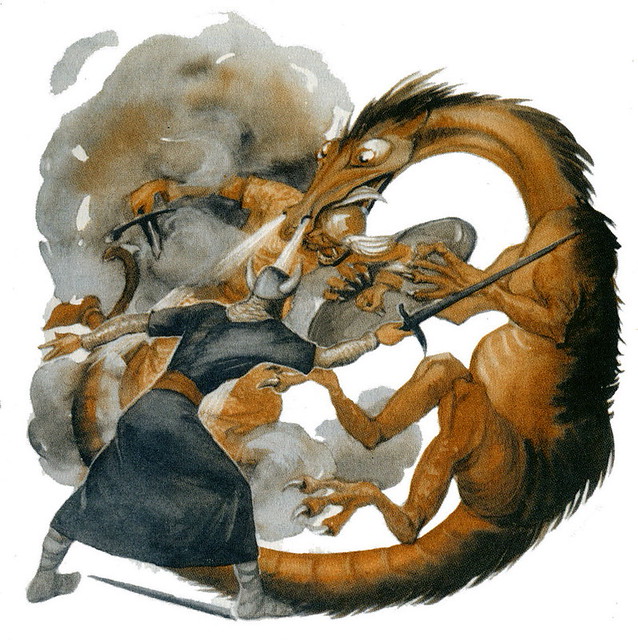
Pride and the lure of treasure surface again in the final act of the play, as Beowulf, now an old king, goes out to battle a “slick-skinned dragon, threatening the night sky with streamers of fire.” Guardian of an ancient underground barrow, the dragon has been burning farms and villages across Geatland, all in revenge for a jeweled cup stolen from its hoard.
Wanting to protect his people, Beowulf is “too proud to line up with a large army against the sky-plague.” He will face the monster alone, confident he will prevail as he did against Grendel and his mother.
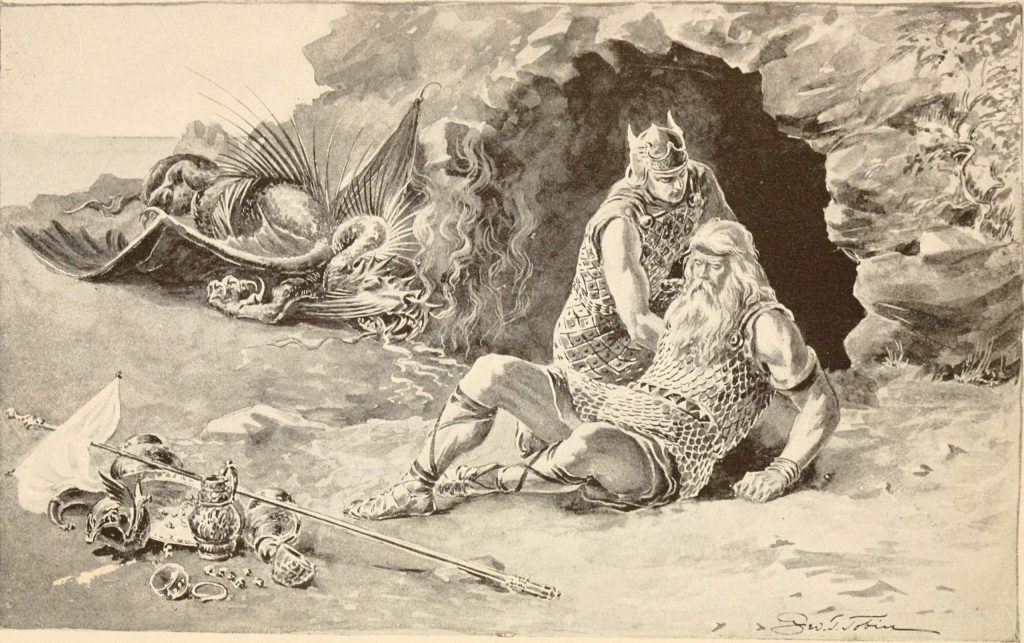
It is not to be. In desperate combat, Beowulf is mortally wounded. His famous sword, Naegling, breaks against the dragon’s scales, and the monster’s teeth penetrate his armor. Beowulf slays the dragon, but only with the help of Wiglaf, a young Geat warrior who could not bear to see his king go into battle alone.
As he is dying. Beowulf asks Wiglaf to gather samples of the dragon’s treasure, so he can feast his eyes on them:
I want to examine that ancient gold, gaze my fill on those garnered jewels (2747-9)
But the value of gold, jewels, fine weapons and armor—even the priceless cache found in the dragon’s hoard—is relative. Nowhere is this better expressed than in what happens next. Instead of using the treasure to enrich the kingdom, the Geats heap it onto Beowulf’s funeral pyre. They bury the rest in a great mound on the headland by the sea.
They let the ground keep that ancestral treasure gold under gravel, gone to earth as useless to men now as it ever was (3166-8).
Nearing the end of the epic, we sense a turning from sword power to soul power. Valued most highly now is inner strength, not physical prowess. The enemy are no longer dragons and monsters, but human rivals—Swedes to the north and Franks and Frisians to the south.
At Beowulf’s funeral, there is great sorrow, but also great fear:
A Geat woman too sang out in grief; with hair bound up she unburdened herself of her worst fears, a wild litany of nightmare and lament, a nation invaded, enemies on the rampage, bodies piled up, slavery and abasement (3150-5).
Wiglaf sees clearly what is to come. In a scathing rebuke, he tells his people they have lost more than a great king. They have lost their heart. It is true—their king chose to go into battle alone. Yet, when his warriors saw him bested by the dragon, they turned and ran.
The tail-turners, ten of them together, when he needed them most, they had made off (2848-9). Now, weakened by cowardice, Geatland is ripe for the picking. So it is goodbye now to all you know and love on your home ground, the open-handedness the giving of war-swords. Every one of you with freeholds of land, our whole nation will be dispossessed (2884-8).
Wiglaf knows that no amount of treasure, or armaments, will protect a people who are paltry of spirit, who abandon each other in times of peril. More important than gold or brawn is the steel of a person’s heart, which underlies all strength. In a remarkable description of interior growth, Wiglaf reveals the change that occurred in him when he ran to assist his beloved king:
There was little I could do to protect his life in the heat of the fray, yet I found new strength Welling up when I went to help him. Then my sword connected and the deadly assaults of our foe grew weaker (2877-80).
Wiglaf’s experience has given him insight into the interior world through which a warrior must journey. His wisdom makes our first English epic as relevant to our time as to his.



 Ben Jacques Stories