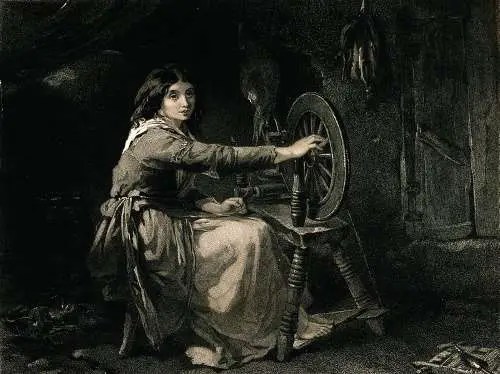
She was seven, too young to lose one parent and be taken from the other. Her name was Abigail. We know about her became Silas Dean, longtime town clerk and church deacon, wrote about her indenture in A Brief History of the Town of Stoneham, published in 1870.
Abigail’s father was Daniel Connery. He lived, according to Dean, in a house “for a long time called Connery’s Den,” the lair of, among other things, Dean comments wryly, “lion rum.”
Daniel died in or before 1776, although his death is not listed in town records. For the family, losing the breadwinner put them in grave peril. There was no safety net then, and the almshouse on Elm Street wouldn’t open until the next century.
Abigail’s mother is not named by Dean, nor is she named in the indenture agreement. She was most likely Elisabeth Phillips of Lynn, married in 1763 to Daniel Connery, as recorded in both towns.
I can only imagine what it must have been like for her, as on May 6, 1776, she prepared to deliver her seven-year-old for indentured service. Was she there as the five selectmen and two justices of the peace signed the legal papers? Did she accompany her daughter to her new family?
So it was that on this spring day Agibail was placed and bound “to Jonathan Green . . . and his wife . . . to learn to spin, knit and sew” and “after the manner of an apprentice to serve for the term of 10 years, 11 months, and 27 days” until she turns 18 (modernized spelling and capitalization.)
Although the document doesn’t specify which Jonathan Green is named—Captain Jonathan Green or his son of the same name—it’s reasonable to assume it is the elder, one of Stoneham’s most prominent and prosperous citizens. A fourth generation of Greens that arrived from England in the 17th century, Captain Jonathan Green was for many years town clerk and treasurer. For 20 years he was a selectman. He commanded a company of militia, and he owned slaves. An inventory of his possessions in 1761 includes, along with 3 horses, 6 oxen, 9 cows, and 20 sheep, “2 servants for life.”
Jonathan’s wife was Rebecca Bucknam, whom he married in 1749 after two previous wives had died. In the home would have been one son, Jesse, 13, and perhaps daughters Sarah, 18, and Rebecca, 21.
As we read the indenture document, it’s important to note its transactional terms. Both parties—the family and the indentured person—will get something. Likewise, each has obligations.
First, Abigail is obligated to serve her master and mistress faithfully and their “lawful commands gladly everywhere obey.” She must also keep their secrets. Today, we call that a nondisclosure agreement. Further, she must do no damage to them or their home or waste their goods. And she must not leave the premises without their consent.
Abigail is also to commit no fornication or enter into matrimony. Also, she must refrain from playing cards or dice. Finally, she must not “haunt ale houses taverns or playhouses, but in all things behave herself as a faithful apprentice ought.”
On the other side, Captain Green and his wife “hereby covenant and promise to teach and instruct … in the art of spinning, knitting and sewing.” They must also provide “sufficient meat, drink, washing and lodging both in sickness and health.” They are also required to teach her to read, although nothing is said about writing or mathematics.
These terms extend through the 11-year-term. Then, when Abigail turns 18, they must give her what were known as “freedom suits.” In this case, “two suits of apparel both wool and linen, fitting for all parts of her body”—one suit for work days and the other for “the Lord’s day.”
As in England, indenture was common in the Massachusetts Bay Colony, involving children as well as adults. Records show that between 1735 and 1805, over 1,400 children were bound over as indentured servants. Hundreds were below the age of 10 and three dozen below the age of 5. Poor, abandoned, orphaned or illegitimate, they would grow up in the households of better-off families. They would eat at their table, take on chores, and assist in the business of the home. The most fortunate would learn a trade, or, in the case of girls reaching adulthood, find someone to marry.
What happened to Abigail we don’t know. Her name doesn’t show up in any other town records. Was she treated well? Did she complete her indenture, perhaps become a seamstress? Did she marry and move away? Thinking of her, I think of my daughter and granddaughter at that age. It must have been heartbreaking for Abigail and her mother.
Nor do we know any more of Elisabeth Connery. Her name doesn’t appear again in either Stoneham or Lynn vital statistics. Did she visit her daughter from time to time? Did she move away.
Meanwhile, Abigail would have grown up in the new Republic, as Massachusetts went from a colony to statehood. What would the changes sweeping through society have meant to her? I only wish we knew more.
Notes:
- I found only one reference to indentured service involving an adult in Stoneham. In the 1746 probate inventory of the late Rev. James Osgood’s possessions is this line: “a white servant for a term £25.” The unnamed servant must have had time left on his or her indentured service, valued at 25 pounds. With this entry was also “a Negro woman £70.” She had been purchased by the minister in 1744 and was “a servant for life.”
- There is also reference made to the indenture of one of Stoneham’s early settlers, Patrick Hay. Silas Dean tells of a young Scottsman who fled his apprenticeship in Edinburgh, boarded a ship to Salem, then was again indentured “for six or seven years” to a Lynnfield farmer to pay for his passage. Completing his term, he came to Stoneham “with his axe and gun” to clear land for a homestead.
Ben Jacques is the author of In Graves Unmarked: Slavery and Abolition in Stoneham, Massachusetts, and If the Shoe Fits: Stories of Stoneham, Then & Now.
 Ben Jacques Stories