When superheroes aren’t enough

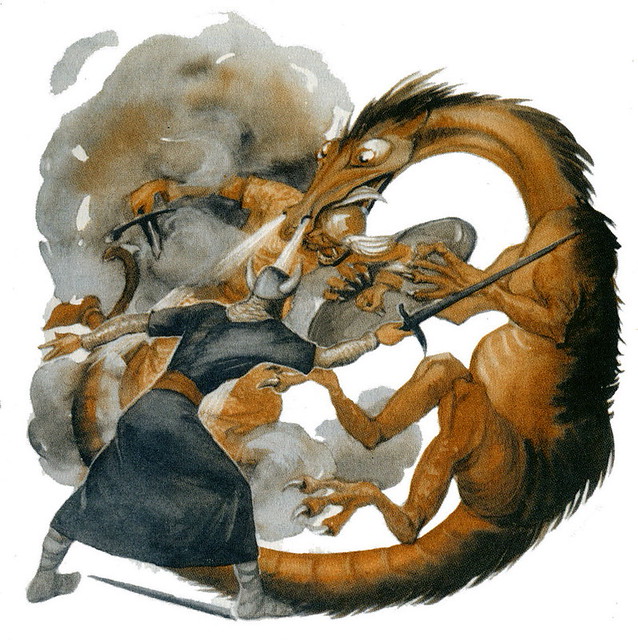
Art by Florence and Margaret Hoopes, from The Wonder Story Books –
They Were Brave and Bold – Beowulf .

Denmark needed a superhero. A treacherous monster named Grendel was savaging them at night, slaughtering their best as they bedded in Heorot, the great hall of the king. Thus the stage was set for Beowulf, a brawny prince who crossed the sea from Geatland to rid the Danes of evil.

The prototype of the Western superhero, Beowulf does what neither King Hrothgar nor his warriors can do. He vanquishes both Grendel and the slayer’s vindictive mother, diving into a black sea, writhing with snakes, to bring an end to oppression.

Yet in the end, fifty years later, neither Beowulf’s strength nor courage can protect the people from the evil destroying their cities. It takes the wisdom of a thane, an underling named Wiglaf, to see that it is not enough to have heroes if the people’s hearts have grown cold.

We know the story as the first great epic in our language, not English as we know it, but Anglo-Saxon. Sung then written down around 900 CE, it was crafted by a descendant of the Angle, Saxon, Jute and Frisian invaders who overwhelmed Celtic Britain in the 5th and 6th centuries. The translation I like best is by the late Irish poet, Seamus Heaney.

A pagan saga with a Judeo-Christian overlay, Beowulf portrays a world in flux. Most modern tellings focus on our hero’s two great victories in Denmark. By the time we get to Beowulf’s last battle, however, things have changed. In several passages, blending Biblical narrative with a pagan’s rumination on the transitory nature of life, the poet reveals a shift in values.

In Beowulf’s world—as today—men seek gold, weapons and treasure. These give them status. With them, kings and queens gain allegiance, reward subjects and build alliances. Treasure shared holds the community together. Treasure hoarded leads to treachery. Hrothgar showers Beowulf with fine gifts: horses, fine armor “and a sword carried high, that was both precious object and token of honour.”

At the same time the king counsels the young warrior to remember he too is mortal. He warns him against vanity and pride, “an element of overweening” that will lull his soul to sleep and expose him to the enemy.

Pride and the lure of treasure surface again in the final act of the play, as Beowulf, now an old king, goes out to battle a “slick-skinned dragon, threatening the night sky with streamers of fire.” Guardian of an ancient underground barrow, the dragon has been burning farms and villages across Geatland, all in revenge for a jeweled cup stolen from its hoard.

Wanting to protect his people, Beowulf is “too proud to line up with a large army against the sky-plague.” He will face the monster alone, confident he will prevail as he did against Grendel and his mother.

It is not to be. In desperate combat, Beowulf is mortally wounded. His famous sword, Naegling, breaks against the dragon’s scales, and the monster’s teeth penetrate his armor. Beowulf slays the dragon, but only with the help of Wiglaf, a young Geat warrior who could not bear to see his king go into battle alone.
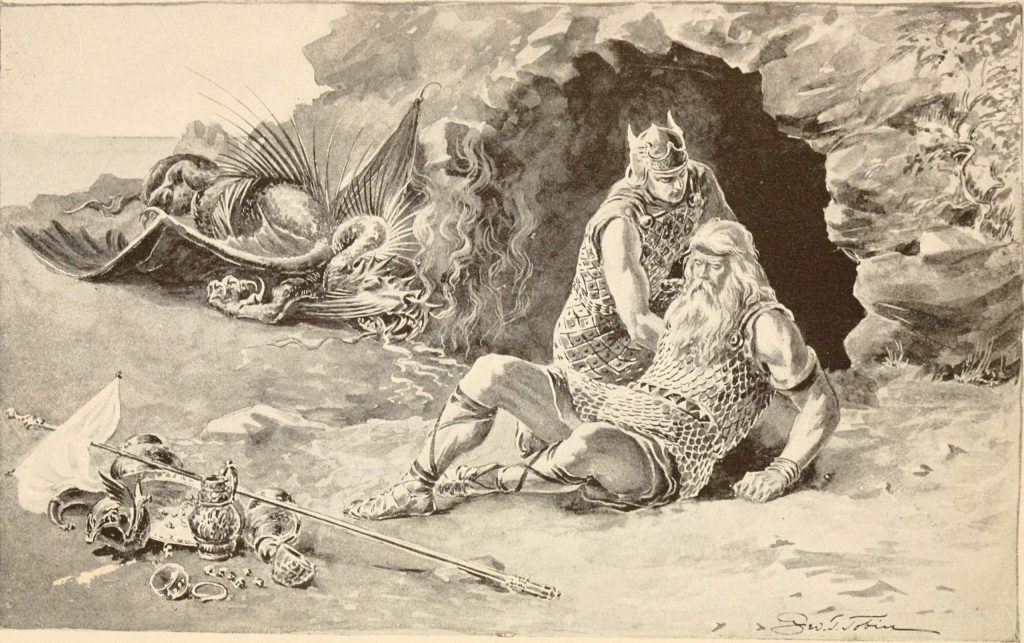
As he is dying. Beowulf asks Wiglaf to gather samples of the dragon’s treasure, so he can feast his eyes on them:

I want to examine
that ancient gold, gaze my fill
on those garnered jewels (2747-9)

But the value of gold, jewels, fine weapons and armor—even the priceless cache found in the dragon’s hoard—is relative.  Nowhere is this better expressed than in what happens next. Instead of using the treasure to enrich the kingdom, the Geats heap it onto Beowulf’s funeral pyre. They bury the rest in a great mound on the headland by the sea.

They let the ground keep that ancestral treasure
gold under gravel, gone to earth
as useless to men now as it ever was (3166-8).

Nearing the end of the epic, we sense a turning from sword power to soul power. Valued most highly now is inner strength, not physical prowess. The enemy are no longer dragons and monsters, but human rivals—Swedes to the north and Franks and Frisians to the south.

At Beowulf’s funeral, there is great sorrow, but also great fear:

A Geat woman too sang out in grief;
with hair bound up she unburdened herself
of her worst fears, a wild litany
of nightmare and lament, a nation invaded,
enemies on the rampage, bodies piled up,
slavery and abasement (3150-5).

Wiglaf sees clearly what is to come. In a scathing rebuke, he tells his people they have lost more than a great king. They have lost their heart. It is true—their king chose to go into battle alone. Yet, when his warriors saw him bested by the dragon, they turned and ran. 

The tail-turners, ten of them together,
when he needed them most, they had made off (2848-9).
Now, weakened by cowardice, Geatland is ripe for the picking.
So it is goodbye now to all you know and love
on your home ground, the open-handedness
the giving of war-swords. Every one of you
with freeholds of land, our whole nation
will be dispossessed (2884-8).

Wiglaf knows that no amount of treasure, or armaments, will protect a people who are paltry of spirit, who abandon each other in times of peril. More important than gold or brawn is the steel of a person’s heart, which underlies all strength. In a remarkable description of interior growth, Wiglaf reveals the change that occurred in him when he ran to assist his beloved king:

There was little I could do to protect his life
in the heat of the fray, yet I found new strength
Welling up when I went to help him.
Then my sword connected and the deadly assaults
of our foe grew weaker (2877-80).

Wiglaf’s experience has given him insight into the interior world through which a warrior must journey. His wisdom makes our first English epic as relevant to our time as to his.
A Poor Girl Named Abigail

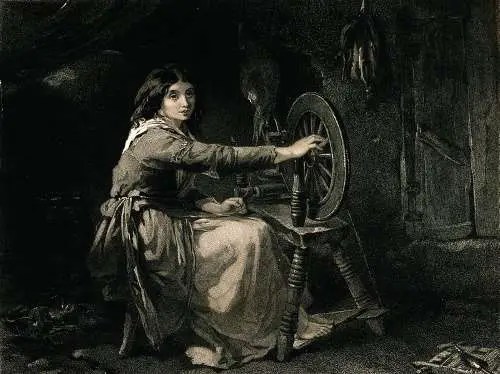
She was seven, too young to lose one parent and be taken from the other. Her name was Abigail. We know about her became Silas Dean, longtime town clerk and church deacon, wrote about her indenture in A Brief History of the Town of Stoneham, published in 1870.

Abigail’s father was Daniel Connery. He lived, according to Dean, in a house “for a long time called Connery’s Den,” the lair of, among other things, Dean comments wryly, “lion rum.”

Daniel died in or before 1776, although his death is not listed in town records. For the family, losing the breadwinner put them in grave peril. There was no safety net then, and the almshouse on Elm Street wouldn’t open until the next century.

Abigail’s mother is not named by Dean, nor is she named in the indenture agreement. She was most likely Elisabeth Phillips of Lynn, married in 1763 to Daniel Connery, as recorded in both towns.

I can only imagine what it must have been like for her, as on May 6, 1776, she prepared to deliver her seven-year-old for indentured service. Was she there as the five selectmen and two justices of the peace signed the legal papers? Did she accompany her daughter to her new family?

So it was that on this spring day Agibail was placed and bound “to Jonathan Green . . . and his wife . . . to learn to spin, knit and sew” and “after the manner of an apprentice to serve for the term of 10 years, 11 months, and 27 days” until she turns 18 (modernized spelling and capitalization.)

Although the document doesn’t specify which Jonathan Green is named—Captain Jonathan Green or his son of the same name—it’s reasonable to assume it is the elder, one of Stoneham’s most prominent and prosperous citizens. A fourth generation of Greens that arrived from England in the 17th century, Captain Jonathan Green was for many years town clerk and treasurer. For 20 years he was a selectman. He commanded a company of militia, and he owned slaves. An inventory of his possessions in 1761 includes, along with 3 horses, 6 oxen, 9 cows, and 20 sheep, “2 servants for life.”

Jonathan’s wife was Rebecca Bucknam, whom he married in 1749 after two previous wives had died. In the home would have been one son, Jesse, 13, and perhaps daughters Sarah, 18, and Rebecca, 21.

As we read the indenture document, it’s important to note its transactional terms. Both parties—the family and the indentured person—will get something. Likewise, each has obligations.

First, Abigail is obligated to serve her master and mistress faithfully and their “lawful commands gladly everywhere obey.” She must also keep their secrets. Today, we call that a nondisclosure agreement. Further, she must do no damage to them or their home or waste their goods. And she must not leave the premises without their consent.

Abigail is also to commit no fornication or enter into matrimony. Also, she must refrain from playing cards or dice. Finally, she must not “haunt ale houses taverns or playhouses, but in all things behave herself as a faithful apprentice ought.”

On the other side, Captain Green and his wife “hereby covenant and promise to teach and instruct … in the art of spinning, knitting and sewing.” They must also provide “sufficient meat, drink, washing and lodging both in sickness and health.” They are also required to teach her to read, although nothing is said about writing or mathematics.

These terms extend through the 11-year-term. Then, when Abigail turns 18, they must give her what were known as “freedom suits.” In this case, “two suits of apparel both wool and linen, fitting for all parts of her body”—one suit for work days and the other for “the Lord’s day.”

As in England, indenture was common in the Massachusetts Bay Colony, involving children as well as adults. Records show that between 1735 and 1805, over 1,400 children were bound over as indentured servants. Hundreds were below the age of 10 and three dozen below the age of 5. Poor, abandoned, orphaned or illegitimate, they would grow up in the households of better-off families. They would eat at their table, take on chores, and assist in the business of the home. The most fortunate would learn a trade, or, in the case of girls reaching adulthood, find someone to marry.

What happened to Abigail we don’t know. Her name doesn’t show up in any other town records. Was she treated well? Did she complete her indenture, perhaps become a seamstress? Did she marry and move away? Thinking of her, I think of my daughter and granddaughter at that age. It must have been heartbreaking for Abigail and her mother.

Nor do we know any more of Elisabeth Connery. Her name doesn’t appear again in either Stoneham or Lynn vital statistics. Did she visit her daughter from time to time? Did she move away.

Meanwhile, Abigail would have grown up in the new Republic, as Massachusetts went from a colony to statehood. What would the changes sweeping through society have meant to her? I only wish we knew more.

Notes:

  1. I found only one reference to indentured service involving an adult in Stoneham. In the 1746 probate inventory of the late Rev. James Osgood’s possessions is this line: “a white servant for a term £25.” The unnamed servant must have had time left on his or her indentured service, valued at 25 pounds. With this entry was also “a Negro woman £70.” She had been purchased by the minister in 1744 and was “a servant for life.”
  2. There is also reference made to the indenture of one of Stoneham’s early settlers, Patrick Hay. Silas Dean tells of a young Scottsman who fled his apprenticeship in Edinburgh, boarded a ship to Salem, then was again indentured “for six or seven years” to a Lynnfield farmer to pay for his passage. Completing his term, he came to Stoneham “with his axe and gun” to clear land for a homestead.

Ben Jacques is the author of In Graves Unmarked: Slavery and Abolition in Stoneham, Massachusetts, and If the Shoe Fits: Stories of Stoneham, Then & Now.

What would he say today?

A fugitive, he got off the boat in Newport and continued by coach to New Bedford. There, in the whaling seaport founded by Quakers, he found safety. He also found work.

“There was no work too hard—none too dirty,” he would write. “I was ready to saw wood, shovel coal, carry wood, sweep the chimney, or roll oil casks.”

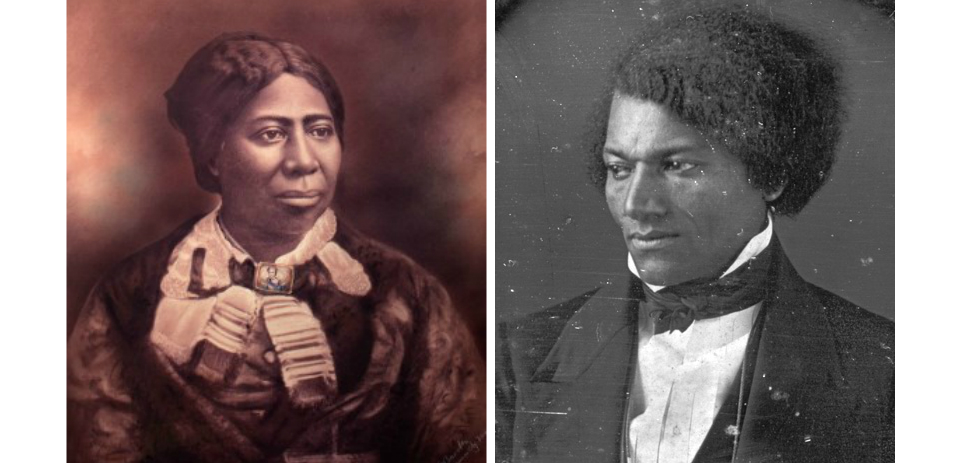
His name was Frederick Douglass and for first time in his life, he was working for himself and his newly married wife, Anna. “It was the first work,” he wrote, “the reward of which was to be entirely my own. There was no Master Hugh standing ready, the moment I earned the money, to rob me of it.”

The year was 1838. Dressed as a sailor and using false papers, the young man (he was just 20) had fled Baltimore. Having found a haven in New Bedford, he was amazed at its wealth and absence of poverty. “I had somehow imbibed the opinion that, in the absence of slaves, there could be no wealth, and very little refinement.”

He continued: “Everything looked clean, new, and beautiful. I saw few or no dilapidated houses, with poverty-stricken inmates; no half-naked children and barefooted women, such as I had been accustomed to see.”

Instead, Douglass found a city bustling with commerce and men and women eagerly engaged in their work. “I saw no whipping of men; but all seemed to go smoothly on. Every man appeared to understand his work, and went at it with a sober, yet cheerful earnestness….”

Most surprising was the condition of fellow fugitives and free Blacks. “I found many, who had not been seven years out of their chains, living in finer houses, and evidently enjoying more of the comforts of life, than the average of slaveholders in Maryland.”

His friends, Nathan and Polly Johnson, who had taken him and Anna into their home, “lived in a neater house; dined at a better table; took, paid for, and read, more newspapers; better understood the moral, religious, and political character of the nation,—than nine tenths of the slaveholders in Talbot county Maryland. Yet Mr. Johnson was a working man. His hands were hardened by toil, and not his alone, but those also of Mrs. Johnson.”

Even though New Bedford had become a refuge for escaped slaves, there was still racial prejudice. In Baltimore, Douglass had worked as a ship’s caulker, but was refused work with the white caulkers here, work which would have earned him twice his laborer’s wage.

Still, he and his wife made a living and found their own apartment. They attended church and socialized with others in the community. As a boy he had been taught to read by the sympathetic wife of his owner. Now he scoured the pages of The Liberator, published in Boston by William Lloyd Garrison.

Three years later, at an abolitionist meeting on Nantucket, he was asked to tell his own story, and the rest is history. He went on to become perhaps the most eloquent champion of the anti-slavery cause, lecturing, editing, writing and speaking throughout the Northern States, England and Ireland. A friend of all those yearning for freedom, he was an advocate for women’s rights as well.

Remembering Frederick Douglass is fitting as we celebrate Black History Month. But it’s also important given the threats to the human rights of millions of those in our nation today threatened with deportation. Like him, they have sought refuge among us. Like him, they will work at anything to provide for their families. Like him, they have stories to tell.

As the Trump administration carries out raids, as it dehumanizes men, women and children because of their immigration status or gender identity, I can’t help wondering what Frederick Douglass what would have to say.

Anna and Frederick Douglass