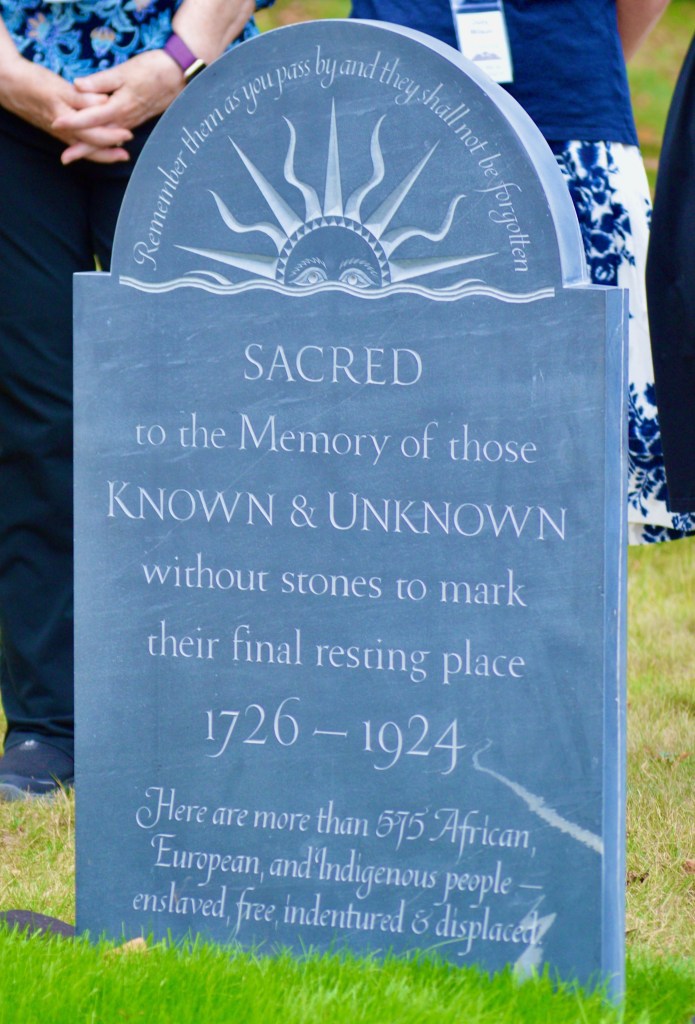
Memorial placed in the OBG
In autumn the Old Burying Ground in Stoneham changes its colors. Yellow and orange leaves fall about the gravestones of the founders of our town. The Goulds, Greens, Holtens and Hays. The Spragues, Stevens, Richardsons and Wrights.
But beyond the cluster of 18th and 19th century stones, there are open areas where no markers disrupt the gentle slope of the earth. Here lie those with no status in early Stoneham. Here are buried the town’s paupers, natives and slaves.
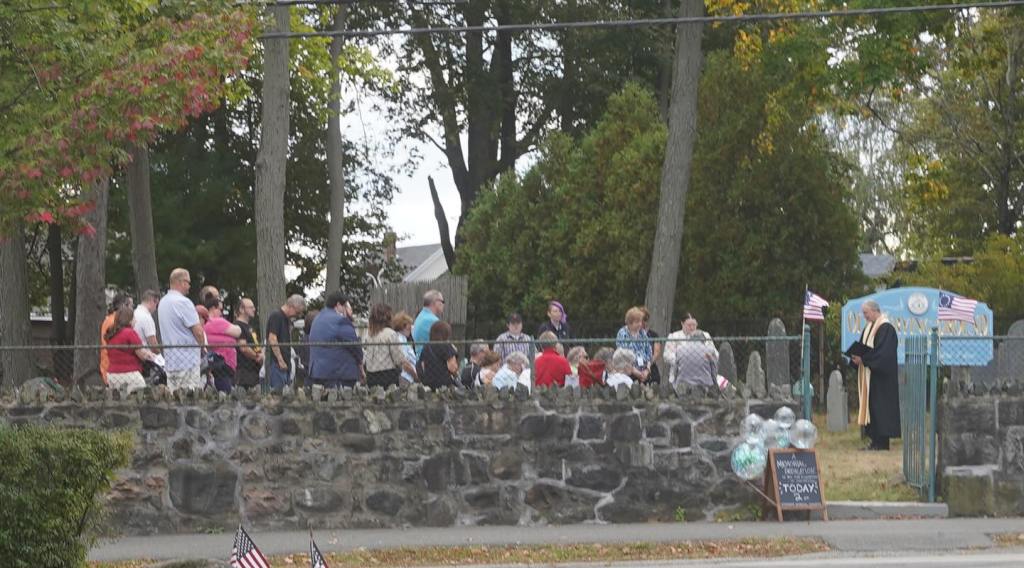
On a recent Saturday, thanks to the Stoneham Historical Commission, Stoneham folk gathered in the Old Burying Ground to remember all those buried in unmarked graves. How many were there? It’s impossible to know, even with radar ground studies. But a scouring of town and church records suggests there were over five hundred.
Who were they, these men and women who, along with our better-off European ancestors, built Stoneham? Who, in the case of slaves, toiled without pay or hope of freedom. Who, in some cases, married, had children and attended church, but were prescribed to the lowest rungs of society?
The first white settlers in Stoneham, then called Charlestown End, arrived in the mid-17th century, about two decades after English colonists led by John Winthrop founded the Massachusetts Bay Colony. Not long after, came the slaves.
The earliest record I could find of slaves in the Stoneham area is in Elbridge Goss’ History of Melrose. It appears in a 1653 order from the General Court, stipulating that a slave owned by Job Lane, named Ebedmeleck, must be punished for “stealing victuals and breaking open a window on the Lord’s day.” He shall “be whipt with five stripes.”
In the century before the American Revolution, at least nine families in Stoneham owned slaves, including the Greens, who settled in the eastern and southeastern area of our town. The Green farm, extending from the Melrose line to Pond Street, would be the home of five generations of the Greens. Forty-two Greens would be buried in the Old Burying Ground.
An inventory of Captain Jonathan Green’s possessions in 1761 includes, along with 3 horses, 6 oxen, 9 cows, and 20 sheep, “2 servants for life.”
Jonathan Green’s name also shows up in the indenture contract binding a 7-year-old girl to the Green family for eleven years. My column of September 11 tells her story.
Indenture in New England was one way of dealing with poor, illegitimate or otherwise destitute children. If they were fortunate, they learned a trade, or, in the case of young women, found a husband after completing their term. Adults were also indentured, often as house servants. In an inventory of the late town minister, James Osgood, is found, along with his other possessions, one Negro woman and one white servant.
Towns also had poor houses, as did Stoneham, although it was customary for officials to “warn out” paupers coming into town, so they would not become a drain on resources.
The earliest mention of an almshouse in Stoneham is a note by Silas Dean that in 1760 town leaders explored working with Reading and Woburn to establish a “work house,” a place for the poor.
The next reference I found is in William B. Stevens’ History of Stoneham, where he records the 1823 purchase of a farm in northeast Stoneham as a place for the poor. As in communities throughout New England, poor farms were funded by towns and cities at public expense. But they were also working homes for the able bodied who could either farm, cook, do laundry, or work at a trade. Here you might find a widow, a disabled or indigent worker, or an orphan.
As Stoneham’s population increased, a larger facility was needed. In 1852 the town purchased 17 acres on Elm Street and began construction of a new Almshouse. Additional acres were later purchased, and the house was enlarged and a shop added where the shoemakers in the home could work. In 1890 the Stoneham Almshouse had 30 residents. Today, it is our Senior Center.
The Old Burying Ground was also the burial place of Native Americans. We know of two because it made the papers. In February of 1813, ruffians murdered a Penobscot couple that had set up camp by Spot Pond. Their names were Nicholas and Sally Crevay. I tell their story in my book, If the Shoe Fits: Stories of Stoneham, Then & Now.
The next time you visit the Old Burying Ground, pause a moment at the beautifully designed memorial placed there by the Historical Commission. It honors the hundreds buried there in unmarked graves, people who lived among us and helped build our town. As we celebrate our Tricentennial, it’s the right thing to do.

 Ben Jacques Stories