The Carpenter and the Cross-Dresser: a Christmas Story

In the darkness before dawn, a man from Georgia is riding in the baggage car of a northbound train. He is exhausted, and to keep awake, he opens the window. Cold air rushes in. Just then the engine whistle sounds, and sticking his head out the window, he sees the flickering lights of Philadelphia. It is Christmas Eve, 1848.

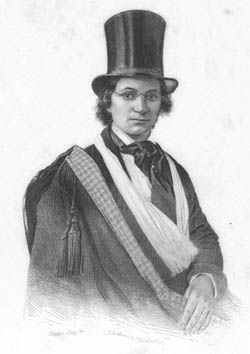
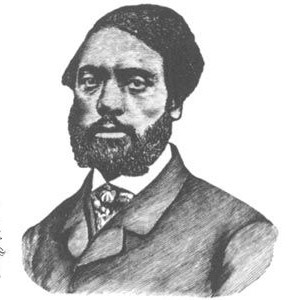
The traveler is a 24-year-old slave named William, on a journey with his master, “Mr. Johnson,” a young gentleman from Macon, traveling north for medical care. But things are not what they seem. In fact, Mr. Johnson is Ellen Craft, a tall, light-skinned African woman, cross-dressed as a plantation owner. And William is not just Mr. Johnson’s slave, he is her husband.

Allowed to marry, Ellen and William have avoided having children, shuddering at the prospect of bearing offspring who might be taken from them and sold. Their desperation has steeled them to dare an escape, despite the horrendous outcome if they are caught.

Born of a white owner and his African slave, Ellen was taken from her mother at age 11 and given as a wedding present. Now a house slave, she has been granted a few days off to visit her family. William, trained as a carpenter and rented out by his owner for wages, has also obtained permission to be absent from work. Growing up, he has seen both his parents and his 14-year-old sister sold away to pay debts.

Two weeks ago William and Ellen spent the night in Ellen’s cabin, planning their escape route. The distance from Macon to a free state is a thousand miles. For the Crafts, attempts on foot are out of the question. Instead, William and Ellen have decided to escape in plain sight, that is, in disguise. Using money saved from jobs on the side, William has been buying pieces of men’s clothing a young gentleman would wear. Ellen, a seamstress, has sewed a fine pair of trousers. She has locked the clothes in a little chest of drawers William made for her. The last thing William bought for his new “master” was a pair of green-tinted spectacles. They will leave on December 21.

The night before, William and Ellen spend the hours talking, asking, what if, and what should we do when? There is a major problem. At every train or customs station, Ellen will be required to sign a register, or to show papers. And she, like her husband, is illiterate.

Ellen has an idea. She will tie up her right arm in a sling, so she will not be asked for her signature. Further, to discourage questioning, she will have bandages with a poultice wrapped around one side of her head.

Just before dawn on Dec. 21, William takes out Ellen’s scissors. Standing behind her like a barber, he cuts her hair. Then he helps her into her gentleman’s clothes, complete with top hat. At the door they pause. No one is in the street. They slip out “quiet as moonlight on the water,” William will later recall, and they separate. They meet at the train station.

Their escape is laden with peril. On each leg there is a new challenge. Settling into her seat on the train to Savannah, Ellen is shocked to see a friend of her owner’s, who would know her, take a seat next to her. Feigning illness, she avoids his inquiries and is undetected.

From the Massachusetts Histoical Society. Not to be reproduced without permission.

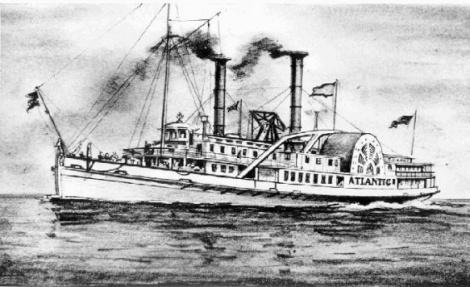
Arriving in Savannah, Mr. Johnson and his slave take an omnibus to the harbor, where they purchase tickets on a steamer bound for Charleston, South Carolina. Going aboard, William helps his master settle into his berth, then goes on deck to find a place to sleep. There are no accommodations for slaves, so he finds a warm place near the funnel on sacks of cotton, resting there until morning.

The next day, as William patiently waits on Mr. Johnson, a vulgar slave trader tries to purchase him from his master. Then a military officer scolds Mr. Johnson for speaking kindly to his slave. “Nothing spoils a slave so soon as saying, ‘Thank you,’” he warns him.

In Charleston, Mr. Johnson and his slave check into a hotel. Here the proprietor is solicitous of the young gentleman’s needs. While his master is served in the dining room, Williams eats off a broken plate in the kitchen.

The next morning, as they prepare to board a steamer to Wilmington, North Carolina, the station officer demands that Mr. Johnson sign the register, despite his apparent injury. Finally, the officer who has come on the same ship from Savannah steps up and vouches for the invalid gentleman. Overhearing this, the ship’s captain signs the register, “Mr. Johnson and slave.”

The next morning William and Ellen Craft arrive in Wilmington, and from there board a train for Richmond, riding in a section reserved for families and invalids. Here they are joined by an older man and two daughters, who insist on making Mr. Johnson as comfortable as possible, and share advice on remedies for rheumatism. “Papa,” one of the daughters says, “Mr. Johnson seems to be a fine gentleman.”

After the train stops in Richmond, the friendly father and daughters disembark, and a stout, elderly lady takes a seat beside the disguised Ellen. Glancing out the window, she sees William approaching on the platform and cries out, “Bless my soul, there goes my nigger, Ned.”

“No, that’s my boy,” Mr. Johnson replies. When William arrives, the lady confesses she was mistaken, then launches into a diatribe against her run-away slave, and all the slaves she owns. She plans to sell them away to New Orleans as soon as she can.

At Fredericksburg, the Crafts again board a steamer, this time to Washington, D. C. Once in the nation’s capital, they go directly to the train station and board a train for Baltimore.

When the train pulls into Baltimore, it is Saturday evening, Christmas Eve. Ellen and William are exhausted and their nerves frayed. They have expected detection at every step. For three days and nights they have had almost no sleep.

Stepping warily onto the station platform, Mr. Johnson and his slave go to the ticket office and purchase tickets for the final leg of their journey, the night train to Philadelphia.

But something goes wrong. Maryland is still a slave state, and it is illegal for any white man to take his slave into Pennsylvania, a free state, without authorization. After settling Ellen in her carriage, William returns to the platform, but is accosted by the station officer, who forbids him to board.

Returning to the station office, crowded with late-evening travelers, Mr. Johnson demands to know why he, a respected gentleman needing medical care, cannot take his faithful slave with him on the train to Philadelphia.

Ellen’s insistence turns to pleading, but to no avail. Have they come so far, only to be arrested as fugitives? They know well the fate that awaits captured run-away slaves. William has seen them attacked by dogs, whipped, tortured or killed as an example to others. Even if they survive, they will be forever separated, assigned to the hardest forms of labor.

As they wait in agonizing suspense, the train whistle sounds. Just then the train conductor enters the room and calls the all-aboard. Then, as if only by Providence, the station officer relents. Seeing how the young gentleman is in such poor condition, and it is Christmas Eve, he gives permission for the two to pass.

As quickly as possible, William settles Ellen into her carriage, then hops into the baggage car where he must ride. Slowly, in the early darkness, the engine picks up steam and the train pulls out of Baltimore station.

It is now almost five in the morning, and the weary fugitive with his head out the window gazes with fascination at the twinkling lights ahead of him. In the cold wind, tears are spreading on his cheeks, and something is happening he can hardly explain. His body has suddenly become lighter.

With a great hissing of steam, the train comes to a stop in Philadelphia station. William and Ellen wait until all the other passengers have disembarked, then William calls for a “fly,” a horse-drawn taxi, and hands the driver the address of a boarding house he has been told is run by an abolitionist. Here they will find refuge and support for their continued journey north.

Inside the carriage, Ellen leans her head on William’s shoulder and bursts into tears. It is Christmas Day. They are free.

Afterword: After boarding with a Quaker family outside Philadelphia, William and Ellen Craft make their way to Boston, where they are welcomed by the abolitionist community of free blacks and white allies. Here William works as a cabinet maker and Ellen as a seamstress until 1850, when the Fugitive Slave Act imperils their freedom and they flee to Nova Scotia, then England. Over the next 15 years they work, study, lecture and raise a family of four boys and one girl. After the Civil War, they return to Georgia and open a school for the children of former slaves. This retelling of their story is based on their book, published in London in 1860, titled “One Thousand Miles to Freedom.”

— Ben Jacques

In Graves Unmarked

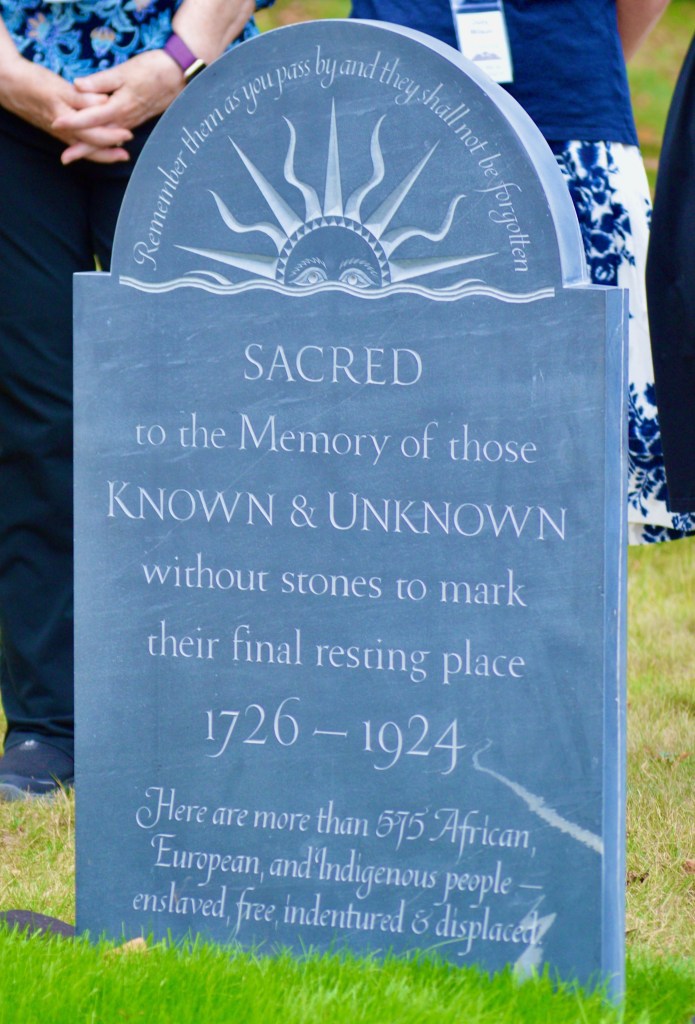
Memorial placed in the OBG

In autumn the Old Burying Ground in Stoneham changes its colors. Yellow and orange leaves fall about the gravestones of the founders of our town. The Goulds, Greens, Holtens and Hays. The Spragues, Stevens, Richardsons and Wrights.

But beyond the cluster of 18th and 19th century stones, there are open areas where no markers disrupt the gentle slope of the earth. Here lie those with no status in early Stoneham. Here are buried the town’s paupers, natives and slaves.

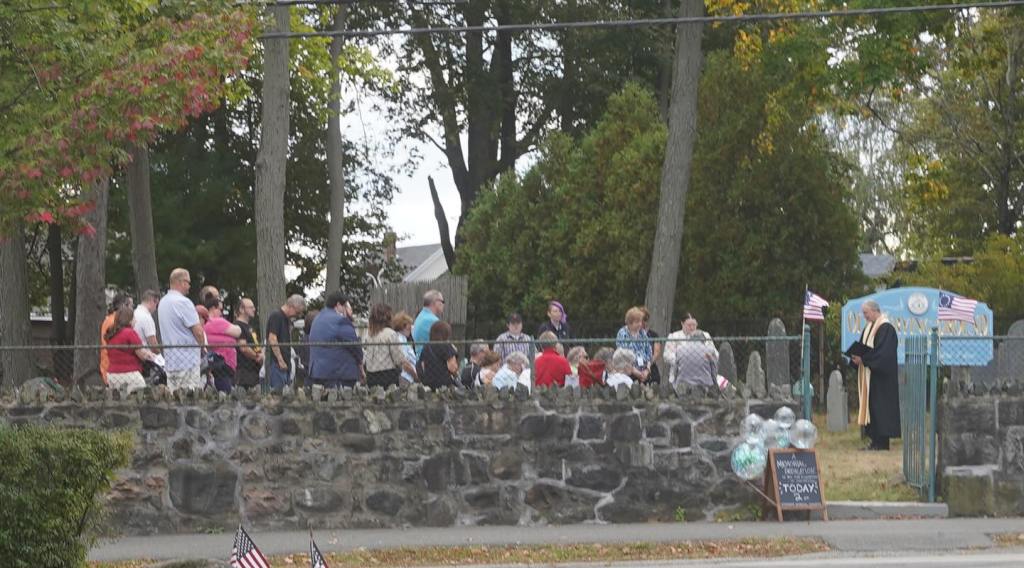
On a recent Saturday, thanks to the Stoneham Historical Commission, Stoneham folk gathered  in the Old Burying Ground to remember all those buried in unmarked graves. How many were there? It’s impossible to know, even with radar ground studies. But a scouring of town and church records suggests there were over five hundred.

Who were they, these men and women who, along with our better-off European ancestors, built Stoneham? Who, in the case of slaves, toiled without pay or hope of freedom. Who, in some cases, married, had children and attended church, but were prescribed to the lowest rungs of society?

The first white settlers in Stoneham, then called Charlestown End, arrived in the mid-17th century, about two decades after English colonists led by John Winthrop founded the Massachusetts Bay Colony. Not long after, came the slaves.

The earliest record I could find of slaves in the Stoneham area is in Elbridge Goss’ History of Melrose. It appears in a 1653 order from the General Court, stipulating that a slave owned by Job Lane, named Ebedmeleck, must be punished for “stealing victuals and breaking open a window on the Lord’s day.” He shall “be whipt with five stripes.”

In the century before the American Revolution, at least nine families in Stoneham owned slaves, including the Greens, who settled in the eastern and southeastern area of our town. The Green farm, extending from the Melrose line to Pond Street, would be the home of five generations of the Greens. Forty-two Greens would be buried in the Old Burying Ground.

An inventory of Captain Jonathan Green’s possessions in 1761 includes, along with 3 horses, 6 oxen, 9 cows, and 20 sheep, “2 servants for life.”

Jonathan Green’s name also shows up in the indenture contract binding a 7-year-old girl to the Green family for eleven years. My column of September 11 tells her story.

The Rev. Ken McGarry offers dedication prayer for all those buried in unmarked graves in the Old Burying Ground in Stoneham.

Indenture in New England was one way of dealing with poor, illegitimate or otherwise destitute children. If they were fortunate, they learned a trade, or, in the case of young women, found a husband after completing their term. Adults were also indentured, often as house servants.  In an inventory of the late town minister, James Osgood, is found, along with his other possessions, one Negro woman and one white servant.

Towns also had poor houses, as did Stoneham, although it was customary for officials to “warn out” paupers coming into town, so they would not become a drain on resources.

The earliest mention of an almshouse in Stoneham is a note by Silas Dean that in 1760 town leaders explored working with Reading and Woburn to establish a “work house,” a place for the poor.

The next reference I found is in William B. Stevens’ History of Stoneham, where he records the 1823 purchase of a farm in northeast Stoneham as a place for the poor. As in communities throughout New England, poor farms were funded by towns and cities at public expense. But they were also working homes for the able bodied who could either farm, cook, do laundry, or work at a trade. Here you might find a widow, a disabled or indigent worker, or an orphan.

As Stoneham’s population increased, a larger facility was needed. In 1852 the town purchased 17 acres on Elm Street and began construction of a new Almshouse. Additional acres were later purchased, and the house was enlarged and a shop added where the shoemakers in the home could work. In 1890 the Stoneham Almshouse had 30 residents. Today, it is our Senior Center.

The Old Burying Ground was also the burial place of Native Americans. We know of two because it made the papers. In February of 1813, ruffians murdered a Penobscot couple that had set up camp by Spot Pond. Their names were Nicholas and Sally Crevay. I tell their story in my book, If the Shoe Fits: Stories  of Stoneham, Then & Now.

The next time you visit the Old Burying Ground, pause a moment at the beautifully designed memorial placed there by the Historical Commission. It honors the hundreds buried there in unmarked graves, people who lived among us and helped build our town. As we celebrate our Tricentennial, it’s the right thing to do.

Slavery, the Smithsonian and Stoneham

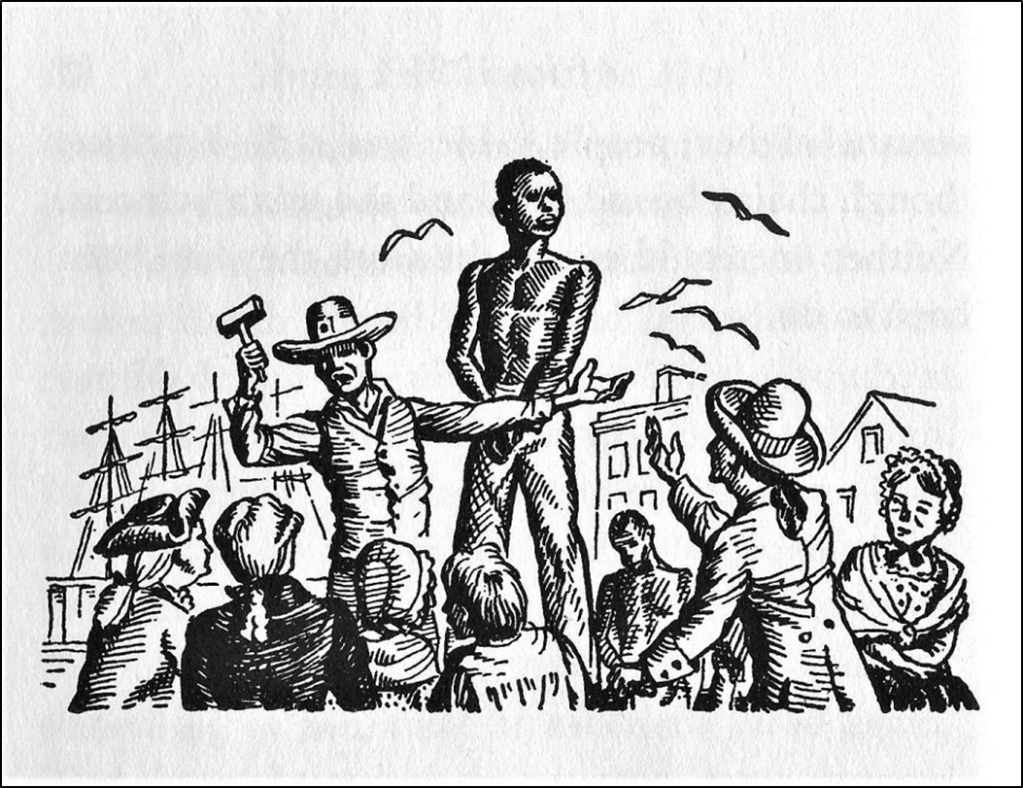
African slaves first arrive in Boston in 1638

Our President is attacking the Smithsonian for its portrayal of slavery. He wants exhibits that show the horrors of slavery taken down. We don’t want our children to get the wrong idea.

It reminds me of comments I heard in the ‘60s. Comments like, most slave owners treated their slaves like family. Or, slaves benefited from slavery because they could learn a trade—a viewpoint recently written into the Florida public schools curriculum.

Which brings me to a document that surfaced this summer in the Stoneham Public Library titled “A History of the Black in Stoneham.” Written in 1969, it was published in the Stoneham Independent.

Disregarding the awkward reference to “the Black,” the reader is left with the impression that slavery was not so bad.

The article covers three periods, Colonial, pre-Civil War, and modern, and provides much good information. But it starts to break down when it compares slavery to indentured servitude, implying little difference. The authors failed to distinguish between the contractual—and finite–obligations of the indentured person and the ownership in perpetuity of slaves and their offspring. In other words, barring exceptional actions by their owners, enslaved men, women and children labored with no rights and no expectation of freedom. They were chattel.

That hopelessness is expressed in the will of one slave owner: “I bequeath unto my son … one negro woman named Fanny and her children now in his possession and one Negro man named Harry and all their increase to him and his heirs forever.”

A few of the article’s statements about enslaved people in Stoneham can only be described as absurd, like this one:  “They were all shoemakers and they laid stone walls, but none was exploited!” And another: “Conditions must have been good because free blacks settled here.”

As we celebrate three hundred years of our history, it’s important to understand the role slavery played in Stoneham. It’s important to know that apart from how individuals were treated and the degree of physical trauma or deprivation they endured, they would have suffered deep and lasting psychological wounds.

Some basic facts. From the colonial period, we have records of some three dozen enslaved men, women and children in Stoneham. Named and unnamed, they show up in church and town records, wills and inventories. Like a “Negro woman and her children” mentioned in Daniel Green’s will. Like the 8-year-old “Mulatto Negro” purchased by James Hay in 1744.

Like “a Negro named Cato, the son of Simon, a Negro servant of Deacon Green,” or a maid named Dinah, owned by the school teacher William Toler.

Like a woman named Phebe, purchased that same year for 75 British pounds by the Rev. James Osgood, and listed along with his house furnishings after his death as simply, “a Negro Woman—70 £.”

Like Jack Thare, 40, “a servant of Joseph Bryant, Jr.,” one of six free or enslaved Black men from Stoneham who fought at Bunker Hill. When Jack failed to return from his enlistment, his master posted a fugitive want ad. Here’s what it said:

Ran away from the subscriber on the 24th of February, a Negro fellow, named Jack, of a — stature, has lost his upper teeth; had on when he went away, a blue coat, with large white buttons. Whoever will take up said Negro, and convey him to the subscriber in Stoneham, shall have three dollars reward. Joseph Bryant, Jr.

The 1969 article on Blacks in Stoneham was published the year I graduated from college. Our nation was still reeling from the assassination of Martin Luther King, Jr. We were being challenged to examine not only our actions and prejudices, but a long history of subjugation and dehumanization of Black people.

As we celebrate our Tricentennial, let’s look honestly at our history. The value of doing so is that it will affect who we will become. By insisting that we tell the truth about our past, we commit to embracing the full humanity of all those around us.

‘Gimme Shelter’

An “illegal alien” finds a home in Stoneham

I guess you could call him an illegal alien. It was sometime in the 17th century, and a British sailor by the name of Hadley had just jumped ship in Boston and high-tailed it inland, looking for a place to hide. The man who found him was a farmer named Gould, one of the first settlers of our town.

A century later town clerk Silas Dean told the story. Dean, also a longtime church deacon, had an ear for stories, and this is how he told it:

A man by the name of Gould . . . on a certain morning during the first settlement of the town, while at his barn at a very early hour, a man approached him, stark naked, and told him he came over to this country on board a war ship. The night previous he had deserted from the ship, and being fearful that his clothes might retard his escape, or the procuring of them cause some alarm, he left the vessel in a state of nudity.

He also stated to Gould that if he would provide him clothes, and afford him means to keep himself secreted till after the vessel left Boston, he would work for him for a sufficient length of time to satisfy him for all the trouble he might be at. The proposal was agreed to, and by this means Hadley took up his abode in this town, and from him all of that name now living in town descended.

This wasn’t the first time desperate sailors sought refuge in Stoneham. In Colonial times, serving in the British navy was no picnic. “Recruits” were often men seized in taverns or sentenced in court to a grueling life at sea.

Silas Dean tells of another deserter, who hid under the floor in a saw mill in Stoneham. British soldiers sent to find him entered the mill and stamped about on the floor, but never discovered him.

Flash forward to the 1830s and we find Stoneham is again a refuge for runaways, this time, runaway slaves. Here we turn to a history of Stoneham written by Marina Memmo in 2010.  She writes:

The issue of African slavery divided the town in the 1830s, but by 1850, Stoneham had fully embraced the abolitionist cause. Members of the Congregational Church led the reform. In 1838, Deacon Abijah Bryant, Levi D. Smith and 60 others formed the Stoneham branch of the Massachusetts Anti-Slavery Society, and Bryant’s home on Main St. became a “station” on the Underground Railroad. When Congress passed the Fugitive Slave Act of 1850, Rev. William C. Whitcomb expressed his outrage in a sermon that was later published. In it, he urged the people to fight for their enslaved brethren, even if it meant suffering and death.

From a village on the outskirts of Colonial civilization to the present, our suburban town has been a place of refuge and opportunity, a place where men and women have come to plant their fields, open their shops, work in the mills, or simply raise their families. They have come from around the world.

Among those who live or work among us today are more recent immigrants, and some of them are living in fear. Whether they lack proper documentation, or have had their legal status revoked, they, like those before them simply need a safe place to live. They want to know that their children won’t be taken from them, and their children know a parent will be there when they come home from school or camp.

You know the stories. You’ve been watching the news. Being true to our history, being true to our best selves, we must protect the rights and humanity of all who live among us.

Happy Juneteenth, Mr. Cephas

June 19, 2025

Dear Mr. Cephas,

You came north after the Civil War, a Black man from Norfolk, Virginia, looking for a place to work and raise a family. You chose us, Stoneham, Massachusetts, a shoe-factory town of about 3,500 people just north of Boston.

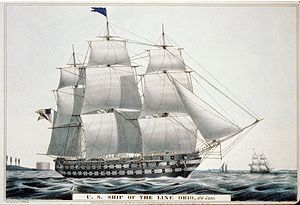
In Virginia, were you enslaved? I could find no record. I did find that the year after the Emancipation Proclamation you enlisted in the Union Navy and spent a year aboard the USS Ohio. The Ohio was used to blockade Confederate ships along the Carolinas and in Europe.

The USS Ohio

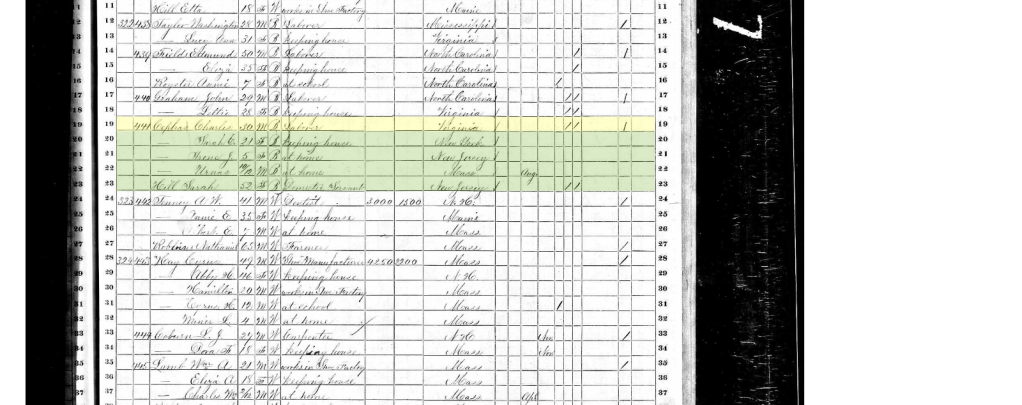
In 1867, two years after the war, you appeared before the Justice of the Peace in Stoneham with your bride, Sarah Cecelia Hill, from Brooklyn. You were 23 and she was 18. With her you would raise five children, three sons and two daughters.

Cabinet card portraits of African Americans from the David V. Tinder Collection of Michigan Photography. Left: Man with Pipe, circa 1887. Right: Woman in Silk Dress, circa 1888. William L. Clements Library

I don’t know if you were tall or short. I do know you were strong. I found this ad in an old Stoneham Independent: “The services of Charles Cephas stone mason can now be had. He tends to laying pipes, sinking wells, digging cesspools and blasting. ‘He thoroughly understands his business.’”

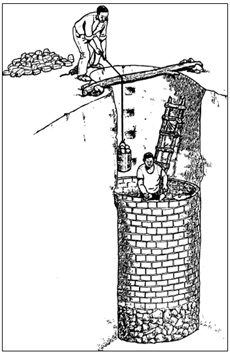
Remember that summer when people were praying for rain, you made the news when you dug and lined a 35-foot-deep well, a record in Woburn.

Business must have been good, because in 1876 you bought a house on Hancock Street, then moved it over to Albion Avenue on the northwest side of town.

Lining a hand-dug well

For you and the few other African American families, Stoneham was a good place to put down roots. But the soil was rocky, in more ways than one. Getting along in an overwhelmingly white community sometimes meant conflict. Sometimes you were the target. In 1878, as reported in the Independent, five men attacked and beat you and your friend Thomas Shanks.

Another time, when you were walking by the Cogan and Sons shoe factory, from the upstairs window, someone dumped a bucket of white wash on your head. Furious, you stormed into the building demanding to know who the culprit was.

You raised such a fuss that the police were called. But instead of helping to find the offender, the police arrested you and charged you with disturbing the peace.

Another time, faced with arrest after a domestic dispute, you threatened to blow up the police station with dynamite you had in your work bag. Appearing in court the next day you stated you couldn’t remember making such a threat, but if you did, you were sorry. You were fined $10.

1870 U. S. Census showing Charles Cephas, his wife, Sarah, his mother-in-law and two children.

Were there good times? Did you and Sarah get together with other families after church for dinner? Your children would have gone to school in town. 

In 1902 the Independent reported the wedding of your son, George, to Carrie Yancey. It was “a very pretty home wedding, performed in the presence of a large company of friends.”

Another time we learn of your son, Ernest, playing hockey on Spot Pond. Earnest would later go to sea, serving in the U.S. Navy during the Spanish American War.

There were painful losses, as the loss of your firstborn son, Charles H. Cephas, age one. Infant deaths were also recorded in 1874 and 1883.

At some point the stresses of life must have crossed over to your marriage. In 1895, after 28 years, your wife petitioned the Middlesex Court for divorce, and it was granted.

Sometime after this, you moved to Chelsea and started working as a stone mason at the Charleston Navy Yard. I couldn’t find any more about you until 1908, when I found this in the Stoneham Independent:

Charles Cephas, colored, passed away Wednesday evening of last week, at the Chelsea Marine hospital, as the result of injuries received by being assaulted as he was coming out of the Charlestown Navy Yard.

The reporter speculated that your killers must have been after your pension money.

Although there was no mention in the Boston papers, I did find a copy of the coroner’s report. It stated the cause of death as “acute fibrinous pneumonia consequent on hemorrhage and laceration of the brain sustained under circumstances unknown, probably those of an accidental fall.” Accidental fall? Really?

After a funeral in Chelsea, they brought you back to Stoneham for burial in the Civil War military section. Was there an honor guard? On Memorial Day I stopped by Lindenwood to pay my respects.

Sometimes I wonder what you would make of our town today. Of our nation. Some things are better. Some not.

Charles Cephas stone in Lindenwood Cemetery in Stoneham

There’s so much that would amaze you. So many stories of African Americans who paved the way in education, music, science, law enforcement, athletics, and business, not only on the national stage, but in our own town, some of them your descendants.

If I tell you about the achievements, however, I also have to mention the set-backs. I have to tell you about George Floyd.

But here’s something to celebrate. Did you know we now celebrate Juneteenth, the date in 1865 when enslaved folk in Texas finally found out they were free?

Mr. Cephas, when I think of you, I think of a man digging wells so families can have water. I think of a stone mason, his hands rough with callouses. I think of a man who had a temper, but who wanted, above all, a safe place to live, work and raise a family. Who deserved more respect than he got.

Happy Juneteenth, Mr. Cephas.

Ben Jacques

Stoneham

The Story of James Osgood

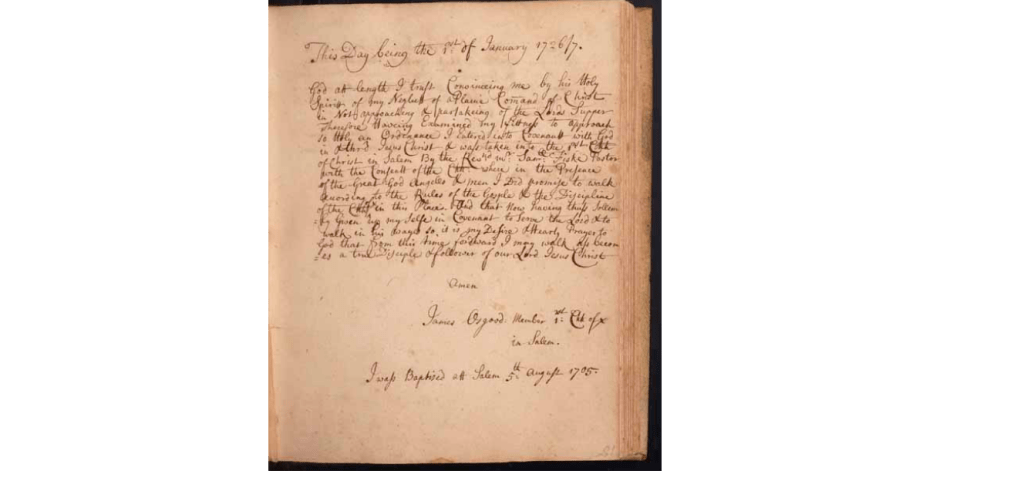
From James Osgood’s Diary, 1727

Stoneham’s first employee was a “reverend”

As we celebrate our town’s 300th birthday, reflecting on our founding in 1725, you may have wondered, who was our first employee?

Well, it seems we were rather selective, because the first person we hired was a graduate of Harvard. But before I tell you who it was, here’s some historical context.

In 1725, as we broke away from Charlestown, we were just a village ten miles north of Boston in a colony called Massachusetts Bay. Massachusetts Bay was founded in 1630 by English Puritans led by John Winthrop, who became its first governor.

The Puritans, who had separated from the Church of England, were a serious lot. They based their customs and laws on English Common Law and the Bible, especially the Old Testament.

They also believed that church and state should function as one, and that’s why, as stated in the founding document, the town was required to find, install and support a minister. That person would become the first paid employee of the Town of Stoneham.

That person was James Osgood and he came from Salem. When the words “Puritan” and “Salem” are mentioned in the same breath, it is not unnatural to think of witchcraft, and the trials and executions of the late 17th century. For the Osgood family, some of whom lived in Andover, the connection was personal. In 1692 James’ paternal grandmother, Mary Clements Osgood was accused of being a witch.

Mary Osgood’s story is too long to tell here. Suffice it to say, she confessed in 1692, under considerable pressure, of making a pact with the Devil and afflicting several other women and was subsequently imprisoned in Salem. But under examination by the Rev. Increase Mather, who had been sent to Salem to reign in the witchcraft hysteria, she recanted her confession and said she had made it all up. You can read about it in the report made by Governor Thomas Hutchinson. Meanwhile, over 50 citizens of Andover had petitioned for her release, and she was freed.

One of Mary’s sons was Peter Osgood, a tanner, who did so well that he sent two sons to Harvard, the younger one being James. One other thing I should mention is that the Osgood family owned slaves. Owning slaves was not common in colonial Massachusetts, but neither was it exceptional. For an enterprising farmer, seaman, merchant or tradesman, owning a slave could make the difference between just getting by and prospering. A 1754 inventory of enslaved persons age 16 and over in Salem listed 83. There were 989 in Boston. Eight in Stoneham.

Growing up in Salem, James Osgood followed his brother to Harvard. From what we know, he did well. At one point, however, he appears to have gotten into trouble. In a biographical sketch of Harvard graduates, we read that “James found himself caught up in the student riot of 1722 at Harvard, managing to break glass to the value of 11 shillings.” My guess is, he smashed a window.

But time can make a difference, as the parents of any college student know. By the time James graduated with a master’s degree, he was described as “one of the soberest and quietest members of his class.”

Looking for Employment

When James Osgood graduated from Harvard in 1727, he must have wondered what the future would hold. The youngest son of a Salem tanner and church deacon, he had earned a master’s degree, placing him into the upper echelon of Puritan society.

A few months before his graduation, there had been a turning point. An entry in his diary from this period stands out. It’s dated Jan. 1, 1727. It seems James had stopped taking Communion in church. Had he, a college don studying Greek and Latin, entertained doubts? Had he grown skeptical?

For whatever reason, as he now wrote, he repented his neglect of the sacrament and promised to “walk according to the Rules of the Gosple & the Discipline of the Church.” From now on, he covenanted, he would “walk as becomes a true Disciple & follower of our Lord Jesus Christ.”

After graduation, Osgood left Cambridge and returned to Salem, where he began looking for employment. One of his first jobs was teaching school in Salisbury, for which, records show, he received 30 pounds. He was also called on to fill the pulpit as a guest preacher in nearby parishes, giving him valuable experience.

In the fall of 1728 the young theologian received an invitation from the newly incorporated town of Stoneham, which was searching for its first minister. To audition for the job, Mr. Osgood would have to preach in front of the whole town, around 65 families, and get the approval of town voters, all 13 of them, men only. Other candidates would also be invited.

Meanwhile, in Stoneham “it was voted in town meeting assembled to set apart a day for prayer to ask God’s direction in the choice of a minister” (William B. Stevens, The History of Stoneham).

James Osgood was only 23 when he came down from Salem, probably on horseback, to audition for the job. What must have gone through his mind as he entered the simple structure of the Meeting House, erected by the townspeople just three years earlier, and stood before the small congregation. We can only imagine his looks and manner, and the sermon to follow. We can assume he made a powerful impression, because he got the job.

Was it a hard choice for him to make? I wonder when I read that it took him until April to formally accept. Nevertheless a few months later, on Sept. 10, 1729, he was ordained and installed in the Meeting House as Stoneham’s first minister.

All things considered, it was not a bad job. The town voted him an annual salary of 110 British pounds (about $22,000 today). It also gave him 172 pounds ($38,000) “for a settlement,” and agreed to supply him with ten cords of wood for heating and cooking.

At first boarding at the home of Peter Hay, a prominent town citizen, the young bachelor set about ministering to the families of the parish. Besides preaching two or more sermons a week, his duties included teaching, baptizing, counseling and consoling. He conducted weddings and funerals. And he began plans for a parsonage. As Stevens records: “Mr. Osgood purchased land and built him a house which was a fine one for those times.”

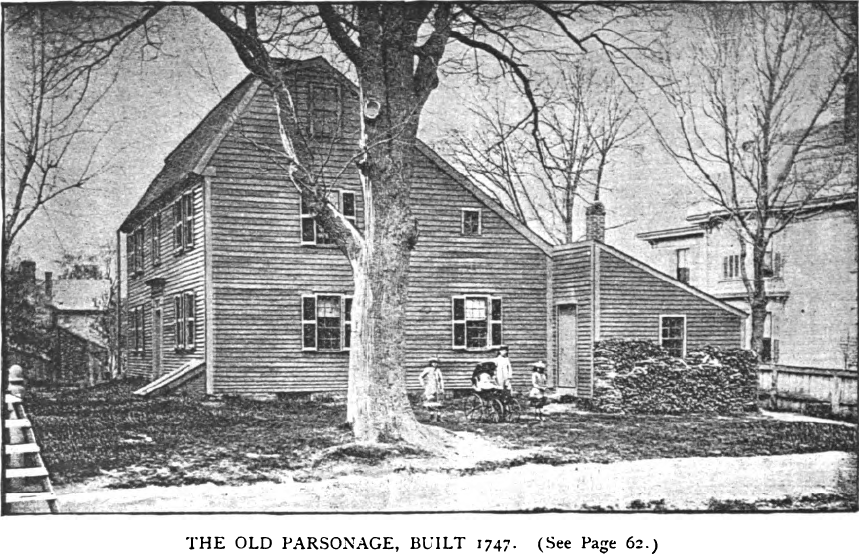
A photograph of the parsonage, taken in the 19th century, shows a large house in the traditional saltbox style. Nine windows face the street, and a storage shed is attached at the rear. Cord wood is stacked on the side, and children play in the yard.

We don’t know when the house was completed, but it may have been before 1735, when Osgood, now 30, returned from Killingly, Connecticut, with his new bride. Her name was Sarah Fiske and she was 17. In Stoneham, the couple would have two children, Abigail and John.

From William B. Stevens’ History of Stoneham, 1891.

The Reverend’s Account Books

On August 6, 1729, James Osgood started recording his expenses in two books, preserved in the Congregational Library in Boston. These daily accounts give us clues into the 24-year-old Harvard graduate from Salem, ordained in October as Stoneham’s first minister.

The entries, made in his own hand, are various and include lists, like what books he was reading, the founding of Puritan churches in Massachusetts Bay, and commentary on historical and theological matters. They also record payments received, like one of 56 pounds from Daniel Gould, town treasurer, half of his yearly salary.

Another shows Osgood paying 49 pounds, then another 50, to “Mr. Ebenezer Phillips, yeoman,” for the purchase of land. Below that is payment made to Francis Kittridge–12 pounds, 16 shillings and 6 pence—for 1,000 board feet of lumber for construction of his house.

Most of Osgood’s purchases, however, are for daily necessities, such as 16 shillings paid to David Gould for a bushel of corn. There are also payments for rye, sugar, molasses, tea, salt, beef, veal, and fish. Also, cotton, wool, linen and eiderdown, as well as kettles, tallow and other houseware items. And there are regular purchases of rum.

We also see a stream of payments for workmen building the parsonage. Others for plowing, hauling manure, planting and mowing. There are purchases of animals, including a pig. A payment is made to have Osgood’s horse shod.

Then there are payments for services rendered, like weaving and shoemaking. In one entry, the minister pays Simon Barjona, a cordwainer, one pound for a pair of shoes.

After his marriage to Sarah and the arrival of children, we see purchases that reflect his family, such as a handkerchief, silk, a looking glass and a pair of stockings for Sarah. Also a buckle and a new hat for Johnny, and a frock for his daughter, whom he calls Nabbe.

We find regular payments made to Abigail, the household maid. To employ a household maid must have made a huge difference to the family, especially for Sarah, whose duties as the minister’s wife would have gone beyond household management and raising children. She would have been called on to support her husband’s ministry in various ways, counseling the women and children, visiting the poor and the sick.

In October of 1743, however, payments to the maid cease. From November through January, no further payments are found. For whatever reason, Abigail is no longer employed. It appears the Osgood family is without household support.

In February that is about to change in a way that we, looking back three centuries later, find disturbing. On Feb. 21, 1744, Osgood writes: “Paid away for a Negro woman named (Fibbe) to Mr. Thomas Bancroft, 20 pounds.”

Osgood’s payment of 20 pounds was just a down payment. In March he will make a second payment of 12 pounds. Then in April, as he notes in his account book, “paid for my Negro woman in full, 43 pounds”—bringing the total to 75 pounds.

Reading this, I am stunned. Yes, I’ve known that many prominent families in colonial New England owned slaves. But this feels personal. It is my church, the First Congregational Church, founded in 1729, and in my town, which this year celebrates its 300th Birthday.

How could the minister of my church be a slave owner? Next week, I will conclude my story of the Rev. James Osgood. I’ll tell of his sudden demise and what happened to his family and his enslaved servant, Phebe.

Page 26 of James Osgood’s Account Book for the year 1744.

A Slave in the Parsonage

When James Osgood in 1744 brought home a Negro woman he had purchased, few in town would have questioned his actions or his ethics. Slavery had sprung up in the Massachusetts Bay Colony soon after its founding in 1630. English colonists had initially enslaved natives captured in battle, but found them too difficult to manage.

In 1637 the slave ship Desire, built in Marblehead, left for the Caribbean with 17 Pequot natives, including 15 children, to be sold to Caribbean plantations. Eight months later, the ship sailed into Boston with a cargo of cotton, tobacco and slaves from Africa.

In 1641 the Puritan community published The Body of Liberties, which spelled out rights and obligations of its members. Article 91 sanctioned the owning of slaves.

In Stoneham, as throughout New England, having slaves signaled a family’s success and status. Among owners were merchants, tradesmen, land owners and ship captains. There were also ministers, like the eminent Puritan minister, Cotton Mather, in Boston. Or like James Osgood.

The minister’s own family, his father, Peter Osgood, and uncles, owned slaves in Salem and Andover. When James Osgood arrived in Stoneham, he first boarded with Captain Peter Hays, who kept two slaves. At one time or another, at least eight Stoneham families owned slaves.

Osgood believed, as did Cotton Mather, that it was the duty of slave masters not only to treat their slaves kindly, but to Christianize them, thus to save their souls. In Stoneham, writes Stevens, “The colored people, though in a state of slavery, were admitted as brethren and sisters to the church.” Welcome in the Meeting House, they were restricted, however, to sitting in the balcony.

Church records show that Osgood “received” several slaves into full communion. Among them were “Amos, Negro servant of Deacon Green” and “Pomfrey, Negro servant of Mr. Sprague.” The minister also officiated at their weddings. In 1738 he blessed the marriage of Mingo and Moll, “servants” of Peter Hay, Jr.,” and in 1743 of “Obadiah How, Negro servant of Mr. Souther, married to Priscilla.”

The Puritans in Massachusetts had rejected the rigid hierarchy of the Church of England and instituted congregational reforms that gave the common person more say in church and society. Yet they continued to see themselves as part of the Great Chain of Being, which described their place in the natural order. At the bottom of this chain were natives and Africans.

So it was that Phebe, the woman Osgood had purchased for 75 pounds, was expected to serve the family in perpetuity. Regardless of the degree of kindness shown her, she must labor with no pay and no hope of freedom.

What would eventually happen to Phebe, however, the Stoneham minister would never know, because on March 2, 1745, a few months shy of his 40th birthday, the Rev. James Osgood suffered a fatal stroke.

James Osgood had served the people of Stoneham for 16 years, and his sudden demise must have shocked the town. William B. Stevens writes: “His body was carried to the Meeting House and there attended to grave by several ministers and a great Concourse of People.” He was laid to rest in the Old Burying Ground on Pleasant Street.

For the minister’s family, the loss was enormous. John, his son, was only 6, and his sister, Abigail, 9. Details about the family after his death are few. John Osgood grew up in Stoneham and married Lucy Torrey, and they had one daughter. He then married Jane Libby on January 2, 1781. He died in 1792 in Boston at the age of 53.

Abigail, their daughter, at age 15 married Joseph Bryant, Jr, in Stoneham. He would later fight in the Revolutionary War. They had five children. Abigail lived a long life, 89 years, and died in 1826 in Stoneham.

Sarah, town records show, remarried in 1752 to a Captain Ralph Hart of Boston. She, too, lived into the next century. When she died in 1801 at age 83, she was buried beside her first husband in the Old Burying Ground. In his Brief History of the Town of Stoneham, Silas Dean described her as “a very amiable and excellent person.”

As to what happened to Phebe, the Osgood’s household slave, I found two pieces of information. The first is her mention in the inventory of the Osgood’s belongings, made after his death. The inventory list is chilling, because tucked between items like “A looking Glass, 2 oval Tables, a Desk and Tankard board” and “A bed and furniture, a low Chest with Draws & a Table” is the entry: “A Negroe Woman, 70 pounds,” valued at five pounds less than her original purchase price.

The second is from Stoneham vital records for 1747, two years later. It noted the marriage of “Phebe, servant of Mrs. Sarah Osgood, and Quecoo, servant of Peter Hay, 3d, Mar. 12, 1747.” I could find no further information.

As we look back to our founding, we view it from afar. When Reverend Osgood arrived from Salem, Stoneham had just incorporated as a Puritan community in a British Colony. Yet it was in those times that our town was forged. What followed was earth shaking, the Revolutionary War and the creation of a republic inspired by the Declaration of Independence. Soon after, in 1780, came the Massachusetts Constitution. Authored by John Adams, it became the model for the U.S. Constitution. It was also the basis for the Massachusetts Supreme Judicial Court ruling in 1783 that ended slavery in the Commonwealth. In the first federal census of 1790, there were no enslaved persons in Stoneham.

For history to have value for us, we must do our best to tell it with honesty. We must acknowledge its complexity. This shouldn’t deter us, however, from paying tribute to the founders of Stoneham, including our first minister and first employee, the Rev. James Osgood. We also pay tribute to all those, enslaved or free, who helped build our town.

What would he say today?

A fugitive, he got off the boat in Newport and continued by coach to New Bedford. There, in the whaling seaport founded by Quakers, he found safety. He also found work.

“There was no work too hard—none too dirty,” he would write. “I was ready to saw wood, shovel coal, carry wood, sweep the chimney, or roll oil casks.”

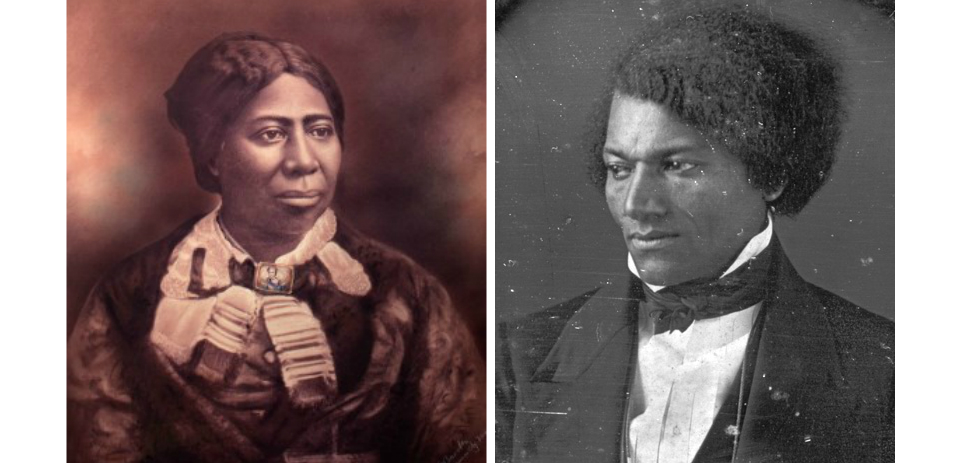
His name was Frederick Douglass and for first time in his life, he was working for himself and his newly married wife, Anna. “It was the first work,” he wrote, “the reward of which was to be entirely my own. There was no Master Hugh standing ready, the moment I earned the money, to rob me of it.”

The year was 1838. Dressed as a sailor and using false papers, the young man (he was just 20) had fled Baltimore. Having found a haven in New Bedford, he was amazed at its wealth and absence of poverty. “I had somehow imbibed the opinion that, in the absence of slaves, there could be no wealth, and very little refinement.”

He continued: “Everything looked clean, new, and beautiful. I saw few or no dilapidated houses, with poverty-stricken inmates; no half-naked children and barefooted women, such as I had been accustomed to see.”

Instead, Douglass found a city bustling with commerce and men and women eagerly engaged in their work. “I saw no whipping of men; but all seemed to go smoothly on. Every man appeared to understand his work, and went at it with a sober, yet cheerful earnestness….”

Most surprising was the condition of fellow fugitives and free Blacks. “I found many, who had not been seven years out of their chains, living in finer houses, and evidently enjoying more of the comforts of life, than the average of slaveholders in Maryland.”

His friends, Nathan and Polly Johnson, who had taken him and Anna into their home, “lived in a neater house; dined at a better table; took, paid for, and read, more newspapers; better understood the moral, religious, and political character of the nation,—than nine tenths of the slaveholders in Talbot county Maryland. Yet Mr. Johnson was a working man. His hands were hardened by toil, and not his alone, but those also of Mrs. Johnson.”

Even though New Bedford had become a refuge for escaped slaves, there was still racial prejudice. In Baltimore, Douglass had worked as a ship’s caulker, but was refused work with the white caulkers here, work which would have earned him twice his laborer’s wage.

Still, he and his wife made a living and found their own apartment. They attended church and socialized with others in the community. As a boy he had been taught to read by the sympathetic wife of his owner. Now he scoured the pages of The Liberator, published in Boston by William Lloyd Garrison.

Three years later, at an abolitionist meeting on Nantucket, he was asked to tell his own story, and the rest is history. He went on to become perhaps the most eloquent champion of the anti-slavery cause, lecturing, editing, writing and speaking throughout the Northern States, England and Ireland. A friend of all those yearning for freedom, he was an advocate for women’s rights as well.

Remembering Frederick Douglass is fitting as we celebrate Black History Month. But it’s also important given the threats to the human rights of millions of those in our nation today threatened with deportation. Like him, they have sought refuge among us. Like him, they will work at anything to provide for their families. Like him, they have stories to tell.

As the Trump administration carries out raids, as it dehumanizes men, women and children because of their immigration status or gender identity, I can’t help wondering what Frederick Douglass what would have to say.

Anna and Frederick Douglass

Happy Juneteenth!

As we celebrate our newest national holiday, the day enslaved folk in Texas finally learned of their freedom, we recall our own history of slavery and abolition:

1754—A census of enslaved people in Massachusetts that year shows there were eight slaves above the age of 16 in Stoneham. They were among at least three dozen slaves in our town during the Colonial period—men like Cato, belonging to Deacon Green, and women like Dinah, a slave of the teacher James Toler, “who waited upon him to the end of his days” (Silas Dean). And they were children, like the unnamed 8-year-old mulatto purchased by Captain Peter Hay in 1744, the same year the Rev. James Osgood paid £75 for a woman named Phebe.

1775—Six Black men from Stoneham, three enslaved and three free, fight in the Battle of Bunker Hill, joining white colonists in the struggle for freedom from Great Britain.

1780—Four years after the Declaration of Independence, Massachusetts voters ratify the Massachusetts Constitution, authored mainly by John Adams.

1781—A slave called Mumbet (Elizabeth Freeman) and another named Brom sue their Sheffield owner for their freedom and win. This and other court cases bring about the eventual freedom of all slaves in Massachusetts based on the Massachusetts Constitution.

1790—The first federal census lists no enslaved people living in Stoneham.

1823—A former slave from Virginia named Randolph is seized in New Bedford. The state Supreme Judicial Court upholds the property rights of his owner, and he is returned to slavery.

1837—After an abolitionist meeting in Stoneham, a fight breaks out in the street, and a Stoneham man, Timothy Wheeler, is knifed and killed. He leaves a wife and four children.

1838-9—Sarah Richardson Gerry leads 27 women in founding the Female Anti-Slavery Society of Stoneham. The men also create a chapter.

1839—Church deacons pass a resolution calling on all ministers of the Gospel to “bear faithful witness against the sin of slavery.”

1850—A thirty-year-old minister of First Congregational Church, the Rev. William Whitcomb, preaches a fiery sermon against the federal Fugitive Slave Act, passed as part of the Compromise of 1850. He calls on his parishioners to aid all fugitives, even at the expense of their property and lives.

1850—Deacon Abijah Bryant’s home on Main Street becomes a station on the Underground Railroad, sheltering fugitive slaves and enabling their safe passage to Canada.

1854—Anthony Burns, a 20-year-old former slave from Virginia is arrested in Boston and brought to trial. Thousands of abolitionists attempt to free Burns from the courthouse, but fail. In a widely reported trial, Burns is convicted and ordered sent back to his owner. Thousands line the streets as Burns is led in shackles to the docks and shipped back to his owner.

1861—Hundreds of Stoneham men join Massachusetts regiments responding to President Lincoln’s call for a voluntary army to defend the Union.

1864—54 Stoneham men die in the War of Rebellion: 11 killed in battle, 9 from wounds, 9 while in Confederate prisons, 25 from disease. These include Col J. Parker Gould, with others buried in Lindenwood Cemetery.

1862—Rev. William Whitcomb, is commissioned as a chaplain in the Union Army. He serves in hospitals in North Carolina until his death from malaria.

Over time we have learned to extend the human rights we hold so dear, those spelled out so eloquently in the Constitution of the Commonwealth of Massachusetts, to everyone, regardless of race, ethnicity, religion or gender. From our Constitution we read:

“All men are born free and equal, and have certain natural, essential, and unalienable rights; among which may be reckoned the right of enjoying and defending their lives and liberties; that of acquiring, possessing, and protecting property; in fine, that of seeking and obtaining their safety and happiness.”

Happy Juneteenth!