When superheroes aren’t enough

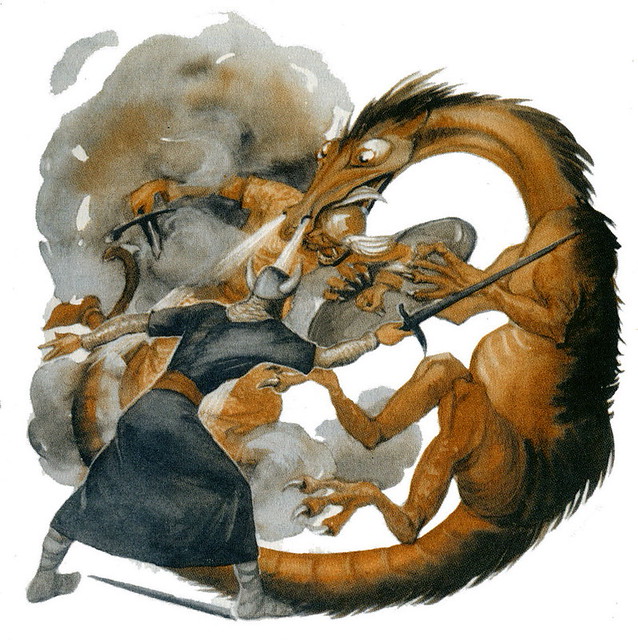
Art by Florence and Margaret Hoopes, from The Wonder Story Books –
They Were Brave and Bold – Beowulf .

Denmark needed a superhero. A treacherous monster named Grendel was savaging them at night, slaughtering their best as they bedded in Heorot, the great hall of the king. Thus the stage was set for Beowulf, a brawny prince who crossed the sea from Geatland to rid the Danes of evil.

The prototype of the Western superhero, Beowulf does what neither King Hrothgar nor his warriors can do. He vanquishes both Grendel and the slayer’s vindictive mother, diving into a black sea, writhing with snakes, to bring an end to oppression.

Yet in the end, fifty years later, neither Beowulf’s strength nor courage can protect the people from the evil destroying their cities. It takes the wisdom of a thane, an underling named Wiglaf, to see that it is not enough to have heroes if the people’s hearts have grown cold.

We know the story as the first great epic in our language, not English as we know it, but Anglo-Saxon. Sung then written down around 900 CE, it was crafted by a descendant of the Angle, Saxon, Jute and Frisian invaders who overwhelmed Celtic Britain in the 5th and 6th centuries. The translation I like best is by the late Irish poet, Seamus Heaney.

A pagan saga with a Judeo-Christian overlay, Beowulf portrays a world in flux. Most modern tellings focus on our hero’s two great victories in Denmark. By the time we get to Beowulf’s last battle, however, things have changed. In several passages, blending Biblical narrative with a pagan’s rumination on the transitory nature of life, the poet reveals a shift in values.

In Beowulf’s world—as today—men seek gold, weapons and treasure. These give them status. With them, kings and queens gain allegiance, reward subjects and build alliances. Treasure shared holds the community together. Treasure hoarded leads to treachery. Hrothgar showers Beowulf with fine gifts: horses, fine armor “and a sword carried high, that was both precious object and token of honour.”

At the same time the king counsels the young warrior to remember he too is mortal. He warns him against vanity and pride, “an element of overweening” that will lull his soul to sleep and expose him to the enemy.

Pride and the lure of treasure surface again in the final act of the play, as Beowulf, now an old king, goes out to battle a “slick-skinned dragon, threatening the night sky with streamers of fire.” Guardian of an ancient underground barrow, the dragon has been burning farms and villages across Geatland, all in revenge for a jeweled cup stolen from its hoard.

Wanting to protect his people, Beowulf is “too proud to line up with a large army against the sky-plague.” He will face the monster alone, confident he will prevail as he did against Grendel and his mother.

It is not to be. In desperate combat, Beowulf is mortally wounded. His famous sword, Naegling, breaks against the dragon’s scales, and the monster’s teeth penetrate his armor. Beowulf slays the dragon, but only with the help of Wiglaf, a young Geat warrior who could not bear to see his king go into battle alone.
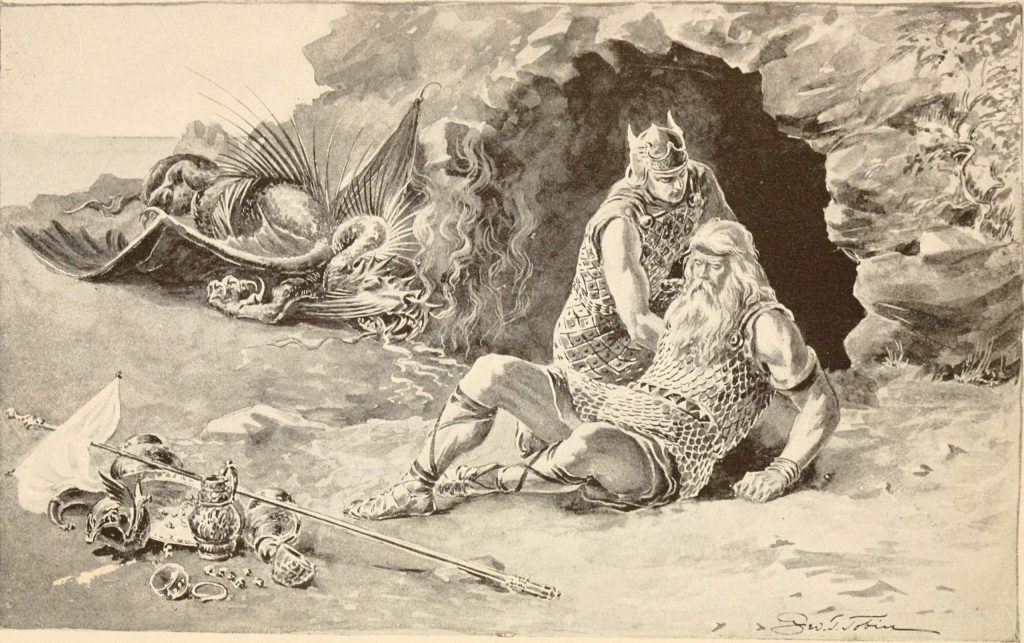
As he is dying. Beowulf asks Wiglaf to gather samples of the dragon’s treasure, so he can feast his eyes on them:

I want to examine
that ancient gold, gaze my fill
on those garnered jewels (2747-9)

But the value of gold, jewels, fine weapons and armor—even the priceless cache found in the dragon’s hoard—is relative.  Nowhere is this better expressed than in what happens next. Instead of using the treasure to enrich the kingdom, the Geats heap it onto Beowulf’s funeral pyre. They bury the rest in a great mound on the headland by the sea.

They let the ground keep that ancestral treasure
gold under gravel, gone to earth
as useless to men now as it ever was (3166-8).

Nearing the end of the epic, we sense a turning from sword power to soul power. Valued most highly now is inner strength, not physical prowess. The enemy are no longer dragons and monsters, but human rivals—Swedes to the north and Franks and Frisians to the south.

At Beowulf’s funeral, there is great sorrow, but also great fear:

A Geat woman too sang out in grief;
with hair bound up she unburdened herself
of her worst fears, a wild litany
of nightmare and lament, a nation invaded,
enemies on the rampage, bodies piled up,
slavery and abasement (3150-5).

Wiglaf sees clearly what is to come. In a scathing rebuke, he tells his people they have lost more than a great king. They have lost their heart. It is true—their king chose to go into battle alone. Yet, when his warriors saw him bested by the dragon, they turned and ran. 

The tail-turners, ten of them together,
when he needed them most, they had made off (2848-9).
Now, weakened by cowardice, Geatland is ripe for the picking.
So it is goodbye now to all you know and love
on your home ground, the open-handedness
the giving of war-swords. Every one of you
with freeholds of land, our whole nation
will be dispossessed (2884-8).

Wiglaf knows that no amount of treasure, or armaments, will protect a people who are paltry of spirit, who abandon each other in times of peril. More important than gold or brawn is the steel of a person’s heart, which underlies all strength. In a remarkable description of interior growth, Wiglaf reveals the change that occurred in him when he ran to assist his beloved king:

There was little I could do to protect his life
in the heat of the fray, yet I found new strength
Welling up when I went to help him.
Then my sword connected and the deadly assaults
of our foe grew weaker (2877-80).

Wiglaf’s experience has given him insight into the interior world through which a warrior must journey. His wisdom makes our first English epic as relevant to our time as to his.

The Smile of the Nightwatchman’s Daughter

Is it you then that thought yourself less?

The question, posed long ago by Walt Whitman, is still fresh in my mind. It’s a line from “Song for Occupations,” Whitman’s ode to the working class, published in 1855. In intimate conversation with the reader, the poet is clarifying what is of most value in our lives.

The question resonates today as then. Who among us has not, in a society that values wealth and achievement above all else, felt themself to be less?

I remember asking that question of my students years ago as we sat around a long table at a Massachusetts public college, reading aloud Whitman’s poems. The course was New World Voices, and the bard from Long Island was the foundation. 

Whitman was a contemporary of Ralph Waldo Emerson, Emily Dickinson, and Edgar Allan Poe, yet his poems are nothing like theirs. He exploded all poetic norms to fashion a new American verse, free verse. He loved the vernacular and the natural rhythms of  speech. The pal of workers and prostitutes, fugitives and suffragists, he called for democracy to extend into all aspects of human life, including the home.

When I taught Whitman, we’d begin with “When I Heard the Learned Astronomer.” In this poem, the narrator listens to a lecture on astronomy, but tiring of this, walks out to an open field to gaze directly at the stars. 

Next, we would read “Song of Myself,” Whitman’s 52-stanza celebration of being alive, the heart of “Leaves of Grass.” But it was when we came to “Song for Occupations” that I sensed my students most identified with the poet’s words.

In this six-part poem, Whitman catalogs working people in cities and farms — plowers, milkers, millers, ironworkers, glassblowers, sailmakers, cooks, bakers, carpenters, masons, surgeons, and seamstresses.

The poem, published in 1855, is vibrant in detail, cataloging both laborers and their tools.

The pump, the piledriver, the great derrick . . the coalkiln and brickkiln, Ironworks or whiteleadworks . . the sugarhouse . .  steam-saws, and the great mills and factories; 

The cottonbale . . the stevedore’s hook . . the saw and buck of the sawyer . . the screen of the coalscreener . .  the mould of the moulder . . the workingknife of the butcher; 

The cylinder press . . the handpress . . the frisket and tympan . . the compositor’s stick and rule 

“Why should we care?” I remember asking my students — themselves the sons and daughters of carpenters and electricians, nurses and social workers, teachers and technicians.

After a pause, one young woman answered: “Because it all matters. Our lives and the work we do matters.”

She had, of course, identified the central theme of Whitman’s art: the immeasurable value of each human being, regardless of class, gender, race, religion, or occupation. Aware of society’s prejudices, Whitman returns to this theme again and again.

Is it you then that thought yourself less?

Is it you that thought the President greater than you? Or the rich better off than you? Or the educated wiser than you?

If so, he has an answer:

I bring what you much need, yet always have, / Bring not money or amours or dress or eating . . . . but I bring as good.

It eludes discussion and print, / It is not to be put in a book . . . it is not in this book.

In the cadences of a preacher he continues:

You may read in many languages and read nothing about it; / You may read the President’s message and read nothing about it there: / Nothing in the reports from the state department or treasury department . . . . or in the daily papers or the weekly papers, / Or in the census returns or assessor’s returns or prices current or any accounts of stock.

Today, as then, I can still hear Whitman whisper:

The sum of all known value and respect I add up in you whoever you are; / The President is up there in the White House for you . . . . it is not you who are here for him.

What Whitman offers in this poem is the gift of ourselves and those around us, an acceptance enriched by his democratic vista. In line after line he reminds us that we are, ourselves, the goal of science, art, laws, politics, commerce —  and, yes, education.

It’s a good lesson for all, because it affirms what is of most value in a society prone to power mongering and elitism. And it’s a tender reminder that happiness is not tied to wealth, but to other human beings.

Whitman closes “A Song for Occupations” with an elegant affirmation. Praising the singer over the psalm, the preacher over the sermon, the carpenter over the pulpit he carved, he exclaims:

When a university course convinces like a slumbering woman and child convince, 

When the minted gold in the vault smiles like the nightwatchman’s daughter . . . I intend to reach them my hand and make as much of them as I do of men and women.

Walt Whitman’s voice is good medicine for us today. Wherever we are, in a classroom or on the subway, he calls us to our shared humanity. Open your eyes, he is saying, to those around you, whether engineer or washer woman. And keep a lookout for the smile of the night watchman’s daughter.

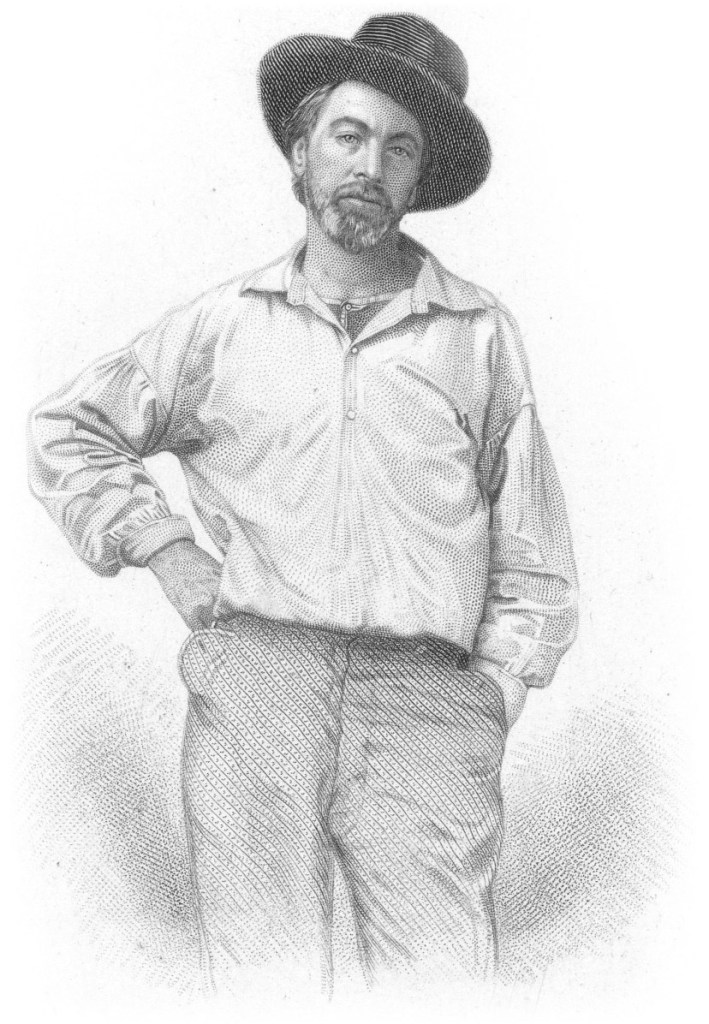
Art: Walt Whitman. Steel engraving by Samuel Hollyer from a lost daguerreotype by Gabriel Harrison. Used as frontispiece in 1855 (1st) edition of Leaves of Grass. Library of Congress Prints & Photographs Division: //hdl.loc.gov/loc.pnp/cph.3b29437

Note: This essay was published by the Boston Globe on August 3, 2025.

A Rose for Cesar

A ROSE FOR CESAR

CHORUS

Come plant a rose for Cesar,
And pick a rose for Delores.
Sing a song of peace and justice,
Sing aloud de colores.

In a river town called Yuma
Cesar’s family farmed the soil,
But a banker grabbed their deed,
What they’d earned by sweat and toil.

So they loaded up the Studebaker
Joined the migrants going west,
Picking peaches, hoeing lettuce
In the hot sun with no rest.

Years later in Sal Si Puede,
Meaning: get out if you can,
Cesar, with his new wife, Helen,
Chose to make a stand.

He was joined by Delores Huerta,
A teacher with a heart of fire.
In Delano they formed a union.
Si, se puede, is still the cry.

In the valley San Joaquin
Filipinos pruned and picked the vines, 
Getting paid less than braceros,
They soon formed a picket line.

Yes, said Cesar, we will join you.
We will strike for decent pay.
Until the growers sign a contract,
On the vines the grapes will stay.

So the workers fought for rights,
Marching, singing, organizing,
Facing violence, hunger and low wages,
Beat down, they kept on rising.

Fought for toilets and clean water,
Long-handled hoes so backs wouldn’t break,
Housing, health care, and old-age pensions,
All that’s due for fairness sake,

For the children, for the parents,
Campesinos proud and strong,
Bringing us each day our food,
Teaching us the justice song.

And still the fight continues.
Pesticides still make us sick.
Growers, politicians, attack our union
Sowing seeds of harsh conflict.

But united we fight on.
La Causa is our way of life
Until all God’s children work together,
Free of fear and want and strife.

Can’t you see the smiles of children?
Can’t you hear the songs they sing?
Songs of flowers, birds and rainbows,
Songs of letting freedom ring.

Things go better with a contract
A flower grower one day said.
Then to honor Cesar Chavez,
That brave Chicano man who led,

They named a new rose after him,
A rose deep red so all would know
That those who own and those who pick
Can jointly sew the seeds of hope.

So plant a rose for Cesar
And pick a rose for Delores.
Sing a song of peace and justice.
Sing aloud de colores.

De colores,
de colores se visten los campos
en la primavera.
De colores, de colores son los pajaritos
que vienen de afuera.

De colores, de colores es el arco iris
que vemos lucir.
Y por eso los grandes amores
de muchos colores me gustan a mi.
Y por eso los grandes amores
de muchos colores me gustan a mi.

A corrido

by Ben Jacques

Who would you honor?

January 4, 2025

Today President Joseph Biden honored 19 Americans with the highest civilian award, the Medal of Freedom. The recipients ranged from human rights workers to basketball stars, philanthropists to actors.

Although critics will snipe that some of the names were political choices, who among us did not cheer when our nation’s highest civilian award went to the José Andrés, World Kitchen chef, or Jane Goodall, animal biologist, or Michael J. Fox, actor and voice for Parkinson’s research.

Who didn’t chuckle when a towering Earvin “Magic” Johnson stooped down so the president could fasten the pendant around his neck? Or cheer when Bono, the U2 rock star who has fought for debt relief for poor nations, got the award.

The ceremony got me to thinking about the word “freedom” itself. What is freedom? Are there more than one? What freedoms are we talking about?

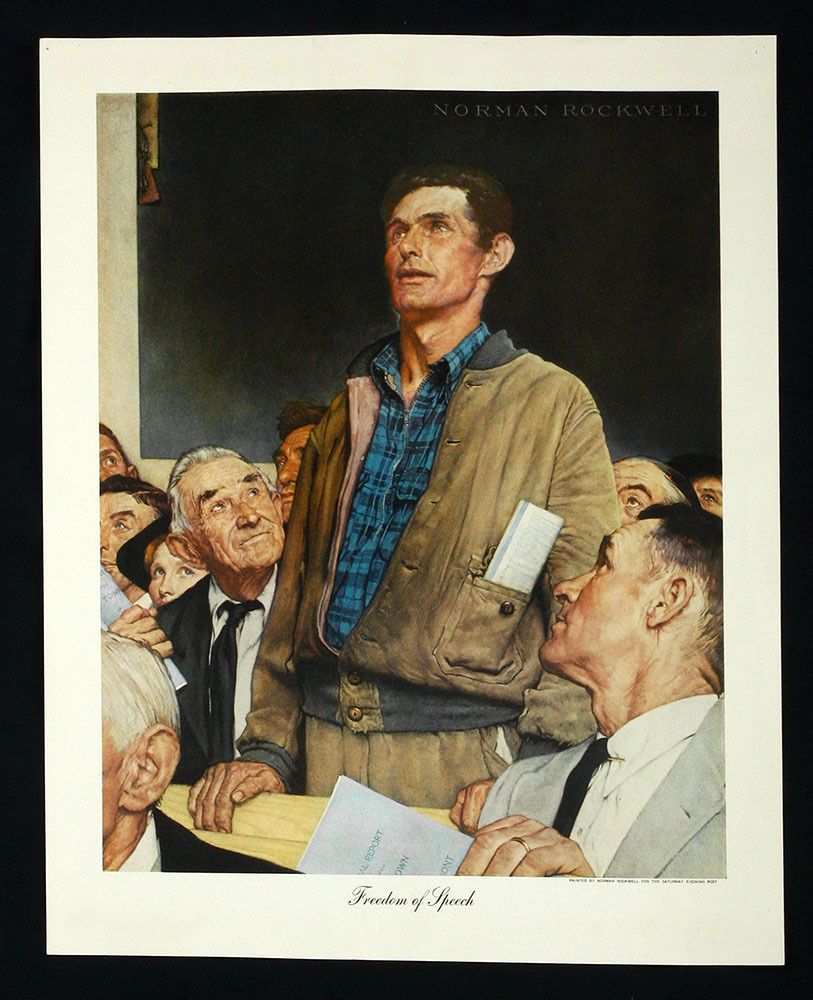
In a State of the Union address given 84 years ago, President Franklin D. Roosevelt said, “we look forward to a world founded upon four essential human freedoms.”

He continued: “The first is freedom of speech and expression—everywhere in the world. The second is freedom of every person to worship God in his own way.”

He defined the third as “freedom from want” and called for “economic understandings that will secure to every nation a healthy peacetime life for its inhabitants.”

The fourth freedom, Roosevelt stated, was “freedom from fear.” He called for a reduction in global armaments to the degree that that “no nation will be in a position to commit an act of physical aggression against any neighbor.”

Articulated eleven months before the attack on Pearl Harbor, the Four Freedoms theme was incorporated into the Atlantic Charter and later became part of the Charter of the United Nations.

Although the three-term president was now defining freedom in global terms, his administration had from the start applied them to domestic policy and public programs.

In 1943 in four Saturday Evening Post covers painted by Normal Rockwell, the Four Freedoms showed us what freedom looks like at home, at the table, in moments of worship, and at a town meeting. You can see the original paintings today at the Norman Rockwell Museum in Stockbridge.

Thinking about the recent Medal of Freedom ceremony, I realized that each person honored had in some way contributed to expanding one of the Four Freedoms.

And that got me to wondering, if I were to pick individuals in Stoneham who exemplified these freedoms, who would they be?

What my choices would have in common is the desire to realize freedom not only in their own lives, but in the lives of others as well. I would look for people who lift others up. A teacher who teaches compassion as well as calculus. A banker who helps small businesses gain a foothold. A town moderator who keeps democracy on track. An artist who teaches seniors to paint. A tutor who helps immigrants learn English. A food bank or community dinner director. A legislator, coach, librarian, nurse, police or fire fighter, pastor, and more.

Who would you choose? Look around you. In the New Year, we will be challenged to honor and uphold the freedoms we cherish. It’s something each of us, in our own way, can do.