If we are to find our way through the current moral and political crisis, we should pay more attention to our children.
That’s the message I got on Monday as Becky and I watched the HBO documentary, “We are the Dream: The Kids of the Oakland MLK Oratorical Fest.”
The film was shown at the Stoneham Public Library, which opened on the holiday just for the screening in commemoration of Dr. Martin Luther King, Jr. It was sponsored by our town’s Human Rights Commission.
“We are the Dream” tells the story of the children of Oakland, California, who compete in the annual MLK Oratorical, culminating in a remarkable presentation celebrating the life of the beloved civil rights leader.
In the film, the students, K-12, bring to life the words of Dr. King and others—poets, artists and activists. Sometimes, they perform their own compositions. We see them as they prepare, rehearse and take the stage.
Oakland, California, is a city of some 440,000 residents. Like San Francisco across the Bay, it is a consortium of races and ethnicities, with no one group a majority. Hispanics comprise about 30 percent, Whites 26, Blacks 20 and Asians 15. About 10 percent are listed as bi-racial, and there are smaller numbers of American or Hawaiian natives and Pacific islanders.
Which is to say, when you walk into Oakland’s schools, you will find the America envisioned 68 years ago in Dr. King’s “I Have a Dream” speech. You’ll see Black kids holding hands with White kids and Asian kids singing with Latino kids. You’ll find immigrants from around the world–from South America to Southeast Asia, from the Middle East to Eastern Europe.
Like most urban centers in the United States, Oakland struggles with issues of poverty, housing shortages and homelessness. What Oakland has demonstrated, however, is the that all races can live and work together and that diversity, equity and inclusion are essential American values.
What the HBO film shows us is that in a country still struggling with hate and division, we can create better. That’s the message of the children, and why we must pay attention.
In Stoneham, as well, we must pay attention to our children, those in our schools, clubs and churches, those like the young people at the Boys & Girls Club who gathered on Monday to thematic mural at the Teen Center on Central Street.
Have you noticed that children don’t get tied up in political and philosophical rationalizations? Most kids are quick to tell you what is right and wrong. They have an innate sense of fairness, and they know who the bullies are. They know violence is not the answer. As one second grader in Oakland said of the late civil rights leader, “Dr. King showed us how to fight without using our fists.”
Children know you don’t steal another person’s candy or their country. Or their dignity by calling them names. And you don’t shoot people who are getting in your way.
On this national holiday, the children call on us not to forget the dream of Martin Luther King. This dream, our children are showing us, can restore our spirit and renew our strength. It can lead us to renew our commitment to the “beloved community.”
Note: As we often spend time in Oakland during the winter, and as our son, who was director of academic programs for Oakland schools, was helping with this project, I was asked to fill in as one of the contest judges.. It just happened to be the year that HBO made the documentary above.
Woodie Guthrie wrote the lyrics. Martin Hoffman set them to music. Since then, it’s been sung by Bob Dylan, Joan Baez, Johnny Cash, Dolly Parton, Bruce Springsteen, Pete Seeger and Arlo Guthrie.
It’s a ballad called “Deportees” and it tells of an airplane crash in California’s Los Gatos Canyon. On board were 28 migrant farm workers from Mexico.
The lyrics are as searing now as in 1848 when Guthrie wrote them:
The sky plane caught fire over Los Gatos Canyon, A fireball of lightning, and shook all our hills, Who are all these friends, all scattered like dry leaves? The radio says, “They are just deportees.”
Guthrie wrote the ballad one night after news reports listed the names of the pilots, attendant and immigration guard lost in the crash, but referred to the farm workers only as “deportees.” After the braceros’ bodies were recovered, they were buried in a mass grave without names, marked “Mexican Nationals.”
The roundup of the Los Gatos laborers was just one episode in several government campaigns to remove Mexicans and those with Mexican ancestry. Mass deportation began in 1930 and continued through the Great Depression. Then in 1954, the Immigration and Naturalization Service (INS) brought out “Operation Wetback.” Under this federal program, officials used strong-arm tactics to arrest tens of thousands of immigrants across the country. Caught up in the raids were farm and factory workers, including American citizens.
In July of 1955, several thousand deportees were found wandering the streets of Mexicali, a desert town bordering California. Yanked from their jobs and families, they had simply been dumped across the border. According to one account, 88 died of heat exposure in the 112 degree heat.
In Texas, thousands of deportees were crammed onto boats bound for Mexican ports. Testimony before a Congressional committee described conditions akin to those on slave ships. Other immigrants were packed into trucks. By the end of Operation Wetback, the INS claimed it had “repatriated” 1.3 million Mexicans.
Goodbye to my Juan, goodbye, Rosalita, Adios mis amigos, Jesus y Maria; You won’t have your names when you ride the big airplane, All they will call you will be “deportees.”
Accompanying the mass deportations were media depictions of Mexicans as dirty, disease-bearing and lazy. News coverage focused on border and immigration officials conducting raids.
Only in time did most Americans come to see this as something shameful. In a 2012 ceremony in Los Angeles, Governor Jerry Brown and Mayor Antonio Villaraigosa formally apologized for California’s role in the deportations.
On Labor Day in 2013, United Farm Worker President Arturo Rodriguez joined hundreds gathered at the Holy Cross Cemetery in Fresno, California, to memorialize the 28 farm workers killed in Los Gatos Canyon. They were 25 men and three women. This time, inscribed in the headstone, was each person’s name.
Now, deportation planes are again in the sky. Planes to El Salvador, Guatemala and Honduras. Planes to India and Rwanda. Planes to Eswatini, a tiny country in southern Africa.
Through October 2025, the Department of Homeland Security operated 1,701 deportation flights to 77 countries. And it recently bought six Boeing 737s, expanding capacity.
Meanwhile, 66,000 men, women and children await deportation in detention centers. Arrested, often with brutal force, they were tracked down in streets, courthouses, parking lots, fields and construction sites.
Some of us are illegal, and some are not wanted, Our work contracts out and we have to move on. Six hundred miles to that Mexican border, They chase us like outlaws, like rustlers, like thieves.
Compared to programs of the past, Donald Trump’s campaign is Operation Wetback on steroids. The president wants 3,000 arrests a day, or one million by the end of his first year in office. Each day, it seems, he expands his list of targets, Somalis, Haitians, Venezuelans, Afghans. What they have in common is their darker shades of skin.
As I listen to Woodie Guthrie’s song, I think of my children and grandchildren. I wonder, what song will they sing in years to come? Who will write the words, and who will remember the names?
Will there be, one day in the future, a public apology, a ceremonial mea culpa for the cruelty, the harm inflicted on so many? If so, what song will we then sing.
In the darkness before dawn, a man from Georgia is riding in the baggage car of a northbound train. He is exhausted, and to keep awake, he opens the window. Cold air rushes in. Just then the engine whistle sounds, and sticking his head out the window, he sees the flickering lights of Philadelphia. It is Christmas Eve, 1848.
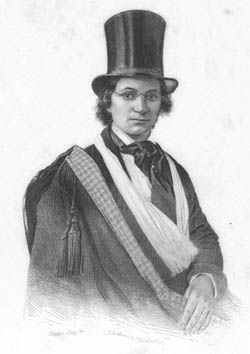
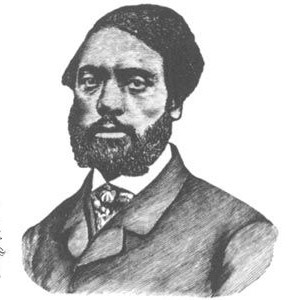
The traveler is a 24-year-old slave named William, on a journey with his master, “Mr. Johnson,” a young gentleman from Macon, traveling north for medical care. But things are not what they seem. In fact, Mr. Johnson is Ellen Craft, a tall, light-skinned African woman, cross-dressed as a plantation owner. And William is not just Mr. Johnson’s slave, he is her husband.
Allowed to marry, Ellen and William have avoided having children, shuddering at the prospect of bearing offspring who might be taken from them and sold. Their desperation has steeled them to dare an escape, despite the horrendous outcome if they are caught.
Born of a white owner and his African slave, Ellen was taken from her mother at age 11 and given as a wedding present. Now a house slave, she has been granted a few days off to visit her family. William, trained as a carpenter and rented out by his owner for wages, has also obtained permission to be absent from work. Growing up, he has seen both his parents and his 14-year-old sister sold away to pay debts.
Two weeks ago William and Ellen spent the night in Ellen’s cabin, planning their escape route. The distance from Macon to a free state is a thousand miles. For the Crafts, attempts on foot are out of the question. Instead, William and Ellen have decided to escape in plain sight, that is, in disguise. Using money saved from jobs on the side, William has been buying pieces of men’s clothing a young gentleman would wear. Ellen, a seamstress, has sewed a fine pair of trousers. She has locked the clothes in a little chest of drawers William made for her. The last thing William bought for his new “master” was a pair of green-tinted spectacles. They will leave on December 21.
The night before, William and Ellen spend the hours talking, asking, what if, and what should we do when? There is a major problem. At every train or customs station, Ellen will be required to sign a register, or to show papers. And she, like her husband, is illiterate.
Ellen has an idea. She will tie up her right arm in a sling, so she will not be asked for her signature. Further, to discourage questioning, she will have bandages with a poultice wrapped around one side of her head.
Just before dawn on Dec. 21, William takes out Ellen’s scissors. Standing behind her like a barber, he cuts her hair. Then he helps her into her gentleman’s clothes, complete with top hat. At the door they pause. No one is in the street. They slip out “quiet as moonlight on the water,” William will later recall, and they separate. They meet at the train station.
Their escape is laden with peril. On each leg there is a new challenge. Settling into her seat on the train to Savannah, Ellen is shocked to see a friend of her owner’s, who would know her, take a seat next to her. Feigning illness, she avoids his inquiries and is undetected.
From the Massachusetts Histoical Society. Not to be reproduced without permission.
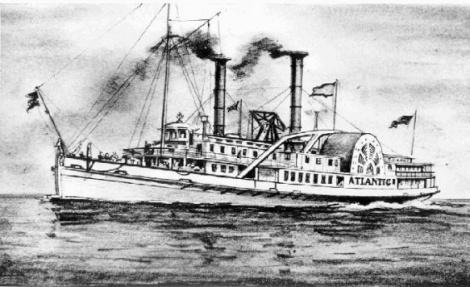
Arriving in Savannah, Mr. Johnson and his slave take an omnibus to the harbor, where they purchase tickets on a steamer bound for Charleston, South Carolina. Going aboard, William helps his master settle into his berth, then goes on deck to find a place to sleep. There are no accommodations for slaves, so he finds a warm place near the funnel on sacks of cotton, resting there until morning.
The next day, as William patiently waits on Mr. Johnson, a vulgar slave trader tries to purchase him from his master. Then a military officer scolds Mr. Johnson for speaking kindly to his slave. “Nothing spoils a slave so soon as saying, ‘Thank you,’” he warns him.
In Charleston, Mr. Johnson and his slave check into a hotel. Here the proprietor is solicitous of the young gentleman’s needs. While his master is served in the dining room, Williams eats off a broken plate in the kitchen.
The next morning, as they prepare to board a steamer to Wilmington, North Carolina, the station officer demands that Mr. Johnson sign the register, despite his apparent injury. Finally, the officer who has come on the same ship from Savannah steps up and vouches for the invalid gentleman. Overhearing this, the ship’s captain signs the register, “Mr. Johnson and slave.”
The next morning William and Ellen Craft arrive in Wilmington, and from there board a train for Richmond, riding in a section reserved for families and invalids. Here they are joined by an older man and two daughters, who insist on making Mr. Johnson as comfortable as possible, and share advice on remedies for rheumatism. “Papa,” one of the daughters says, “Mr. Johnson seems to be a fine gentleman.”
After the train stops in Richmond, the friendly father and daughters disembark, and a stout, elderly lady takes a seat beside the disguised Ellen. Glancing out the window, she sees William approaching on the platform and cries out, “Bless my soul, there goes my nigger, Ned.”
“No, that’s my boy,” Mr. Johnson replies. When William arrives, the lady confesses she was mistaken, then launches into a diatribe against her run-away slave, and all the slaves she owns. She plans to sell them away to New Orleans as soon as she can.
At Fredericksburg, the Crafts again board a steamer, this time to Washington, D. C. Once in the nation’s capital, they go directly to the train station and board a train for Baltimore.
When the train pulls into Baltimore, it is Saturday evening, Christmas Eve. Ellen and William are exhausted and their nerves frayed. They have expected detection at every step. For three days and nights they have had almost no sleep.
Stepping warily onto the station platform, Mr. Johnson and his slave go to the ticket office and purchase tickets for the final leg of their journey, the night train to Philadelphia.
But something goes wrong. Maryland is still a slave state, and it is illegal for any white man to take his slave into Pennsylvania, a free state, without authorization. After settling Ellen in her carriage, William returns to the platform, but is accosted by the station officer, who forbids him to board.
Returning to the station office, crowded with late-evening travelers, Mr. Johnson demands to know why he, a respected gentleman needing medical care, cannot take his faithful slave with him on the train to Philadelphia.
Ellen’s insistence turns to pleading, but to no avail. Have they come so far, only to be arrested as fugitives? They know well the fate that awaits captured run-away slaves. William has seen them attacked by dogs, whipped, tortured or killed as an example to others. Even if they survive, they will be forever separated, assigned to the hardest forms of labor.
As they wait in agonizing suspense, the train whistle sounds. Just then the train conductor enters the room and calls the all-aboard. Then, as if only by Providence, the station officer relents. Seeing how the young gentleman is in such poor condition, and it is Christmas Eve, he gives permission for the two to pass.
As quickly as possible, William settles Ellen into her carriage, then hops into the baggage car where he must ride. Slowly, in the early darkness, the engine picks up steam and the train pulls out of Baltimore station.
It is now almost five in the morning, and the weary fugitive with his head out the window gazes with fascination at the twinkling lights ahead of him. In the cold wind, tears are spreading on his cheeks, and something is happening he can hardly explain. His body has suddenly become lighter.
With a great hissing of steam, the train comes to a stop in Philadelphia station. William and Ellen wait until all the other passengers have disembarked, then William calls for a “fly,” a horse-drawn taxi, and hands the driver the address of a boarding house he has been told is run by an abolitionist. Here they will find refuge and support for their continued journey north.
Inside the carriage, Ellen leans her head on William’s shoulder and bursts into tears. It is Christmas Day. They are free.
Afterword: After boarding with a Quaker family outside Philadelphia, William and Ellen Craft make their way to Boston, where they are welcomed by the abolitionist community of free blacks and white allies. Here William works as a cabinet maker and Ellen as a seamstress until 1850, when the Fugitive Slave Act imperils their freedom and they flee to Nova Scotia, then England. Over the next 15 years they work, study, lecture and raise a family of four boys and one girl. After the Civil War, they return to Georgia and open a school for the children of former slaves. This retelling of their story is based on their book, published in London in 1860, titled “One Thousand Miles to Freedom.”
The long summer’s over, Lord. Time to turn our clocks back. Time for cold winds to blow.
But wait. So the last fruits may ripen give us two more warm days. push the pears to plumpness, chase the sugar in the heavy vine.
If you have no house, too late to build. If you’re alone now, get used to it. You’ll wake up, read a little, write long letters, then wander in side streets here and there, restless as a falling leaf.
HERBSTTAG
Herr: es ist Zeit. Der Sommer war sehr gross. Leg deinen Schatten auf die Sonnenuhren, und auf den Fluren lass Winde los.
Befiehl den letzen Früchten voll zu sein; gib ihnen noch zwei südlichere Tage, dränge sie zur Vollendung hin und jage die letze Süsse in den schweren Vein.
Wer jetzt kein Haus hat, baut sich keines mehr. Wer jetzt allein ist, wird es lange bleiben wird wachen, lesen, lange Briefe schreiben, und wird in den Alleen hin und her unruhig wandern, wenn die Blätter treiben.
Cleve would forget he’ d told me about the squaretail, the brook trout he’d caught as a boy on the farm in Wiscasset, Maine, and tell me the story again. He must have told me twenty times. But I’d let him tell it again. I didn’t mind. He had given me my first fly rod, and I figured I could spare the time.
I never fished much as a boy. But soon after I married Cleve’s daughter, I started going with him and Morrill, my brother-in-law. My job was to run the boat, to put it where my in-laws could cast.
We often fished the Rangeley Lakes region, from Beaver Mountain to the Little Kennebago River. On any given day, while fishing we might see deer, otters or a beaver. Or a heron, osprey or kingfisher. Sometimes a pair of loons would surface and we’d be serenaded by their throaty calls. Once, in a stream, we heard splashing ahead. Pretty soon a young bull moose came around the bend and walked past us, not ten feet away.
The thing about brook trout is that once you catch one, other fish look ugly. Brookies, or squaretails, are small trout in general, but their sides are prettier than a church window. Their minute scales are flecked with yellow and red spots, sometimes with blue haloes. When spawning, males have orange-red sides and bellies.
Eventually, I got tired of steering the boat so my in-laws could fish, and I picked up a spare fly rod. “Put on a number 12 Hornberger,” Cleve said. That done, I started whipping the line back and forth. First I snagged it in the alders, then on Morrill’s hat. “Easy, now,” he said.
After a good deal of practice, I dropped the fly gently down on the surface and got a hit, then lost it. But at the mouth of the brook, now fishing the Hornberger wet, I brought in my first catch. I stared in amazement at the eight-inch brookie in my hand.
That autumn, after the fishing season, Cleve had a massive stroke. He lay on the hospital bed in Maine Medical Center, unable to move. Then one day I saw his thumb twitch. Miraculously, and with intense will, not to mention speech and physical therapy, he came back, but not all the way.
In the winter months I played Cribbage with him, making small talk as he struggled to shuffle and deal. By spring he was doing much better. He had learned to sign his checks with his left hand. He was also learning to drive again. He never got his fine-motor movement back, so important to fly fishing, but that didn’t keep him from trying.
In July we I asked Cleve if he was ready to go fishing again. Morrill and I helped Cleve off the dock into the boat. We crossed the lake, entered the stream, then drifted toward our favorite spot. All three of us began casting, but when Cleve hooked one, I quickly reeled in and turned to assist. He brought his fish slowly to the boat, just the way you’re supposed to. “Get the net,” Morrill called out. But I didn’t like using nets, and I reached down to gently lift the brookie in for him. Coming out of the water, the trout leaped in an arc and was gone. If it had been my fish, I would’ve cursed. “There’ll be another one,” was all Cleve said.
In later years, the fish Cleve liked to talk about, more than the salmon or togue, more than the grayling and pike he had caught out in Minnesota, was the 15-inch squaretail he caught when he was a boy, in the stream that wound through the farm before dropping into the Sheepscot River.
At dawn one Sunday morning, he had grabbed his rod and a few night crawlers and headed for the bend where the stream pooled deep. His timing was right. He caught a couple of nine-ten-inchers. Then he crawled out on a tree that bent over the pool and dropped his line straight down where the water was black.
The sudden tug almost pulled him off balance. He inched back down the trunk, then patiently tired the fish before sliding him up on the bank.
It was a beautiful trout, deep in color and thick as a man’s fist. He gathered his trophy and the other two on a string, ran up to the house, knocked on his father’s bedroom door and walked over beside the bed. Tapping his father on the shoulder, he first held out the two smaller trout.
His father squinted at the fish, then rolled over. “Now, how ‘bout this one?” the boy held out the large brook trout. This time his father in one motion swung his legs out from under the bed covers. This was a squaretail worth looking at.
Word got out at church that morning about the boy’s fish, and that afternoon Cleve’s uncle drove over from Damariscotta. “Show me your trout,” he told his nephew. “Too late,” Cleve said. “We et him for lunch.”
Over the next few years, Cleve had a series of smaller strokes and setbacks. But often, when the talk died down, or our thoughts turned to the upcoming season, Cleve would ruminate on that trout. He’d say, “Did I ever tell you about the squaretail I caught in the stream on the farm?”
I figured that trout—rich in symbol and pride—had helped my father-in-law through the hard times , the heart attack, the strokes, the long hours of therapy, the loss of his wife, the loneliness of hospital nights.
A year later, Cleve started losing his memory, or rather began returning to another time. Sometimes he’d get up a 3 a.m., get his things together and announce it was time to go home. One day when we took him out for a drive to town landing, he said he wanted to go home. But when we headed for home, he said it wasn’t the right way.
Eventually he had to go to a nursing home. One of the last times I visited with him, he was waiting for his parents to pick him up.
It’s hard having a conversation with someone with dementia. You want so bad to connect, for yourself as well as for them.
As I sat beside him in his wheelchair, there were no more words. Then I thought of asking him about the brook trout. “Do you remember the squaretail, Dad? The one you caught when you were a boy on the farm?”
He looked at me for a moment, patiently, I thought. Then he said, simply, quietly, “No.”
I was stunned. Something inside him had let the fish go. I grabbed desperately for the net. It was too late. That magnificent trout, beautiful as a Monet, had simply snapped the leader drawing it to the surface and turned back in a silent rush to the pool’s depths.
A month later, Cleve, too, entered that dark pool. I like to think he found the squaretail again. That his eyes once again lit up at the beautiful colors. But I don’t know. These things are hard to tell.
As autumn wanes into winter, the voice of the greatest of poets comes again to me. “That time of year thou mayst in me behold.”
It’s not just the coming of winter, but also the accumulation of years. I will soon turn 79. William Shakespeare must have felt a similar melancholy when he wrote Sonnet 73.
Wonderfully crafted, Sonnet 73 is an appeal to the poet’s beloved, written in his later years. Setting the stage, so to speak, Shakespeare creates three scenes, one quatrain for each. The first is late fall. Most of the leaves are gone. Trees, where once birds sang, are “bare ruined choirs.”
The second is the sky just after the sun has gone down. A faint wash of color remains. For the third scene, the poet brings us indoors. He is now sitting by the hearth, before the “glowing of such fire that on the ashes of his youth doth lie.”
This is what you see in me, he tells his beloved–the last fall colors, the fading sunset, the low flames of an almost-spent fire. Perceiving all this, the poet closes in a couplet, “makes thy love more strong.”
The sonnet ends with a call to his beloved “to love that well which thou must leave ere long.”
So are we all called, as we turn the clocks back, as we approach yet another New England winter, to love well those around us, young and old.
Here, now, is Sonnet 73, a poem for the ages:
That time of year thou mayst in me behold When yellow leaves, or none, or few, do hang Upon those boughs which shake against the cold, Bare ruin’d choirs, where late the sweet birds sang. In me thou see’st the twilight of such day As after sunset fadeth in the west, Which by and by black night doth take away, Death’s second self, that seals up all in rest. In me thou see’st the glowing of such fire That on the ashes of his youth doth lie, As the death-bed whereon it must expire, Consum’d with that which it was nourish’d by. This thou perceiv’st, which makes thy love more strong, To love that well which thou must leave ere long.
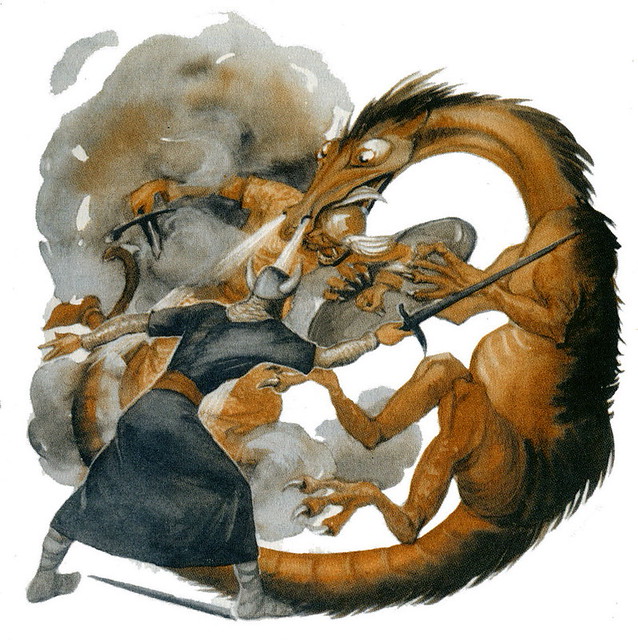
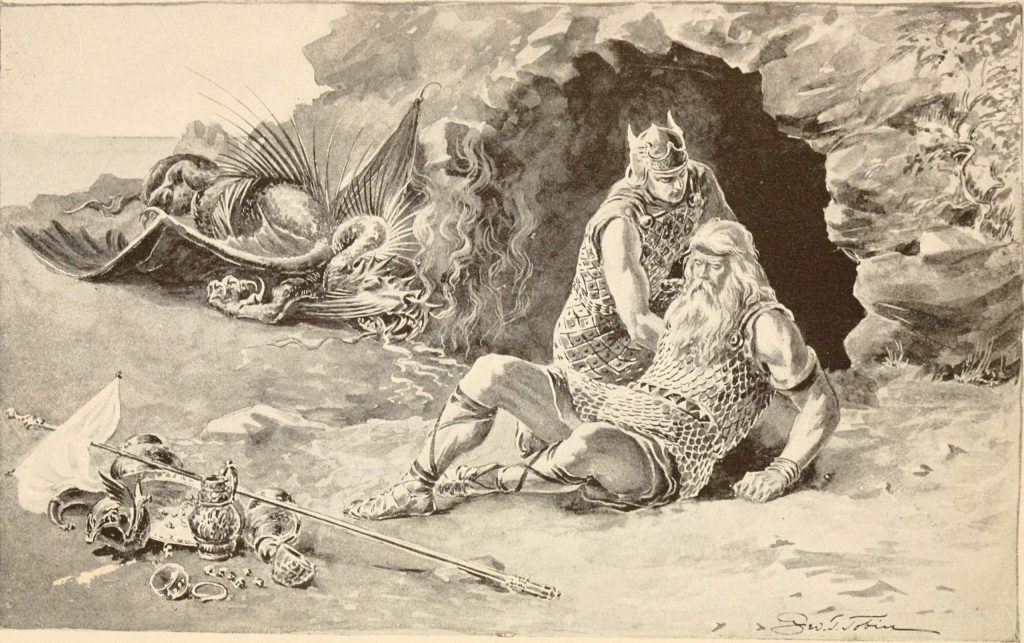
Art by Florence and Margaret Hoopes, from The Wonder Story Books – They Were Brave and Bold – Beowulf .
Denmark needed a superhero. A treacherous monster named Grendel was savaging them at night, slaughtering their best as they bedded in Heorot, the great hall of the king. Thus the stage was set for Beowulf, a brawny prince who crossed the sea from Geatland to rid the Danes of evil.
The prototype of the Western superhero, Beowulf does what neither King Hrothgar nor his warriors can do. He vanquishes both Grendel and the slayer’s vindictive mother, diving into a black sea, writhing with snakes, to bring an end to oppression.
Yet in the end, fifty years later, neither Beowulf’s strength nor courage can protect the people from the evil destroying their cities. It takes the wisdom of a thane, an underling named Wiglaf, to see that it is not enough to have heroes if the people’s hearts have grown cold.
We know the story as the first great epic in our language, not English as we know it, but Anglo-Saxon. Sung then written down around 900 CE, it was crafted by a descendant of the Angle, Saxon, Jute and Frisian invaders who overwhelmed Celtic Britain in the 5th and 6th centuries. The translation I like best is by the late Irish poet, Seamus Heaney.
A pagan saga with a Judeo-Christian overlay, Beowulf portrays a world in flux. Most modern tellings focus on our hero’s two great victories in Denmark. By the time we get to Beowulf’s last battle, however, things have changed. In several passages, blending Biblical narrative with a pagan’s rumination on the transitory nature of life, the poet reveals a shift in values.
In Beowulf’s world—as today—men seek gold, weapons and treasure. These give them status. With them, kings and queens gain allegiance, reward subjects and build alliances. Treasure shared holds the community together. Treasure hoarded leads to treachery. Hrothgar showers Beowulf with fine gifts: horses, fine armor “and a sword carried high, that was both precious object and token of honour.”
At the same time the king counsels the young warrior to remember he too is mortal. He warns him against vanity and pride, “an element of overweening” that will lull his soul to sleep and expose him to the enemy.
Pride and the lure of treasure surface again in the final act of the play, as Beowulf, now an old king, goes out to battle a “slick-skinned dragon, threatening the night sky with streamers of fire.” Guardian of an ancient underground barrow, the dragon has been burning farms and villages across Geatland, all in revenge for a jeweled cup stolen from its hoard.
Wanting to protect his people, Beowulf is “too proud to line up with a large army against the sky-plague.” He will face the monster alone, confident he will prevail as he did against Grendel and his mother.
It is not to be. In desperate combat, Beowulf is mortally wounded. His famous sword, Naegling, breaks against the dragon’s scales, and the monster’s teeth penetrate his armor. Beowulf slays the dragon, but only with the help of Wiglaf, a young Geat warrior who could not bear to see his king go into battle alone.
As he is dying. Beowulf asks Wiglaf to gather samples of the dragon’s treasure, so he can feast his eyes on them:
I want to examine that ancient gold, gaze my fill on those garnered jewels (2747-9)
But the value of gold, jewels, fine weapons and armor—even the priceless cache found in the dragon’s hoard—is relative. Nowhere is this better expressed than in what happens next. Instead of using the treasure to enrich the kingdom, the Geats heap it onto Beowulf’s funeral pyre. They bury the rest in a great mound on the headland by the sea.
They let the ground keep that ancestral treasure gold under gravel, gone to earth as useless to men now as it ever was (3166-8).
Nearing the end of the epic, we sense a turning from sword power to soul power. Valued most highly now is inner strength, not physical prowess. The enemy are no longer dragons and monsters, but human rivals—Swedes to the north and Franks and Frisians to the south.
At Beowulf’s funeral, there is great sorrow, but also great fear:
A Geat woman too sang out in grief; with hair bound up she unburdened herself of her worst fears, a wild litany of nightmare and lament, a nation invaded, enemies on the rampage, bodies piled up, slavery and abasement (3150-5).
Wiglaf sees clearly what is to come. In a scathing rebuke, he tells his people they have lost more than a great king. They have lost their heart. It is true—their king chose to go into battle alone. Yet, when his warriors saw him bested by the dragon, they turned and ran.
The tail-turners, ten of them together, when he needed them most, they had made off (2848-9). Now, weakened by cowardice, Geatland is ripe for the picking. So it is goodbye now to all you know and love on your home ground, the open-handedness the giving of war-swords. Every one of you with freeholds of land, our whole nation will be dispossessed (2884-8).
Wiglaf knows that no amount of treasure, or armaments, will protect a people who are paltry of spirit, who abandon each other in times of peril. More important than gold or brawn is the steel of a person’s heart, which underlies all strength. In a remarkable description of interior growth, Wiglaf reveals the change that occurred in him when he ran to assist his beloved king:
There was little I could do to protect his life in the heat of the fray, yet I found new strength Welling up when I went to help him. Then my sword connected and the deadly assaults of our foe grew weaker (2877-80).
Wiglaf’s experience has given him insight into the interior world through which a warrior must journey. His wisdom makes our first English epic as relevant to our time as to his.
She loves us, she loves us not. She loves us, she loves us not. So the petals of the daisy tell the story of America’s love-hate relationship with her immigrant people—homesteaders and refugees, migrants and asylum seekers, those fleeing poverty, war, persecution and famine.
President Donald Trump, aide Stephen Miller, DHS’s Kristi Noem, and ICE tsar Tom Holman are not the first ones in our nation’s history to tilt America against immigrants. Anti-immigrant sentiment has been fanned into flames on and off from our earliest days. Posing as populists, politicians have railed against foreigners “poisoning the blood of our country,” as Trump put it in during his presidential campaign.
Since the first Europeans arrived without visas, and Africans arrived in chains, America has opened doors to newcomers, then shut them, opened, then shut them again. In the 19th century, we needed workers for our factories and farmers for our prairies. We needed merchants and tradesmen, engineers and inventors. It helped if you were Protestant and white. It wasn’t good if you were Chinese or Irish or Mexican.
Although doors for a while swung open to “your tired, your hungry, your masses yearning to breathe free,” by the 1920s they had all but closed again. Laws approved by Congress in 1917 and 1921 slowed immigration to a trickle, setting quotas based on national origin. These laws and anti-Semitic sentiment kept out thousands of Jews attempting to flee Nazi Germany. Included among them were 907 passengers–men, women and children–aboard the M.S. St. Louis. Refused permission to dock in Miami, the ship turned back to Europe. Some 250 perished in concentration camps.
The Immigration and Nationality Act of 1952 preserved a restrictive quota system favoring Europeans, but made an important change. The bill abolished the “alien ineligible to citizenship” category applied to Asians, although it limited the number of those who could qualify.
Deciding who to allow in America is one thing. What to do with those already in is another. The answer has often been harsh. For example, the Chinese and the Chinese Exclusion Act of 1882. For example, the braceros invited in to plant and harvest our crops.
In 1954, the Immigration and Naturalization Service (INS) brought out “Operation Wetback.” Under this federal program, officials used military-like tactics to arrest tens of thousands of immigrants across the country. Caught up in the raids were farm and factory workers, including some American citizens. Deemed unwelcome, they were flown, trucked or shipped across the border.
I was thinking of all this as I sat in a café in Woburn the other night, listening to the stories of three immigrants. From Nicaragua, Turkey and India, they shared stories of their arrival and the challenges and obstacles they faced. As they pursue remarkable careers in science, health care and technology, they are reaching out to others, mentoring and building community.
Above all, they are sharing their love for America. She loves me. She loves me not.
Like many Americans, I am pained by the policies and actions of our government, by the slamming of doors to thousands of refugees who were already been vetted for resettlement. By the ending of legal protections for thousands fleeing violence and persecution in their home countries. By the brutal and cruel tactics of ICE agents as they take parents from children and children from families.
The simple truth is, we need immigrants. We need them, not only for economic reasons, to bring young life to an aging demographic, but for their love ethic.
Last week we flew home from Edinburgh, and on the seven-hour flight I got to thinking of Patrick Hay, who made a similar journey. Flying now-a-days is no fun, but it certainly is easier than the journey the young Scotsman took by ship more than three and a half centuries ago.
It happened like this. Around 1675, escaping from an apprenticeship in Edinburgh, Hay stole aboard a ship leaving for the New World. Arriving in Salem, Massachusetts, with no means to pay for his passage, he indentured himself again, this time for “six or seven years” to a farmer in Lynnfield, who paid off the captain. After this, Hay came to Stoneham, then a sparsely settled area known as Charleston End. As historian Silas Dean writes, Hay “came over from Lynnfield with his axe and gun.”
Clearing land around Cobble Hill, Hay “stood somewhat in fear of the Indians, although he purchased his land of them, at the rate of two coppers per acre.” Here he built a log house.
A colonial farm in the 18th century. Wood engraving, American, 1853.
From this modest beginning, Hay went on to become one of Stoneham’s most prominent citizens and land owners and one of its most colorful characters. Dean writes: “During his life time he is said to have married no less than five wives. At the last marriage ceremony, (which took place after he was seventy years old) he is said to have displayed his youthful buoyancy, by dancing on the occasion.”
In 1730 Hay was “admitted to full communion” in the First Church of Christ in Stoneham.
William B. Stevens in his History of Stoneham has more to say about Hays. “He must have been a man of great force and character, buying as he did numerous tracks of land, clearing farms, and erecting buildings.”
Stevens continues: “[Patrick] Hay was not only the owner of houses and land and man-servants and maid-servants, but he had a multitude of wives, no less than four. He was one of the first selectmen when the town was organized. After having lived the life of a patriarch, so far as such a life was possible in the eighteenth century, and in Puritan New England, he died at the age of ninety in 1748.”
Not long after Hay arrived, he was instrumental in the establishment of another Stoneham family, the Gerrys. The first Gerry arrived in Boston as a boatswain in the British Royal Navy. While stationed here, Gerry met Hay, who brought him out to Charlestown End.
“Being pleased with the prospect of taking up his residence here, [Gerry] returned to Boston, got permission to return here and live, with the promise that if ever called for to go on an expedition against the enemy, (the French), he must go.”
It was Gerry, Dean writes, who with his axe slew a pack of wolves that attacked him on his return home one night. Finding a bride in Boston, Gerry and his wife raised several children, whose lives played important roles in Stoneham and beyond. Gerry himself, however, being called back into war service, “left his wife and children, never to return; as it is said he fell during an engagement with a foreign enemy.”
The children of Patrick Hay were also major players in the life of our town. James became a well-off shopkeeper, having inherited a 60-acre farm from his father. Another son, Captain Peter Hay, “was one of the most consequential men in Stoneham of his time . . . holding many offices and possessing a considerable estate.”
Like his father and his son, Peter Hay owned slaves.
Much has changed in Stoneham since then. Likewise, in Edinburgh, Scotland, the birthplace of Patrick Hay. Visiting there last week, we found the city eminently beautiful and accommodating. People are friendly and tolerant of our American accents. The modern parliament building stands in striking contrast to the castles and medieval streets of the Old Town.
The glories of the past are still there. So are the centers of education and invention. But I could find no remnants of the harshness that drove so many poor and oppressed to America—that brought a teenager, unhappy with his condition, to find a prosperous and influential life in Stoneham.
Note: Ben Jacques writes about local history in his book, If the Shoe Fits: Stories of Stoneham Then & Now. His articles have appeared in a number of magazines and newspapers, including the Boston Globe.











 Ben Jacques Stories