How will we respond?

It was a gray day in Moscow, and a 7-year-old girl was on the way to the train station. Her mother had gone to the hospital to deliver, and the girl was being sent to her aunt.  In the streets, she remembers, were soldiers with rifles, and everywhere people in shock, some openly weeping.

Why are they crying,” she asked her father. It was March 5, 1953.

“Stalin has died,” her father said.

A friend and colleague told me this story. She also said that in a little bag her father took with him to work each day he packed a toothbrush, razor and extra underwear, in case he didn’t return.

I could relate. Also having Russian heritage, I knew of the Soviet dictator’s reign of terror. My relatives, German-Russian farmers on the Kuban steppe in Southern Russia, were exiled to Siberia and Kazakhstan. One died in a gulag. Another was shot. My Tanta Anna as a teenager was forced to work in a logging camp.

Meanwhile, my friend grew up under Stalin’s successor, Nikita Khrushchev. In a famous speech, Khrushchev had shocked the party by condemning Stalin’s crimes, coining the phrase, “cult of personality.”

In the following years, she excelled at the university, earning a doctorate. and began a career teaching math. After the breakup of the Soviet Union, she, her husband and their parents left Moscow and settled in New England. We taught together in Massachusetts.

As I had tea with her one day between classes, we talked about Stalin and the power he had over people. I recalled a passage in Alexander Solzhenitsyn’s Gulag Archipelago describing a Communist party meeting in the 1940s, where, after Stalin had spoken, the audience jumped to its feet to applause. The applause continued. It didn’t stop. Looking around, members were afraid to stop clapping. Would someone notice? Would they be on the slow train to Siberia?

Similar scenes occurred in Nazi Germany. In a 1936 photograph of a rally held at a shipyard, one German worker stands in a crowd with his arms folded. He is the only one not giving the Nazi salute. Once a loyal member of the Party, August Landmesser had fallen in love with a Jewish woman. After his engagement was discovered, he was expelled from the Party, and his marriage application denied. They had a daughter.

In 1937 Landmesser attempted to flee Germany with his family, but was arrested at the border. The Gestapo also arrested his wife, who delivered their second child in prison. Sent to the Bernburg Euthanasia Centre, she was murdered along with 14,000 others.

After three years in a concentration camp, Landmesser was forced into the German Army. He went missing in Croatia.

Many are the lessons we can draw from history. One we cannot ignore, however, is that authoritarian, autocratic governments cause great harm, not only to democratic institutions, but to vulnerable people.
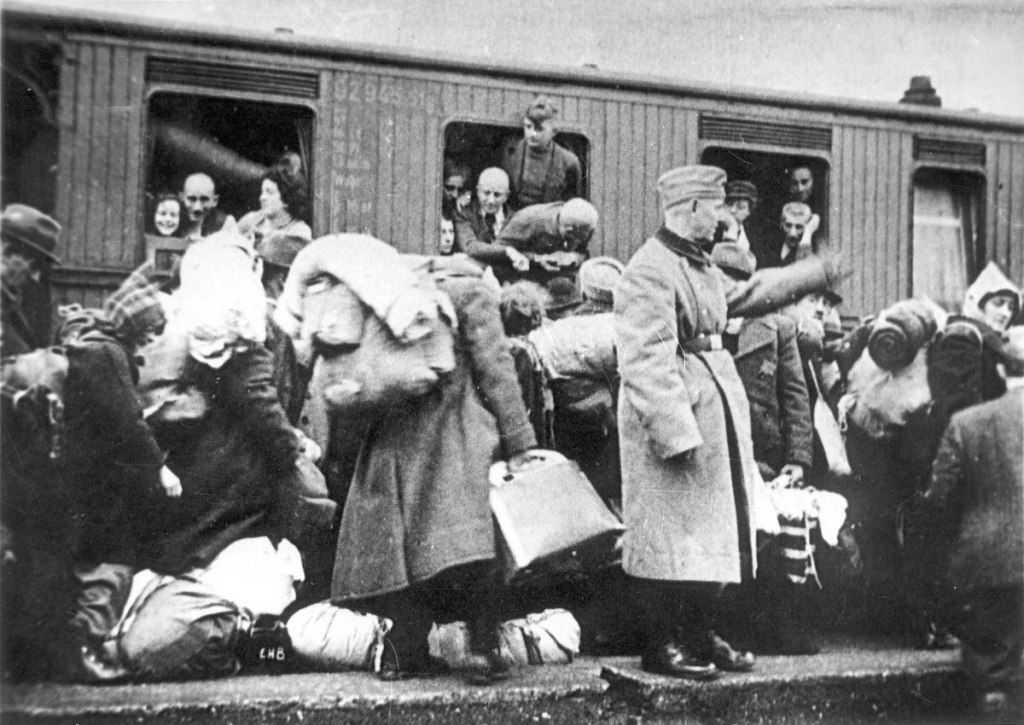
Deportation of Jews from Muenster, Germany, Dec. 13, 1941.

As we begin life under a second Trump administration, millions of our neighbors are threatened with deportation. These include hundreds of thousands of DACA students and millions under temporary protected status (TPS) or awaiting action on their requests for asylum.

In the coming days, how shall we respond. Will we clap? Will we fold our arms? Will we speak what we believe? Will we act to safeguard the lives and liberties of others?

A family reunion and the shadow of history

This summer when our cousins, the Haegelens, arrived from Germany, east and west came together. Irina grew up in a village in Siberia, Manfred in Ufa on the slopes of the Ural Mountains. When they were 15, as the Soviet Union was crumbling, their families emigrated to Germany.

When their jet touched down at Logan, they brought their two children, Friedrich and Johanna. They also brought stories, not only about their busy lives near Dusseldorf, but about family history.

Their branch of the family connects to the same tree as my paternal ancestors. We share great grandparents, Mennonite farmers who settled in Southern Russia, along with other ethnic Germans invited to Russia in the 18th century by Catherine II.

In 1914, at the start of the Great War, my grandfather was arrested and exiled to Siberia. The next year, however, he escaped to China, then boarded a ship to San Francisco. The rest of the family remained in Russia.

Now, in our backyard, children and grandchildren were playing together. We made day trips to Walden Pond and Rockport, hiked in the Fells and visited Stone Zoo. In the evening we played dominoes and bingo, calling out numbers in two languages.

Arriving in Germany as teenagers, Manfred and Irina found opportunities unavailable in Russia. Excelling in their studies, they both earned doctorates, Manfred in engineering, Irina in pharmacology.

In the evening we shared old photos and stories. Irina remembered carrying milk in cans from their small farm to the depot. She also remembers her grandfather, who taught math in the village school. He saw her potential and encouraged her.

We also talk of our beloved Tanta Anna, who with two of her five children left their kolkhoz, a collective farm in Southern Russia, to find a new life in Cologne. I have a photo of her on a motorcycle.

When she was 17, during World War II, she was forced to work in the forests, cutting and hauling trees. It happened like this. After Hitler’s tanks crossed into Russia, Stalin, fearing that the nation’s ethnic minorities would rise up against him, ordered their removal and banishment. It was the Great Deportation of 1941.

On September 1, 1941, some 440,000 ethnic Germans living along the Volga were told to report for deportation. Treated as prisoners, they were herded into freight cars for the long trek east. The journey—the trains stopping only every three or four days for food and water—took weeks, sometimes months. On the way four of ten deportees died, their bodies left inside the cars or thrown out beside the tracks.

The mass deportations were also accompanied by summary executions. Manfred’s grandfather, who taught German in the village school, was taken out and shot.

Siberia was not the only destination. Thousands were deported to Kazakhstan and other eastern republics. Cousin Lena, who also emigrated to Germany, told me her grandmother’s account.

“When the soldiers came, they took everything. If a woman had two skirts on, she had to take one off and give it to them.”

They traveled in horse-drawn carts across Kazakhstan almost to the Chinese border. If someone died, they had to leave them lying there. There was no time for burial.

At their destination, there were no houses, so to survive the oncoming winter, they dug shelters in the earth. The next year they built crude houses. They could travel no more than three kilometers in any direction.

Russia’s Germans were not the only ones deported. In all, there were at least 1.5 million, including the Crimean Tatars, Kalmyks, Chechens and others.

As we sat on the couch sharing family photos, or watched the kids swinging in the hammock, I realized how lucky we are. How lucky the Haegelens are to have found good lives in Germany, and how lucky we are in America. Yet somewhere in my consciousness, as it is in theirs, is the shadow of history. A history of deportation, compulsion and violence. I pray it is something our children will never know.