When Marco Rubio announced recently that the State Department was switching its official typeface, I wondered what was going on. Having taught a course in typography, I am well aware of type design and the nuanced notions associated with certain fonts.
I also immediately thought of a typeface called fraktur, a Germanic font Adolf Hitler loved, then hated, and the controversy over typefaces during the Third Reich.
The typeface Rubio doesn’t like is Calibri. It’s a standard sans-serif font. For many years it was the default in Microsoft programs, most recently replaced by a similar one called Aptos.
“Sans serif” means the letters are simple strokes without serifs, the little hands and feet at the end of lines. There is also no variation in line width. Their development was part of the avant garde movement in art, meant to express simplicity and modernity.
One of many sans-serif fonts in the modernist or humanist style, Calibri was created by Dutch typographer Lucas de Groot. With clean lines and slightly rounded corners, it is easily readable online and print and is often selected for presentations. Used during the Biden presidency, it is easier to read in small sizes and considered more accessible for those with disabilities.
So, what’s wrong with it? According to Rubio, Calibri is too informal, not befitting the dignity and tradition of America. In a directive to all diplomats, Rubio mandated the use, instead, of Times New Roman, a traditional serif typeface. He called the use of Calibri by the previous administration a capitulation to DEIA–that’s diversity, equity, inclusion and accessibility. In short, Calibri is too “woke.”
But why Times New Roman?
One of many classic serif typefaces, Times New Roman was designed in 1931 as the typeface for the Times of London and has long been a go-to font for books and newspapers. Its condensed letter forms and spacing make it efficient for presenting large amounts of text. I use it occasionally, when I want a traditional look in my designs.
The hullabaloo about typefaces reminds me of what happened in Germany in the 1930s, just as the modernist typefaces were gaining popularity. It should not surprise you to learn that Adolf Hitler and the Nazis abhorred the sans serif designs. Instead, they wanted a typeface that would reflect their heritage and status as a Nordic power. They chose an old typeface called fraktur.
Fraktur is distinctly unlike both the sans serifs and traditional “romans” in use throughout the Western world. Designed in the 16th century, it’s an updated version of a German blackletter, with thick, angular forms similar to what we know as Old English. As the official Nazi typeface in the 1930s, it was used in all government documents and propaganda.
That ended abruptly in 1941, however, when the Nazis discovered that the designer of fraktur was–can you imagine their shock–a Jew. In an about-face, the Nazis then outlawed its use and instead mandated that Antiqua, an old roman typeface, be used.
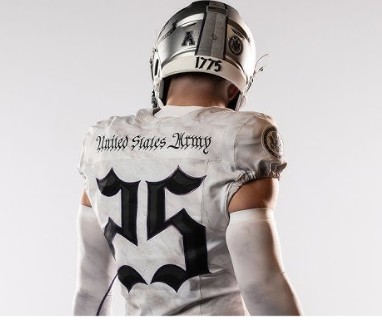
Fraktur and similar blackletter designs never disappeared, however, and since World War II have been widely used by neo-nazis as a link to the Third Reich. Appearing in banners, graffiti and tattoos, they have also crept into mainstream use, as on U.S. Army football jerseys in a recent Army-Navy football game.
In another appearance, Fraktur is used in an ICE recruitment video in which ice agents smash down doors and unleash an attack dog on a suspect. At the end of the video are three phrases: HUNT CARTELS, SAVE AMERICA, JOIN.ICE.GOV.
So, what can we say about typefaces? It’s important to know how typefaces work, why one font works better than another. It’s also important to understand that the typeface you use is part of the message. In some cases, it is the message.
This summer when our cousins, the Haegelens, arrived from Germany, east and west came together. Irina grew up in a village in Siberia, Manfred in Ufa on the slopes of the Ural Mountains. When they were 15, as the Soviet Union was crumbling, their families emigrated to Germany.
When their jet touched down at Logan, they brought their two children, Friedrich and Johanna. They also brought stories, not only about their busy lives near Dusseldorf, but about family history.
Their branch of the family connects to the same tree as my paternal ancestors. We share great grandparents, Mennonite farmers who settled in Southern Russia, along with other ethnic Germans invited to Russia in the 18th century by Catherine II.
In 1914, at the start of the Great War, my grandfather was arrested and exiled to Siberia. The next year, however, he escaped to China, then boarded a ship to San Francisco. The rest of the family remained in Russia.
Now, in our backyard, children and grandchildren were playing together. We made day trips to Walden Pond and Rockport, hiked in the Fells and visited Stone Zoo. In the evening we played dominoes and bingo, calling out numbers in two languages.
Arriving in Germany as teenagers, Manfred and Irina found opportunities unavailable in Russia. Excelling in their studies, they both earned doctorates, Manfred in engineering, Irina in pharmacology.
In the evening we shared old photos and stories. Irina remembered carrying milk in cans from their small farm to the depot. She also remembers her grandfather, who taught math in the village school. He saw her potential and encouraged her.
We also talk of our beloved Tanta Anna, who with two of her five children left their kolkhoz, a collective farm in Southern Russia, to find a new life in Cologne. I have a photo of her on a motorcycle.
When she was 17, during World War II, she was forced to work in the forests, cutting and hauling trees. It happened like this. After Hitler’s tanks crossed into Russia, Stalin, fearing that the nation’s ethnic minorities would rise up against him, ordered their removal and banishment. It was the Great Deportation of 1941.
On September 1, 1941, some 440,000 ethnic Germans living along the Volga were told to report for deportation. Treated as prisoners, they were herded into freight cars for the long trek east. The journey—the trains stopping only every three or four days for food and water—took weeks, sometimes months. On the way four of ten deportees died, their bodies left inside the cars or thrown out beside the tracks.
The mass deportations were also accompanied by summary executions. Manfred’s grandfather, who taught German in the village school, was taken out and shot.
Siberia was not the only destination. Thousands were deported to Kazakhstan and other eastern republics. Cousin Lena, who also emigrated to Germany, told me her grandmother’s account.
“When the soldiers came, they took everything. If a woman had two skirts on, she had to take one off and give it to them.”
They traveled in horse-drawn carts across Kazakhstan almost to the Chinese border. If someone died, they had to leave them lying there. There was no time for burial.
At their destination, there were no houses, so to survive the oncoming winter, they dug shelters in the earth. The next year they built crude houses. They could travel no more than three kilometers in any direction.
Russia’s Germans were not the only ones deported. In all, there were at least 1.5 million, including the Crimean Tatars, Kalmyks, Chechens and others.
As we sat on the couch sharing family photos, or watched the kids swinging in the hammock, I realized how lucky we are. How lucky the Haegelens are to have found good lives in Germany, and how lucky we are in America. Yet somewhere in my consciousness, as it is in theirs, is the shadow of history. A history of deportation, compulsion and violence. I pray it is something our children will never know.
Post-election analysis has included a lot of finger-pointing about why Kamala Harris lost. Yet the simple truth is that Donald Trump won because white people, the demographic majority, voted for him. About 60 percent of whites went for Trump. And a huge portion of these came from Christians. People like me.
“White Christians made Donald Trump president—again,” headlined the Religion News Service.
“Trump’s Path to Victory Still Runs through the Church,” proclaimed Christianity Today.
CNN exit polls revealed that 72 percent of white Protestants and 61 percent of white Catholics voted for Trump. Among white Christians who identified as evangelical or “born again,” the percentage was 81.
Among Christians of all races, Trump still won a clear majority: 63 percent of Protestants and 53 of Catholics. A significant boost in the Catholic vote, especially in swing states, helped put Trump over the top. “Jesus is their savior, Trump is their candidate,” ran an Associated Press headline.
But not all Christians voted for Trump, and a sizable minority has reacted with shock that someone known for racist and misogynistic behavior, vulgar language and threats of violence could win the support of those claiming to be followers of Jesus?
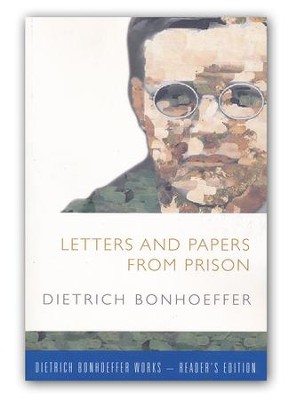
An answer may be found in the release in theaters this month of the movie, “Bonhoeffer.” The film is based on the life of the German pastor and theologian, Dietrich Bonhoeffer, executed by the Nazis in 1945. While the film highlights the dissident’s role in a plot to assassinate Adolf Hitler, the real lessons for us can be found in the years leading up to World War II.
By 1933, when Hitler was elected chancellor, Germans were well aware of his hatred of Jews. As early as 1920 he had labeled them an “alien race” and called for their “irrevocable removal.” Once in control, Hitler began the progressive persecution of Jews and other undesirables. Soon after his inauguration, he released the Aryan Paragraph, barring Jews from civil service and multiple professions. In 1935 the Nuremburg Laws stripped them of citizenship.
In November of 1938 state-sanctioned mobs brutally attacked Jews throughout Germany and its territories, destroying businesses, homes and synagogues. Ten thousand Jewish men were arrested and sent to concentration camps. By the time World War II started, the “final solution” of six million Jews throughout Europe was well underway.
From the German population, 95 percent Christian, the Nazis drew wide support, playing on anti-Semitic and nationalistic themes, heightened by propaganda and misinformation. Following Hitler’s election, one church leader wrote: ‘A fresh, enlivening and renewing reformation spirit is blowing through our German lands….The word of God and Christianity shall be restored to a place of honor.”
In 1933 Hitler appointed Ludwig Müller, an openly anti-Semitic Lutheran cleric, as Reichbishof. In this role, he was to proclaim “positive Christianity.” Mueller presided over the consolidation of the Evangelical (Lutheran) Churches of Germany, representing a majority of German Christians.
In a revision of history, the bishop claimed that Jesus was not a Jew, but an Aryan. In a statement clarifying church policy, he wrote that Jews posed a threat by bringing “foreign blood into our nation.”
One of the Mueller’s early acts was to demand that churches fire any pastors of Jewish ancestry or those married to a Jew. He also ordered all pastors to sign a loyalty oath to the Führer.
Not everyone, however, submitted to the nazification of the German Church. Dietrich Bonhoeffer and other dissidents, refused to submit to church control. In 1933 they formed the Confessing Church.
Throughout Bonhoeffer’s years as pastor, teacher, author and seminary director, he struggled to find his role in the Third Reich. While his early protests centered on preserving church autonomy, he increasingly spoke out against the Reich’s treatment of Jews. He wrote: “Only the person who cries out for the Jews may sing Gregorian chants.”
In time Bonhoeffer understood his mission as going beyond protest to political action. In 1939 he returned from the United States, where a position had been created at Union Theological Seminary expressly for his safety. Back in Germany, he joined the Abwehr, the German Intelligence agency. He was hired by his brother-in-law, Hans von Dohnanyi, on the pretense that the cleric’s many ecumenical contacts would make him an asset. Unknown to the Nazis was his brother-in-law’s role in the Resistance.
In 1943, after the Gestapo found incriminating papers, Bonhoeffer was arrested and imprisoned. On April 9, 1945, just days before American troops liberated the prison camp, he was hanged.
Bonhoeffer was not the only Christian leader to stand against Hitler. The number, however, was small. Most church leaders, including those of smaller denominations, found it expedient to accommodate Nazi ideology. Years later, Harold Alomia, a Protestant pastor and historian, would write: “God’s bride danced with the Devil.”
As we begin life under a second Trump presidency, enabled largely by the votes of white Christians, Bonhoeffer’s story is a warning of what can happen when race hatred and Christian nationalism are joined. American voters, Christian voters, please pay attention.
Stormtroopers holding German Christian propaganda during the Church Council elections on July 23, 1933, at St. Mary’s Church, Berlin.
By Ben Jacques
On a warm day in August, 1934, thousands of Baptists from around the world filed into the vast Tagungshalle in Berlin. From 70 countries, they were there for a week-long Congress of the Baptist World Alliance. Behind the podium was a portrait of three Baptist founders below a cross. To the right hung a red banner with a swastika.
At the conference the delegates were welcomed by the deputy mayor of Berlin, who stressed the good work the government was doing for children and the unemployed (Brown). They also received a greeting from Reichsbishof Ludwig Mueller, whom Hitler had appointed to head the consolidated Evangelical (Lutheran) Churches of Germany. An ardent supporter of Hitler’s “positive Christianity,” Mueller made no secret of his anti-Semitic stance.
The delegates also heard Paul Schmidt, director of the German Baptist Union, praise the good work of the new government, declaring that God had chosen Hitler to rescue the German nation (Norris).
On Tuesday the morning session was suspended so delegates could tune in to the funeral of German President von Hindenburg, whose death two days earlier had left Hitler in full control of the government. A wreathed portrait of von Hindenburg was placed on the stage. Wrote British delegate Eva Brown, “We listened to the chaplain of the German Army, to Hitler, to guns firing, and to a verse of ‘Ein feste Berg,’” Martin Luther’s famous hymn, “A Mighty Fortress.”
In days to follow the international body debated and passed resolutions calling for separation of church and state and freedom of religion. Another resolution deplored “all racial animosity, and every form of oppression or unfair discrimination toward the Jews, toward colored people, or toward subject races in any part of the world” (Resolution 1934.7).
Despite these sentiments, however, a number of delegates sympathized with the Germans’ anti-Semitic policies. M. E. Dodd, president of the Southern Baptist Convention, wrote that Jews, while only one percent of the population, were using their disproportionate influence in professions for “self-aggrandizement to the injury of the German people.”
Others expressed approval of the crackdown on immorality. John W. Bradbury, a Baptist pastor from Boston, wrote: “It was a great relief to be in a country where salacious sex literature cannot be sold; where putrid motion pictures and gangster films cannot be shown” Bradbury continued: “The new Germany has burned great masses of corrupting books and magazines along with its bonfires of Jewish and communistic libraries” (Allen, “How Baptists Assessed Hitler”).
Baptists weren’t the only ones to equate Nazi policies with Christian reforms. A year earlier, the president of the German Seventh-day Adventist Church, Adolph Minck, wrote: ‘A fresh, enlivening and renewing reformation spirit is blowing through our German lands…. The word of God and Christianity shall be restored to a place of honor” (Alomia).
Methodist Bishop Dr. Otto Melle, speaking at the Oxford World Conference in London in 1937, claimed that “God in his providence has sent a leader who was able to banish the danger of Bolshevism in Germany and rescue a nation of 67 million from the abyss of despair” (Manchester Guardian Weekly, July 30, 1937).
Although they comprised only a fraction of Germany’s Protestant population, Baptists, Methodists and Adventists came under enormous pressure to conform. Like the Lutherans and Catholics, they struggled with threats to their beliefs. With notable exceptions, however, most found it expedient to accommodate Nazi ideology. As Adventist minister and historian Harold Alomía would later write, “God’s bride danced with the Devil.”
What they got in return was the survival of their organizations, a chance to evangelize, and an opportunity to play a stronger role in society.
What they should have foreseen, however, was the moral stranglehold they would encounter. While allowed to operate, the churches were counted on to support Nazi ideology. They were also asked to become ambassadors abroad.
In March of 1933, within days after Hitler took control, Nazi Foreign Minister Konstantin von Neurth and Propaganda Minister Joseph Goebbels met with Bishop John L. Nuelsen, president of the Europe Central Conference of the Methodist Episcopal Church. Because he had ties with the large Methodist population in America, he and fellow clergy could be of great help in influencing public opinion abroad at a time when Hitler needed international good will (Blaich, “A Tale of Two Leaders”).
In response, writes historian Roland Blaich, Bishop Nuelsen “joined General Superintendent Hans Dibelius of the Evangelical Church in a short-wave broadcast assuring the outside world that all was well in Germany.” Methodist leaders also sent telegrams to the press in England and the United States “protesting reports of alleged atrocities” (Blaich, “A Tale of Two Leaders”).
The Nazis also reached out to the Baptists and Adventists. What followed were numerous trips by church leaders to the United States. Speaking at church, academic and cultural associations, they praised the achievements of the Nazi government and countered criticism of its treatment of Jews.
The Seventh-day Adventist Church in Germany sent the director of its reputable social service agency, Hulda Jost. Although the Adventist Church had been declared illegal in 1933, it had appealed, stressing its support for the government and its upholding of family values and healthy living. Within weeks, it was reinstated (Blaich, “Selling Nazi Germany Abroad”).
In 1936, on her way to a church world conference in San Francisco, Jost spoke to organizations across the country. Quoted in a Chicago Daily News article, she claimed that “Hitler does not want war.” When asked about persecution of the Jews, she said “Hitler has merely wanted to take leadership away from the Jews, but he doesn’t want to hurt them.” (Schroder, “Seventh Day Adventists”).
Meanwhile, Christians in Germany were being tested. In April 1933, the Nazis introduced the Prevention of Offspring with Hereditary Diseases Act. This law mandated forcible sterilization for nine disabilities and disorders. As a result, 400,000 Germans were sterilized in Nazi Germany.
In 1935 came the Nuremburg Laws, stripping Jews of citizenship and prohibiting racial intermarriage. Later came euthanasia, or “mercy killing,” which accounted for an estimated 250,000 deaths. “A curious path led from caritas, the caring for the less fortunate and weak, to elimination of the weak, as the work of God,” Blaich writes.
Churches were also told to purge their members of Jews. This spelled particular trouble for the Seventh-day Adventists. Because Adventists kept Saturday as Sabbath, and had similar dietary practices, they were sometimes associated with Judaism. Eager to show they were Christian, Adventists started calling Saturday “Rest Day,” rather than the Sabbath. Across Germany and occupied countries, signs appeared on church doors prohibiting Jews from entering.
There are several accounts of Christians with Jewish heritage being expelled and shunned. Some disappeared. Others died in concentration camps (Heinz, “Painful Rememberance”).
Not all churches in Germany made peace with the Third Reich. Some, like the Confessing Church, were outlawed, and many of their members persecuted or killed. Others fared even worse. Approximately 1,500 Jehovah’s Witnesses died or were killed in concentration camps.
While a majority of German Christians found a way to accommodate the Nazi agenda, there were also individuals, Protestants and Catholics, who risked or gave their lives to protect Jews and others. Their stories are a precious testament to the capacity of the human heart for courage and compassion.
From Christians who went along with the Nazis, however, we see how treacherous is the mix of religion and nationalism and how lethal when race hatred is added. From their tragic experience, we have much to learn.
Brown, Eva. “The Baptist World Conference in Berlin.” Baptist Quarterly, October 1934.
Brumley, Jeff. “What Happens When Church and State Merge? Look to Nazi Germany for Answers.” Baptist Press, Jan. 30, 2023.
“Church’s Relations with the State: The Oxford Conference and the German Delegates,” The Manchester Guardian Weekly, 30 July 1937. The official report on the Oxford Conference is found in J. H. Oldham, The Oxford Conference (New York: Clark, 1937.)
Dodd, M. E. “My Impressions of the Baptist World Congress.” Baptist and Reflector, Sept. 13, 1934.
Heinz, Daniel. “Painful Remembrance: Adventists and Jews in The Third Reich.” Shabbat Shalom Magazine, Viewpoint 28 December 2017. This article appeared originally in German in Adventecho, May 2001, pp. 12-14. Translation by Martin Pröbstle.
King, Christian Elizabeth. The Nazi State and the New Religions. E Mellon Press, London: 1982.
Norris, Kristopher. “Baptists under Nazism and Baptists amid America’s current political crisis: a call to ‘disruption’” Baptist News, Nov. 21, 2019.
Roach, David. “Baptists ‘humbled’ by failure to oppose Nazis.” Baptist Press, Sept. 18, 2014.
Schroder, Corrie. “Seventh Day Adventists,” Oral History Project, University of California at Santa Barbara, 2002.





 Ben Jacques Stories