What Happens There Matters Here

Sunday morning Becky and I walked through heavy rain to a tent set up just outside Delaney Hall, an ICE detention prison holding over a 1,000 men and women in Newark, NJ. We had driven over from our daughter’s home in a Newark suburb. She had arrived earlier, joining other volunteers to set up coffee and food along with clothing, diapers and toys for families hoping to visit their loved one inside.
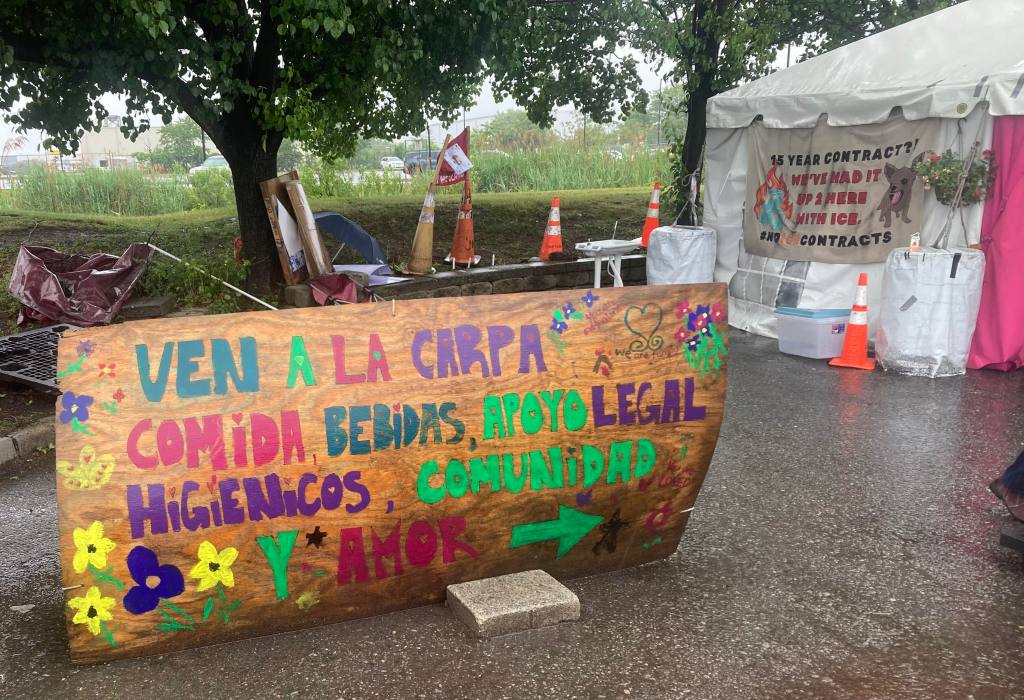
“Come to the Tent” in Spanish is posted by volunteers providing support to families of detainees at the Delaney Hall Detention Center.

Situated off the turnpike in New Jersey among huge gas tanks, warehouses, depots and a state prison, Delaney Hall has been the flashpoint for protests of its inhumane treatment of inmates. On Friday, around 300 detainees began a weekend hunger and labor strike and called on Gov. Mikie Sherrill to visit Delaney Hall, a private, for-profit facility, and address their complaints.

The day before, Senator Andy Kim (Dem-NJ) had visited Delaney Hall and met with inmates and advocates. Voicing his support for the detainees, he wrote this on his Facebook page:

I rushed to ICE detention center Delaney Hall yesterday when I heard detainees began a hunger strike. Here’s what I saw:

An 18 yr-old high-school student crying and saying she just wanted to graduate senior year;

A pregnant woman unable to get full OBGYN medical support;

A woman who had a miscarriage in the detention facility and left to manage all on her own;

A mom not allowed to spend more that a few minutes with 4-month-old baby;

A husband of an American-citizen wife and kid;

A carton with the milk inside congealed solid (expiration date is tomorrow); [there were also complaints of worms in the food.]

A man there for nearly a year with no movement in his legal efforts;

A document showing next Tuesday’s court docket showing 74 cases before one judge in one day (averages about 5 minutes a case);

A man telling me ICE is trying to deport him to the Democratic Republic of Congo, where there is an active Ebola outbreak (he’s from South America originally);

Numerous people who were arrested at scheduled interviews for Green Cards (trying to follow the formal process);

A family unable to find out what hospital their family was sent to (ICE said they cannot give any medical updates to families of hospitalized detainees);

The Statue of Liberty as I left the facility to drive home. [You can see the Statue from Liberty State Park in Jersey City, not far from Delaney Hall.]

In another column, I’ll write more about what happens at Delaney Hall, and in the tent where volunteers provide support to families of detainees. Because what happens there, even if it’s not on the 6 o’clock evening news, must matter to us.

Delaney Hall Detention Center in Newark, NJ

What song will we sing?

Woodie Guthrie wrote the lyrics. Martin Hoffman set them to music. Since then, it’s been sung by Bob Dylan, Joan Baez, Johnny Cash, Dolly Parton, Bruce Springsteen, Pete Seeger and Arlo Guthrie.

It’s a ballad called “Deportees” and it tells of an airplane crash in California’s Los Gatos Canyon. On board were 28 migrant farm workers from Mexico.

The lyrics are as searing now as in 1848 when Guthrie wrote them:

The sky plane caught fire over Los Gatos Canyon,
A fireball of lightning, and shook all our hills,
Who are all these friends, all scattered like dry leaves?
The radio says, “They are just deportees.”

Guthrie wrote the ballad one night after news reports listed the names of the pilots, attendant and immigration guard lost in the crash, but referred to the farm workers only as “deportees.” After the braceros’ bodies were recovered, they were buried in a mass grave without names, marked “Mexican Nationals.”
 
The roundup of the Los Gatos laborers was just one episode in several government campaigns to remove Mexicans and those with Mexican ancestry. Mass deportation began in 1930 and continued through the Great Depression. Then in 1954, the Immigration and Naturalization Service (INS) brought out “Operation Wetback.” Under this federal program, officials used strong-arm tactics to arrest tens of thousands of immigrants across the country. Caught up in the raids were farm and factory workers, including American citizens.

In July of 1955, several thousand deportees were found wandering the streets of Mexicali, a desert town bordering California. Yanked from their jobs and families, they had simply been dumped across the border. According to one account, 88 died of heat exposure in the 112 degree heat.

In Texas, thousands of deportees were crammed onto boats bound for Mexican ports. Testimony before a Congressional committee described conditions akin to those on slave ships. Other immigrants were packed into trucks. By the end of Operation Wetback, the INS claimed it had “repatriated” 1.3 million Mexicans.

Goodbye to my Juan, goodbye, Rosalita,
Adios mis amigos, Jesus y Maria;
You won’t have your names when you ride the big airplane,
All they will call you will be “deportees.”

 
Accompanying the mass deportations were media depictions of Mexicans as dirty, disease-bearing and lazy. News coverage focused on border and immigration officials conducting raids.

Only in time did most Americans come to see this as something shameful. In a 2012 ceremony in Los Angeles, Governor Jerry Brown and Mayor Antonio Villaraigosa formally apologized for California’s role in the deportations.

On Labor Day in 2013, United Farm Worker President Arturo Rodriguez joined hundreds gathered at the Holy Cross Cemetery in Fresno, California, to memorialize the 28 farm workers killed in Los Gatos Canyon. They were 25 men and three women. This time, inscribed in the headstone, was each person’s name.

Now, deportation planes are again in the sky. Planes to El Salvador, Guatemala and Honduras. Planes to India and Rwanda. Planes to Eswatini, a tiny country in southern Africa.

Through October 2025, the Department of Homeland Security operated 1,701 deportation flights to 77 countries. And it recently bought six Boeing 737s, expanding capacity.

Meanwhile, 66,000 men, women and children await deportation in detention centers. Arrested, often with brutal force, they were tracked down in streets, courthouses, parking lots, fields and construction sites.

Some of us are illegal, and some are not wanted,
Our work contracts out and we have to move on.
Six hundred miles to that Mexican border,
They chase us like outlaws, like rustlers, like thieves.

Compared to programs of the past, Donald Trump’s campaign is Operation Wetback on steroids. The president wants 3,000 arrests a day, or one million by the end of his first year in office. Each day, it seems, he expands his list of targets, Somalis, Haitians, Venezuelans, Afghans. What they have in common is their darker shades of skin.

As I listen to Woodie Guthrie’s song, I think of my children and grandchildren. I wonder, what song will they sing in years to come? Who will write the words, and who will remember the names?

Will there be, one day in the future, a public apology, a ceremonial mea culpa for the cruelty, the harm inflicted on so many? If so, what song will we then sing.

A Song for our Time, too

Woodie Guthrie wrote the lyrics. Martin Hoffman set them to music. Since then, It’s been sung by Pete Seeger, Bob Dylan, Johnny Cash, Joan Baez, Dolly Parton, Bruce Springsteen and a dozen others, including Arlo Guthrie.
The ballad tells of an airplane crash in California’s Los Gatos Canyon. On board were 28 migrant farm workers from Mexico.

The year was 1948, six years after the start of Operation Bracero, a government program which recruited Mexican laborers to work in American fields. Now the braceros were being rounded up and flown back to Mexico. At the same time, to keep prices high, the government was paying growers to leave their crops in the field. Peaches were rotting and oranges piling up in dumps.

The song is called “Deportee.” Guthrie wrote it after news reports listed the names of the pilots, attendant and immigration guard, but referred to the farm workers only as “deportees.” Unlike the four Americans, the braceros were buried in a mass grave without names, marked
“Mexican Nationals.” As the song goes,

The sky plane caught fire over Los Gatos Canyon,
A fireball of lightning, and shook all our hills,
Who are all these friends, all scattered like dry leaves?
The radio says, “They are just deportees”

 
The roundup of the Los Gatos laborers was just one episode in several government campaigns to remove Mexicans from American soil. Mass deportations began during the Great Depression and continued through the 1940s. Then in 1954, the Immigration and Naturalization Service (INS) brought out “Operation Wetback.” Under this federal program, officials used military-like tactics to arrest tens of thousands of immigrants across the country. Caught up in the raids were farm and factory workers, including some American citizens.

In July of 1955, several thousand deportees were found wandering the streets of Mexicali, a desert town bordering California. Yanked from their jobs and families, they had simply been dumped across the border. According to one account, 88 died of heat exposure in the 112
degree heat.

In Texas, thousands of deportees were crammed onto boats bound for Mexican ports in conditions comparable with those on slave ships. Others were packed into trucks. By the end of Operation Wetback, the INS claimed it had “repatriated” 1.3 million Mexicans.

Goodbye to my Juan, goodbye, Rosalita,
Adios mis amigos, Jesus y Maria;
You won’t have your names when you ride the big airplane,
All they will call you will be “deportees”

 
Accompanying the mass deportations were media depictions of Mexicans as dirty, disease- bearing and irresponsible. News coverage focused on border and immigration officials planning and conducting raids. Only in time did most Americans come to see this as something shameful. In 2012 the state of California formally apologized for its role in deporting hundreds of thousands of U.S. citizens.

On Labor Day in 2013, United Farm Worker President Arturo Rodriguez joined hundreds gathered at the Holy Cross Cemetery in Fresno, California, to memorialize the 28 farm workers, 25 men and three women, killed in Los Gatos Canyon. This time, inscribed in the headstone, was each person’s name.

Next week American voters will choose a new president. One of the candidates has promised to resurrect Operation Wetback, only under his plan the government, in a military-style operation, will deport 11 million undocumented immigrants (Trump put the figure at 18 million).

Trump would also end deferrals for children (DACA) and temporary protected status (TPS) for migrants fleeing violence and persecution in their home countries. Such a massive deportation would throw our country into financial, legal and social chaos. As Slate authors Louis Hyman and Natasha Iskander have written, “To return to the era of Operation Wetback would be to return to an America ruled not by law but by terror.”

Perhaps worst of all, it would perpetuate the big lie that immigrants, asylum seekers, migrants and refugees are not like us, that they are less than human. That they don’t deserve names.

Once that lie is believed, we become silent to the cruel treatment of others.

Photo: Lance Canales & the Flood