A Ballad for our Time, Too

Woodie Guthrie wrote the lyrics. Martin Hoffman set them to music. Since then, it’s been sung by Bob Dylan, Joan Baez, Johnny Cash, Dolly Parton, Bruce Springsteen, Pete Seeger and Arlo Guthrie.

It’s a ballad called “Deportees” and it tells of an airplane crash in California’s Los Gatos Canyon. On board were 28 migrant farm workers from Mexico.

The lyrics are as searing now as in 1848 when Guthrie wrote them:

The sky plane caught fire over Los Gatos Canyon,
A fireball of lightning, and shook all our hills,
Who are all these friends, all scattered like dry leaves?
The radio says, “They are just deportees.”

Guthrie wrote the ballad one night after news reports listed the names of the pilots, attendant and immigration guard lost in the crash, but referred to the farm workers only as “deportees.” After the braceros’ bodies were recovered, they were buried in a mass grave without names, marked “Mexican Nationals.”
 
The roundup of the Los Gatos laborers was just one episode in several government campaigns to remove Mexicans and those with Mexican ancestry. Mass deportation began in 1930 and continued through the Great Depression. Then in 1954, the Immigration and Naturalization Service (INS) brought out “Operation Wetback.” Under this federal program, officials used strong-arm tactics to arrest tens of thousands of immigrants across the country. Caught up in the raids were farm and factory workers, including American citizens.

In July of 1955, several thousand deportees were found wandering the streets of Mexicali, a desert town bordering California. Yanked from their jobs and families, they had simply been dumped across the border. According to one account, 88 died of heat exposure in the 112 degree heat.

In Texas, thousands of deportees were crammed onto boats bound for Mexican ports. Testimony before a Congressional committee described conditions akin to those on slave ships. Other immigrants were packed into trucks. By the end of Operation Wetback, the INS claimed it had “repatriated” 1.3 million Mexicans.

Goodbye to my Juan, goodbye, Rosalita,
Adios mis amigos, Jesus y Maria;
You won’t have your names when you ride the big airplane,
All they will call you will be “deportees.”

 
Accompanying the mass deportations were media depictions of Mexicans as dirty, disease-bearing and lazy. News coverage focused on border and immigration officials conducting raids.

Only in time did most Americans come to see this as something shameful. In a 2012 ceremony in Los Angeles, Governor Jerry Brown and Mayor Antonio Villaraigosa formally apologized for California’s role in the deportations.

On Labor Day in 2013, United Farm Worker President Arturo Rodriguez joined hundreds gathered at the Holy Cross Cemetery in Fresno, California, to memorialize the 28 farm workers killed in Los Gatos Canyon. They were 25 men and three women. This time, inscribed in the headstone, was each person’s name.

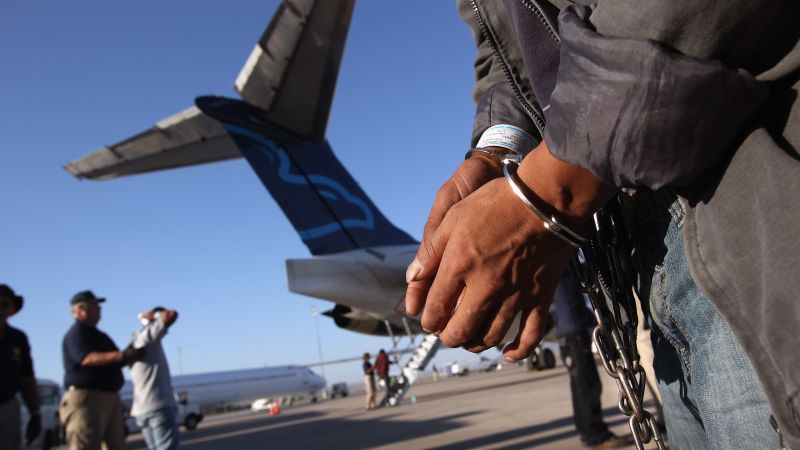
Now, deportation planes are again in the sky. Planes to El Salvador, Guatemala and Honduras. Planes to India and Rwanda. Planes to Eswatini, a tiny country in southern Africa.

Through October 2025, the Department of Homeland Security operated 1,701 deportation flights to 77 countries. And it recently bought six Boeing 737s, expanding capacity.

Meanwhile, 66,000 men, women and children await deportation in detention centers. Arrested, often with brutal force, they were tracked down in streets, courthouses, parking lots, fields and construction sites.

Some of us are illegal, and some are not wanted,
Our work contracts out and we have to move on.
Six hundred miles to that Mexican border,
They chase us like outlaws, like rustlers, like thieves.

Compared to programs of the past, Donald Trump’s campaign is Operation Wetback on steroids. The president wants 3,000 arrests a day, or one million by the end of his first year in office. Each day, it seems, he expands his list of targets, Somalis, Haitians, Venezuelans, Afghans. What they have in common is their darker shades of skin.

As I listen to Woodie Guthrie’s song, I think of my children and grandchildren. I wonder, what song will they sing in years to come? Who will write the words, and who will remember the names?

Will there be, one day in the future, a public apology, a ceremonial mea culpa for the cruelty, the harm inflicted on so many? If so, what song will we then sing.

She loves us, she loves us not

Art by Elizabeth Catlett

She loves us, she loves us not. She loves us, she loves us not. So the petals of the daisy tell the story of America’s love-hate relationship with her immigrant people—homesteaders and refugees, migrants and asylum seekers, those fleeing poverty, war, persecution and famine.

President Donald Trump, aide Stephen Miller, DHS’s Kristi Noem, and ICE tsar Tom Holman are not the first ones in our nation’s history to tilt America against immigrants. Anti-immigrant sentiment has been fanned into flames on and off from our earliest days. Posing as populists, politicians have railed against foreigners “poisoning the blood of our country,” as Trump put it in during his presidential campaign.

Since the first Europeans arrived without visas, and Africans arrived in chains, America has opened doors to newcomers, then shut them, opened, then shut them again. In the 19th century, we needed workers for our factories and farmers for our prairies. We needed merchants and tradesmen, engineers and inventors. It helped if you were Protestant and white. It wasn’t good if you were Chinese or Irish or Mexican.

Although doors for a while swung open to “your tired, your hungry, your masses yearning to breathe free,” by the 1920s they had all but closed again. Laws approved by Congress in 1917 and 1921 slowed immigration to a trickle, setting quotas based on national origin. These laws and anti-Semitic sentiment kept out thousands of Jews attempting to flee Nazi Germany. Included among them were 907 passengers–men, women and children–aboard the M.S. St. Louis. Refused permission to dock in Miami, the ship turned back to Europe. Some 250 perished in concentration camps.

The Immigration and Nationality Act of 1952 preserved a restrictive quota system favoring Europeans, but made an important change. The bill abolished the “alien ineligible to citizenship” category applied to Asians, although it limited the number of those who could qualify.

Deciding who to allow in America is one thing. What to do with those already in is another. The answer has often been harsh. For example, the Chinese and the Chinese Exclusion Act of 1882. For example, the braceros invited in to plant and harvest our crops.

In 1954, the Immigration and Naturalization Service (INS) brought out “Operation Wetback.” Under this federal program, officials used military-like tactics to arrest tens of thousands of immigrants across the country. Caught up in the raids were farm and factory workers, including some American citizens. Deemed unwelcome, they were flown, trucked or shipped across the border.

I was thinking of all this as I sat in a café in Woburn the other night, listening to the stories of three immigrants. From Nicaragua, Turkey and India, they shared stories of their arrival and the challenges and obstacles they faced. As they pursue remarkable careers in science, health care and technology, they are reaching out to others, mentoring and building community.

Above all, they are sharing their love for America. She loves me. She loves me not.

Like many Americans, I am pained by the policies and actions of our government, by the slamming of doors to thousands of refugees who were already been vetted for resettlement. By the ending of legal protections for thousands fleeing violence and persecution in their home countries. By the brutal and cruel tactics of ICE agents as they take parents from children and children from families.

The simple truth is, we need immigrants. We need them, not only for economic reasons, to bring young life to an aging demographic, but for their love ethic.

It’s time to love our immigrants again.  

They Love America, but …

They love America, but America doesn’t love them back. “They” are the millions of immigrants, refugees and asylum seekers facing deportation.

Built by immigrants, America has now turned its back on them, thanks to Donald Trump and his MAGA followers, who for decades have demeaned and dehumanized them, especially those with skin darker than theirs.

Ironically, many immigrants and asylum seekers have come here legally, through government programs granting them the chance to live here in safety. Others, like Marcelo Gomes da Silva, a Milford high school student taken by ICE while on his way to volleyball practice, have grown up among us and know no other life.

Marcelo, who came to the United States from Brazil when he was six, is an honors student. A junior, he plays in the band and would have performed at Sunday’s graduation. According to a friend, he was shackled feet and hands and shoved into a holding cell with 25 older men.

Here’s what’s happening. Trump wants Homeland Security and ICE to roundup 3,000 “illegal” immigrants a day. They haven’t been meeting their quota, though they’ve tried. To make it easier to find bodies to deport, Trump changed the rules. Now a half million immigrants—families, parents and children who were here legally—have had the rug, no, the ground, pulled out from under them.

Fleeing violence and persecution in their home countries, they were granted “humanitarian parole” or “temporary protected status.” They were fingerprinted and documented. By revoking these programs, Trump has made them easy to find.

ICE has also found other easy targets, immigrants who show up at courthouses for hearings. They’ve been nabbed in hallways and stairwells. A judge was arrested and accused of helping one immigrant leave by a back door.

Masked ICE agents are raiding factories and farms, bodegas and restaurants. They are grabbing people off the streets, taking mothers and fathers from children and children from siblings. The word has gone out. No place is safe, including churches, hospitals and schools.

All this is going on while the Trump administration is calling on Americans to have more babies to counter the declining birth rate. He wants more babies, more young families, yet the clear message is that he wants white families, not black or brown. How else to explain the counter-intuitive break-up and deportation of families already here–those who want nothing more than to live in a safe and free country. Those who love America, even if America doesn’t love them back.

If ICE can meet its 3,000 per day quote, over a million of our neighbors will have been arrested and deported this year, one big step towards the deportation of the 15 to 20 million Trump has threatened.

To millions of Americans, sadly, that is a good thing. They voted for someone to do just that. To millions more, however, it is a travesty. It goes against everything they believe in and stand for.

The largest segment of Americans who voted for Trump in 2024 were Christians, especially white Christians. They put Trump in office. They could be the ones, now, to stop him. Leaving their pews, they could pick up the phone, march in the streets, demand an end to the cruelty, whether to our immigrant neighbors, or to the millions of poor who will lose their health insurance if his budget goes through.

Last Friday in an interfaith rally, some 70 clergy did just that. Marching from the Lexington Green to the Boston Common, they protested the cruel treatment of immigrants and international students.

Meanwhile, in Washington, D. C., a group of ministers praying in the Rotunda of the Capitol were cuffed with zip-ties and taken out, arrested for protesting against cuts to Medicaid and the harm it would cause millions. They were led by the Rev. William Barber, co-chair of the Poor People’s Campaign.

These faith leaders, like the prophets of old, are calling us to action. It’s time we pay attention.

Protect the Babies We Have

Art by Thaer Abdallah

Let’s see if I get this right. The Trump administration wants us to have more babies. What with Covid and a declining birth rate, we need more young people to offset those of us with gray hair. We need them to replenish our communities and pay our bills. Trump recently talked of giving a bonus of $5,000 to each new mother.

At the same time his administration is deporting mothers, fathers, and, yes, babies. He is rounding up immigrants, including those who are paying taxes and contributing to Social Security and Medicare. He is breaking up families.

In Harrisburg, Pennsylvania, ICE recently took a mother away from her 1-year-old girl and deported her to Cuba, separating them indefinitely. ICE also deported three children ages 2, 4 and 7 along with their mothers to Honduras. The children are U.S. citizens. The 4-year old has a rare form of cancer.

It’s become clear that Trump’s pro-baby, pro-family approach is meant for one type of family, one type of baby–white families and white babies. And that all this talk about encouraging women to give birth and to stay at home to raise their children is rooted in white nationalist ideology.

What is white nationalism? White nationalism is “advocacy of or support for the perceived political interests of the white population within a particular country, especially to the exclusion or detriment of other racial and ethnic groups.”

White nationalism, along with white supremacy, has always been around. It was behind the enslavement of millions of African Americans. It was behind the Chinese Exclusion Act. It was behind the “separate but equal” Supreme Court decision that affirmed racial apartheid in Southern states. It was given new energy with the re-election of Donald Trump.

Consider the makeup of Trump’s cabinet and advisors. Consider his history of demeaning comments and slurs. Consider the attacks on DEI—diversity, equity and inclusion—and the government’s punitive policies directed towards racial and ethnic minorities. Consider Trump’s revoking of “temporary protected status” for asylum seekers from Haiti and Venezuela.

Consider his shutting down of our refugee resettlement program, stranding thousands of already approved refugees from Africa and the Middle East. At the same time, he has put out the welcome mat for Afrikaners in South Africa, whom he claims are victims of “white genocide.”

Last week 59 white South African “refugees” arrived at Dulles International Airport in Washington, D. C. A photo of them shows young families holding babies in their arms. Deputy Secretary of State Christopher Landau told them: “We’re excited to welcome you here to our country where we think you will bloom.”

All this, while Trump denies a haven to black and brown families fleeing famine, war and persecution.

So what do we do about it? First, we need a stop to the deportations of non-violent immigrants—full stop—and the affording of due process to all. And we need a resumption of our long-standing refugee-resettlement program, applied fairly to everyone.

Second, we need immigration reform. For too many decades, we have let Congress off the hook. The last significant immigration reform came during Ronald Reagan’s presidency, when millions of immigrants were granted pathways to citizenship. The failure of Congress and past administrations to legislate common-sense reform has victimized millions of our neighbors, who want nothing more than to build lives for their families in a safe and free country.

As for the Administration’s push to have more babies, I say let’s protect the babies we have, and their parents and siblings–refugees, asylum seekers, DACA enrollees, immigrants. They are part of our communities. We need them. Diverse, multi-cultural, hardworking, creative, they, with us, can build an American future based not on white-nationalist ideology, but on equal opportunity for all people, regardless of race, ethnicity, gender or religion. A future aligned with our Declaration of Independence and Constitution.

Let’s hold the babies we have.

Protecting our Neighbors

Painting by B Faustin

Rumeysa Ozturk, a doctoral student at Tufts, is grabbed off the street and flown to a prison in Louisiana. In Boston a man is nabbed while leaving the courthouse. In New Bedford, ICE agents smash the windows of a car to arrest someone with no criminal history. In Chelsea, Boston, Worcester, Medford, Wakefield and other cities, hundreds have gone missing, picked up by ICE in raids.

Meanwhile, immigrants, including those with temporary protected status (TPS), are afraid. Children don’t want to go to school for fear their parents won’t be there when they return home. Community leaders talk of a siege mentality.

Since a 2017 ruling by the state Supreme Judicial Court, Massachusetts has limited its cooperation with the federal government’s deportation efforts. As Stoneham Police Chief James O’Connor puts it: “Being in this country without legal documentation is a civil offense. Massachusetts police officers do not have the jurisdiction to enforce civil immigration law.” The only exceptions are in cases of criminal activity or threats to public safety.

In a policy statement, Chief O’Connor stated: “Stoneham Police will afford all residents all civil rights, due process, and equal protection safeguards available under the U. S. Constitution, the Massachusetts Constitution and Town laws, ‘irrespective of the person’s immigration and/or documentation status.’”

Regardless of state and local policies, our immigrant neighbors are increasingly threatened by a Trump administration that has shown no regard for rules or, for that matter, First Amendment rights.

For this reason, four bills are now at the State House that would increase protections for immigrants in Massachusetts. They are sponsored by various state reps and senators and supported by the ACLU, MIRA and numerous organizations.

The first is the Safe Communities Act. It would prohibit voluntary involvement of local police and courts in civil immigration matters and require “informed consent” before any ICE interview can take place.

The second bill is the Immigrant Legal Defense Act. Studies show that immigrants are five times more likely to win relief from deportation if they are represented by a lawyer. This act would provide funds for free legal defense for at-risk immigrants, especially those in federal detention.

A third bill at the State House, the Language Access and Inclusion Bill, would expand translation and interpretation for Massachusetts residents. This is especially important as the federal government is pulling back from communications except in English.

A fourth bill in Boston would prohibit contracts with the federal government for detention facilities in the Commonwealth, such as the Plymouth County  Correctional Facility, which currently holds hundreds of immigrants awaiting deportation.Fact sheets on all four legislative proposals can be found online at the Massachusetts Immigrant and Refugee Advocacy Coalition at miracoalition.org.

This week, members of Stoneham for Social Justice, a network of concerned citizens, endorsed these four bills and called on state legislators to support and fast track them.

In Massachusetts there are an estimated 250,000 undocumented immigrants, individuals and families who have sought a safe place to work and live. Thousands more have fled oppression and disasters under programs that grant them protective status. For many, including Venezuelans and Haitians, this status is being revoked.

Immigrants among us, our families, our neighbors, those we work with, those who provide services to us, are part of our daily lives. They play an integral and productive role in our communities. At the very least, they deserve the rights guaranteed to all in our Constitution, including the right to fair hearings and due process. When these are threatened, they deserve our protection.

A Turning Point?

Flight into Egypt, Italian, c. 1620.

I grew up in a fundamentalist Christian home. Keeping God’s law was a big thing, especially the Ten Commandments. So when I hear Christians today talk about how all these undocumented immigrants are law breakers who must be deported, I know where they’re coming from.

For many Christians, especially white Christians, it doesn’t seem to matter that being in this country without documentation is a civil infraction, not a crime. To them, it’s criminal, deserving of the harshest punishment. It doesn’t matter that parents are taken from children, or that asylum seekers find themselves in prisons in another country.

Neither are many religious people bothered that most immigrants, including families, are here for one reason: poverty, war or threats to their safety in their country of origin.

They should have come in the right way, they say. Yet, within our broken immigration system, we know there is no right way. And now we see that even those here legally, such as those under temporary protected status (TPS), are ordered to leave the country.  These include immigrants from Haiti, Venezuela, Cuba and Nicaragua.

Even those with green cards, authorizing them as permanent residents, are being singled out and deported.

Yet not all Christians support President Trump’s orders and policies. And there is increasing evidence that many who voted for Trump are now recoiling from his cruelty.

Meanwhile, others are calling for a return to the commandment of Jesus in the New Testament: “A new command I give you: Love one another.” Sometimes called Matthew 25 Christians, they turn to the Sermon on the Mount and the Parable of the Last Judgement to stand up against Trump’s cruel policies.

Whatever happened to “I was hungry and you fed me. I was a stranger and you welcomed me”? they ask. What about, “In as much as you have done it unto one of the least of my brethren, you have done it unto me”?

They are joining those from other religions or none to demand a stop to the indiscriminate deportation of immigrants, refugees and asylum seekers. They are insisting on safe homes and communities for millions threatened by arrest and detention.

And they are a calling for a new law, such as one filed last week by Representative Sylvia Garcia of Texas. Co-sponsored by 201 members of Congress, the Dream and Promise Act would provide a pathway to US citizenship for most DACA recipients, other Dreamers, and those on Temporary Protected Status or Deferred Enforced Departure. In short, it would allow millions of our friends and neighbors to continue living, working and going to school in our country.

In a democracy, it is the duty of all to obey the laws. Yet, when a law is unjust, when it goes against our most deeply held beliefs and convictions, it is the duty of citizens to create a better law. For too many years, that has not happened. Now is the time to stop mass deportations. Now is the time to craft new immigration laws. Now, even in the midst of the storm.

What song will we sing?

Woodie Guthrie wrote the lyrics. Martin Hoffman set them to music. Since then, it’s been sung by Bob Dylan, Joan Baez, Johnny Cash, Dolly Parton, Bruce Springsteen, Pete Seeger and Arlo Guthrie.

It’s a ballad called “Deportees” and it tells of an airplane crash in California’s Los Gatos Canyon. On board were 28 migrant farm workers from Mexico.

The lyrics are as searing now as in 1848 when Guthrie wrote them:

The sky plane caught fire over Los Gatos Canyon,
A fireball of lightning, and shook all our hills,
Who are all these friends, all scattered like dry leaves?
The radio says, “They are just deportees.”

Guthrie wrote the ballad one night after news reports listed the names of the pilots, attendant and immigration guard lost in the crash, but referred to the farm workers only as “deportees.” After the braceros’ bodies were recovered, they were buried in a mass grave without names, marked “Mexican Nationals.”
 
The roundup of the Los Gatos laborers was just one episode in several government campaigns to remove Mexicans and those with Mexican ancestry. Mass deportation began in 1930 and continued through the Great Depression. Then in 1954, the Immigration and Naturalization Service (INS) brought out “Operation Wetback.” Under this federal program, officials used strong-arm tactics to arrest tens of thousands of immigrants across the country. Caught up in the raids were farm and factory workers, including American citizens.

In July of 1955, several thousand deportees were found wandering the streets of Mexicali, a desert town bordering California. Yanked from their jobs and families, they had simply been dumped across the border. According to one account, 88 died of heat exposure in the 112 degree heat.

In Texas, thousands of deportees were crammed onto boats bound for Mexican ports. Testimony before a Congressional committee described conditions akin to those on slave ships. Other immigrants were packed into trucks. By the end of Operation Wetback, the INS claimed it had “repatriated” 1.3 million Mexicans.

Goodbye to my Juan, goodbye, Rosalita,
Adios mis amigos, Jesus y Maria;
You won’t have your names when you ride the big airplane,
All they will call you will be “deportees.”

 
Accompanying the mass deportations were media depictions of Mexicans as dirty, disease-bearing and lazy. News coverage focused on border and immigration officials conducting raids.

Only in time did most Americans come to see this as something shameful. In a 2012 ceremony in Los Angeles, Governor Jerry Brown and Mayor Antonio Villaraigosa formally apologized for California’s role in the deportations.

On Labor Day in 2013, United Farm Worker President Arturo Rodriguez joined hundreds gathered at the Holy Cross Cemetery in Fresno, California, to memorialize the 28 farm workers killed in Los Gatos Canyon. They were 25 men and three women. This time, inscribed in the headstone, was each person’s name.

Now, deportation planes are again in the sky. Planes to El Salvador, Guatemala and Honduras. Planes to India and Rwanda. Planes to Eswatini, a tiny country in southern Africa.

Through October 2025, the Department of Homeland Security operated 1,701 deportation flights to 77 countries. And it recently bought six Boeing 737s, expanding capacity.

Meanwhile, 66,000 men, women and children await deportation in detention centers. Arrested, often with brutal force, they were tracked down in streets, courthouses, parking lots, fields and construction sites.

Some of us are illegal, and some are not wanted,
Our work contracts out and we have to move on.
Six hundred miles to that Mexican border,
They chase us like outlaws, like rustlers, like thieves.

Compared to programs of the past, Donald Trump’s campaign is Operation Wetback on steroids. The president wants 3,000 arrests a day, or one million by the end of his first year in office. Each day, it seems, he expands his list of targets, Somalis, Haitians, Venezuelans, Afghans. What they have in common is their darker shades of skin.

As I listen to Woodie Guthrie’s song, I think of my children and grandchildren. I wonder, what song will they sing in years to come? Who will write the words, and who will remember the names?

Will there be, one day in the future, a public apology, a ceremonial mea culpa for the cruelty, the harm inflicted on so many? If so, what song will we then sing.

Being thankful for our immigrant neighbors

Last week Becky and I attended the Immigrant Entrepreneur Awards celebration in Cambridge. It is held each year by the Immigrant Learning Center in Malden to honor immigrants for their outstanding achievements in business and community enrichment.

The first honoree this year is Erdem Kaya from Turkey, who started a community-oriented jewelry business in Newburyport. The second is Krenar Komoni from Kosovo. Komoni founded a company that designed a new system for tracking shipping around the world. His innovations produce savings for everyone on the supply chain.

The third honoree is Mariana Matus from Mexico. Based on her research at MIT, she founded and became CEO of BioBot Analytics in Cambridge, which uses wastewater analysis to improve public health. During the COVID-19 epidemic, her company was the first in the world to provide data on COVID-19 levels, based on wastewater monitoring. This information saved countless lives.

Matus’ company continues to monitor for other public health threats, including influenza, RSV, monkey pox and high-risk substances such as opioids.

Listening to awardees’ inspiring stories, we couldn’t help but think of the thousands of immigrants in Massachusetts and how they benefit and enrich our towns and communities. Like the three above, they bring not only economic benefits, but engagement in civic life, mentoring and culture that enriches all our lives.

At the ceremony, we also learned a few “fun facts” about immigrants. For example, that 31 percent of all new businesses in America are started by immigrants. Immigrants also have a higher workforce participation rate than U.S.-born residents, as well as a higher self-employment rate. And, despite what you have heard, immigrants have a lower crime rate than other Americans.

Attending the Immigrant Entrepreneur Awards program, we are left with the realization that immigrants have always made our country better. And that the current hype that immigrants are to blame for our woes, is not only wrong but terribly short-sighted. We need immigrants, not only like Kaya, Komoni and Matus, but the people who grow and pick our food, who feed us in their restaurants, who care for us in hospitals and nursing homes, who build our houses, and bring their stories and art to remind us of our own humanity.

Looking at the big picture, we see a continued need for newcomers to replenish and support us. Recent dips in fertility rates have pushed us below the population-replacement level. A 2024 study by the University of Pennsylvania projects that as we grow older, the U.S. population growth will decline. Also, the worker-to-retiree ratio is expected to drop from 3-1 to 2-1 by 2075. Both factors signal dire outcomes. Preventing these outcomes “will require faster immigration by several multiples of its current rate.”

The simple truth is that we need immigrants, including asylum seekers and refugees, to keep building our societies. We need workers, but we also need imagination and ideas. We need problem solvers, like the honorees named above.

As the descendant of immigrants, I would like to say to my immigrant friends and neighbors, Thank you.

Note: The awards program was sponsored by the Immigrant Learning Center in Malden. It honors Barry Portnoy, the entrepreneur and philanthropist, late husband of the school’s founder, Diane Portnoy.

A Song for our Time, too

Woodie Guthrie wrote the lyrics. Martin Hoffman set them to music. Since then, It’s been sung by Pete Seeger, Bob Dylan, Johnny Cash, Joan Baez, Dolly Parton, Bruce Springsteen and a dozen others, including Arlo Guthrie.
The ballad tells of an airplane crash in California’s Los Gatos Canyon. On board were 28 migrant farm workers from Mexico.

The year was 1948, six years after the start of Operation Bracero, a government program which recruited Mexican laborers to work in American fields. Now the braceros were being rounded up and flown back to Mexico. At the same time, to keep prices high, the government was paying growers to leave their crops in the field. Peaches were rotting and oranges piling up in dumps.

The song is called “Deportee.” Guthrie wrote it after news reports listed the names of the pilots, attendant and immigration guard, but referred to the farm workers only as “deportees.” Unlike the four Americans, the braceros were buried in a mass grave without names, marked
“Mexican Nationals.” As the song goes,

The sky plane caught fire over Los Gatos Canyon,
A fireball of lightning, and shook all our hills,
Who are all these friends, all scattered like dry leaves?
The radio says, “They are just deportees”

 
The roundup of the Los Gatos laborers was just one episode in several government campaigns to remove Mexicans from American soil. Mass deportations began during the Great Depression and continued through the 1940s. Then in 1954, the Immigration and Naturalization Service (INS) brought out “Operation Wetback.” Under this federal program, officials used military-like tactics to arrest tens of thousands of immigrants across the country. Caught up in the raids were farm and factory workers, including some American citizens.

In July of 1955, several thousand deportees were found wandering the streets of Mexicali, a desert town bordering California. Yanked from their jobs and families, they had simply been dumped across the border. According to one account, 88 died of heat exposure in the 112
degree heat.

In Texas, thousands of deportees were crammed onto boats bound for Mexican ports in conditions comparable with those on slave ships. Others were packed into trucks. By the end of Operation Wetback, the INS claimed it had “repatriated” 1.3 million Mexicans.

Goodbye to my Juan, goodbye, Rosalita,
Adios mis amigos, Jesus y Maria;
You won’t have your names when you ride the big airplane,
All they will call you will be “deportees”

 
Accompanying the mass deportations were media depictions of Mexicans as dirty, disease- bearing and irresponsible. News coverage focused on border and immigration officials planning and conducting raids. Only in time did most Americans come to see this as something shameful. In 2012 the state of California formally apologized for its role in deporting hundreds of thousands of U.S. citizens.

On Labor Day in 2013, United Farm Worker President Arturo Rodriguez joined hundreds gathered at the Holy Cross Cemetery in Fresno, California, to memorialize the 28 farm workers, 25 men and three women, killed in Los Gatos Canyon. This time, inscribed in the headstone, was each person’s name.

Next week American voters will choose a new president. One of the candidates has promised to resurrect Operation Wetback, only under his plan the government, in a military-style operation, will deport 11 million undocumented immigrants (Trump put the figure at 18 million).

Trump would also end deferrals for children (DACA) and temporary protected status (TPS) for migrants fleeing violence and persecution in their home countries. Such a massive deportation would throw our country into financial, legal and social chaos. As Slate authors Louis Hyman and Natasha Iskander have written, “To return to the era of Operation Wetback would be to return to an America ruled not by law but by terror.”

Perhaps worst of all, it would perpetuate the big lie that immigrants, asylum seekers, migrants and refugees are not like us, that they are less than human. That they don’t deserve names.

Once that lie is believed, we become silent to the cruel treatment of others.

Photo: Lance Canales & the Flood