Today President Joseph Biden honored 19 Americans with the highest civilian award, the Medal of Freedom. The recipients ranged from human rights workers to basketball stars, philanthropists to actors.
Although critics will snipe that some of the names were political choices, who among us did not cheer when our nation’s highest civilian award went to the José Andrés, World Kitchen chef, or Jane Goodall, animal biologist, or Michael J. Fox, actor and voice for Parkinson’s research.
Who didn’t chuckle when a towering Earvin “Magic” Johnson stooped down so the president could fasten the pendant around his neck? Or cheer when Bono, the U2 rock star who has fought for debt relief for poor nations, got the award.
The ceremony got me to thinking about the word “freedom” itself. What is freedom? Are there more than one? What freedoms are we talking about?
In a State of the Union address given 84 years ago, President Franklin D. Roosevelt said, “we look forward to a world founded upon four essential human freedoms.”
He continued: “The first is freedom of speech and expression—everywhere in the world. The second is freedom of every person to worship God in his own way.”
He defined the third as “freedom from want” and called for “economic understandings that will secure to every nation a healthy peacetime life for its inhabitants.”
The fourth freedom, Roosevelt stated, was “freedom from fear.” He called for a reduction in global armaments to the degree that that “no nation will be in a position to commit an act of physical aggression against any neighbor.”
Articulated eleven months before the attack on Pearl Harbor, the Four Freedoms theme was incorporated into the Atlantic Charter and later became part of the Charter of the United Nations.
Although the three-term president was now defining freedom in global terms, his administration had from the start applied them to domestic policy and public programs.
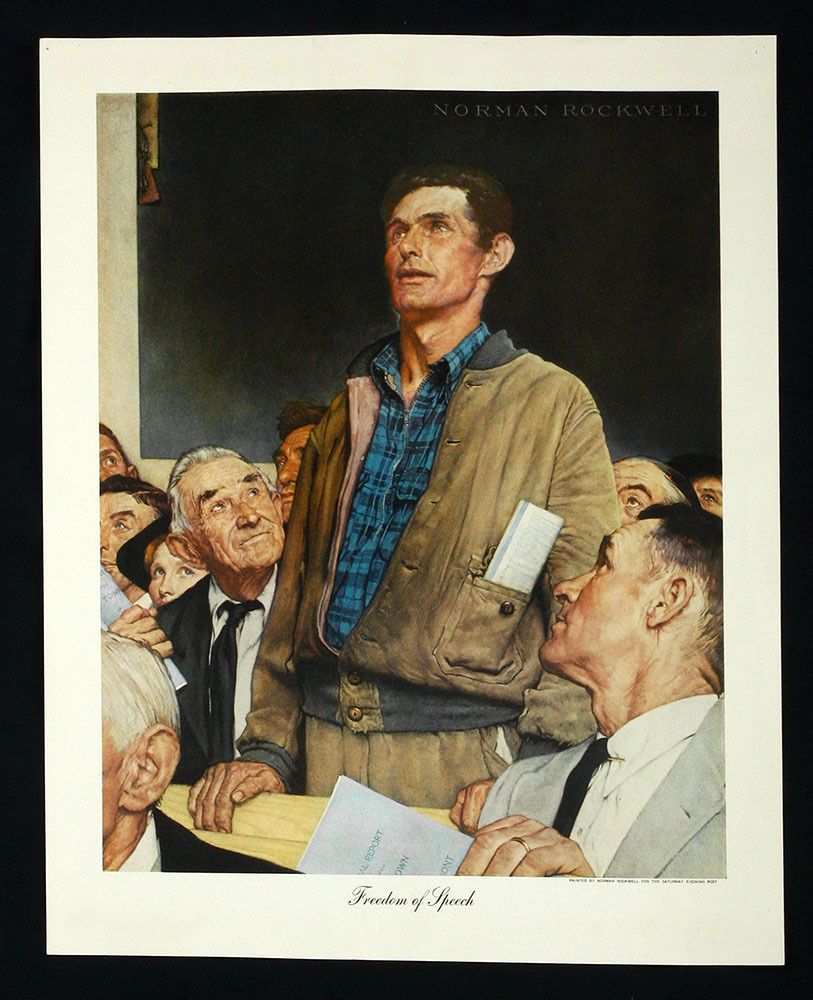
In 1943 in four Saturday Evening Post covers painted by Normal Rockwell, the Four Freedoms showed us what freedom looks like at home, at the table, in moments of worship, and at a town meeting. You can see the original paintings today at the Norman Rockwell Museum in Stockbridge.
Thinking about the recent Medal of Freedom ceremony, I realized that each person honored had in some way contributed to expanding one of the Four Freedoms.
And that got me to wondering, if I were to pick individuals in Stoneham who exemplified these freedoms, who would they be?
What my choices would have in common is the desire to realize freedom not only in their own lives, but in the lives of others as well. I would look for people who lift others up. A teacher who teaches compassion as well as calculus. A banker who helps small businesses gain a foothold. A town moderator who keeps democracy on track. An artist who teaches seniors to paint. A tutor who helps immigrants learn English. A food bank or community dinner director. A legislator, coach, librarian, nurse, police or fire fighter, pastor, and more.
Who would you choose? Look around you. In the New Year, we will be challenged to honor and uphold the freedoms we cherish. It’s something each of us, in our own way, can do.
Last week Becky and I attended the Immigrant Entrepreneur Awards celebration in Cambridge. It is held each year by the Immigrant Learning Center in Malden to honor immigrants for their outstanding achievements in business and community enrichment.
The first honoree this year is Erdem Kaya from Turkey, who started a community-oriented jewelry business in Newburyport. The second is Krenar Komoni from Kosovo. Komoni founded a company that designed a new system for tracking shipping around the world. His innovations produce savings for everyone on the supply chain.
The third honoree is Mariana Matus from Mexico. Based on her research at MIT, she founded and became CEO of BioBot Analytics in Cambridge, which uses wastewater analysis to improve public health. During the COVID-19 epidemic, her company was the first in the world to provide data on COVID-19 levels, based on wastewater monitoring. This information saved countless lives.
Matus’ company continues to monitor for other public health threats, including influenza, RSV, monkey pox and high-risk substances such as opioids.
Listening to awardees’ inspiring stories, we couldn’t help but think of the thousands of immigrants in Massachusetts and how they benefit and enrich our towns and communities. Like the three above, they bring not only economic benefits, but engagement in civic life, mentoring and culture that enriches all our lives.
At the ceremony, we also learned a few “fun facts” about immigrants. For example, that 31 percent of all new businesses in America are started by immigrants. Immigrants also have a higher workforce participation rate than U.S.-born residents, as well as a higher self-employment rate. And, despite what you have heard, immigrants have a lower crime rate than other Americans.
Attending the Immigrant Entrepreneur Awards program, we are left with the realization that immigrants have always made our country better. And that the current hype that immigrants are to blame for our woes, is not only wrong but terribly short-sighted. We need immigrants, not only like Kaya, Komoni and Matus, but the people who grow and pick our food, who feed us in their restaurants, who care for us in hospitals and nursing homes, who build our houses, and bring their stories and art to remind us of our own humanity.
Looking at the big picture, we see a continued need for newcomers to replenish and support us. Recent dips in fertility rates have pushed us below the population-replacement level. A 2024 study by the University of Pennsylvania projects that as we grow older, the U.S. population growth will decline. Also, the worker-to-retiree ratio is expected to drop from 3-1 to 2-1 by 2075. Both factors signal dire outcomes. Preventing these outcomes “will require faster immigration by several multiples of its current rate.”
The simple truth is that we need immigrants, including asylum seekers and refugees, to keep building our societies. We need workers, but we also need imagination and ideas. We need problem solvers, like the honorees named above.
As the descendant of immigrants, I would like to say to my immigrant friends and neighbors, Thank you.
Note: The awards program was sponsored by the Immigrant Learning Center in Malden. It honors Barry Portnoy, the entrepreneur and philanthropist, late husband of the school’s founder, Diane Portnoy.
Woodie Guthrie wrote the lyrics. Martin Hoffman set them to music. Since then, It’s been sung by Pete Seeger, Bob Dylan, Johnny Cash, Joan Baez, Dolly Parton, Bruce Springsteen and a dozen others, including Arlo Guthrie. The ballad tells of an airplane crash in California’s Los Gatos Canyon. On board were 28 migrant farm workers from Mexico.
The year was 1948, six years after the start of Operation Bracero, a government program which recruited Mexican laborers to work in American fields. Now the braceros were being rounded up and flown back to Mexico. At the same time, to keep prices high, the government was paying growers to leave their crops in the field. Peaches were rotting and oranges piling up in dumps.
The song is called “Deportee.” Guthrie wrote it after news reports listed the names of the pilots, attendant and immigration guard, but referred to the farm workers only as “deportees.” Unlike the four Americans, the braceros were buried in a mass grave without names, marked “Mexican Nationals.” As the song goes,
The sky plane caught fire over Los Gatos Canyon, A fireball of lightning, and shook all our hills, Who are all these friends, all scattered like dry leaves? The radio says, “They are just deportees”
The roundup of the Los Gatos laborers was just one episode in several government campaigns to remove Mexicans from American soil. Mass deportations began during the Great Depression and continued through the 1940s. Then in 1954, the Immigration and Naturalization Service (INS) brought out “Operation Wetback.” Under this federal program, officials used military-like tactics to arrest tens of thousands of immigrants across the country. Caught up in the raids were farm and factory workers, including some American citizens.
In July of 1955, several thousand deportees were found wandering the streets of Mexicali, a desert town bordering California. Yanked from their jobs and families, they had simply been dumped across the border. According to one account, 88 died of heat exposure in the 112 degree heat.
In Texas, thousands of deportees were crammed onto boats bound for Mexican ports in conditions comparable with those on slave ships. Others were packed into trucks. By the end of Operation Wetback, the INS claimed it had “repatriated” 1.3 million Mexicans.
Goodbye to my Juan, goodbye, Rosalita, Adios mis amigos, Jesus y Maria; You won’t have your names when you ride the big airplane, All they will call you will be “deportees”
Accompanying the mass deportations were media depictions of Mexicans as dirty, disease- bearing and irresponsible. News coverage focused on border and immigration officials planning and conducting raids. Only in time did most Americans come to see this as something shameful. In 2012 the state of California formally apologized for its role in deporting hundreds of thousands of U.S. citizens.
On Labor Day in 2013, United Farm Worker President Arturo Rodriguez joined hundreds gathered at the Holy Cross Cemetery in Fresno, California, to memorialize the 28 farm workers, 25 men and three women, killed in Los Gatos Canyon. This time, inscribed in the headstone, was each person’s name.
Next week American voters will choose a new president. One of the candidates has promised to resurrect Operation Wetback, only under his plan the government, in a military-style operation, will deport 11 million undocumented immigrants (Trump put the figure at 18 million).
Trump would also end deferrals for children (DACA) and temporary protected status (TPS) for migrants fleeing violence and persecution in their home countries. Such a massive deportation would throw our country into financial, legal and social chaos. As Slate authors Louis Hyman and Natasha Iskander have written, “To return to the era of Operation Wetback would be to return to an America ruled not by law but by terror.”
Perhaps worst of all, it would perpetuate the big lie that immigrants, asylum seekers, migrants and refugees are not like us, that they are less than human. That they don’t deserve names.
Once that lie is believed, we become silent to the cruel treatment of others.
In the fall of 1919, just three months after the Versailles Treaty marked Germany’s defeat in World War I, Adolf Hitler wrote a letter to a fellow army soldier. It is considered the first printed expression of his antisemitism. Composed most likely on an army typewriter, the letter lays out Hitler’s belief that Jews are not just people of a different religion. Rather, they are an “alien race,” intent on destroying society.
To counter their influence, Hitler proposed a “rational antisemitism,” a political movement to systematically take away their “privileges,” culminating in their “irrevocable removal” from Germany.
In time, their “irrevocable removal” became the “final solution,” the murder of six million Jews throughout Europe.
It’s not difficult to see in the candidacy of Donald J. Trump a similar convergence of nationalism and racism. Substitute the word “immigrant” for “Jew,” and you see the same calculated dehumanization of a sector of the population.
Trump’s targeting of immigrants is built on racism. In 2018 he complained about “having all these people from shithole countries come here,” that is, from Haiti, El Salvador and Africa. Then he added, “We should have more people from Norway.”
In following years, Trump has ramped up his attacks. In 2023 he said “illegal immigrants are poisoning the blood of our nation,” echoing Hitler’s statement that “Jews and migrants are poisoning Aryan blood.”
At the 2024 Republican Convention, Trump promised the deportation of 11 million illegal immigrants—a figure he put at 18 million. In September he said the mass roundup would be a “bloody story.”
Since then, Trump’s attacks have intensified, including the assertion, repeated by his running mate and other followers, that Haitian immigrants in Springfield, Ohio, were eating their neighbors’ pets.
Targeting immigrants, legal or otherwise, is not new in America, nor is “white nationalism.” The nation that opened its doors to European immigrants also passed the Chinese Exclusion Act, denying citizenship to Chinese workers who built our railroads.
During World War II we imprisoned 120,000 Japanese Americans in concentration camps. In the 1950s we deported a million Mexicans, legal and undocumented, who had harvested our crops. From 2017-21 under Trump’s “zero tolerance” policy, 3,900 children were taken from their parents.
We are also the nation that in 1939 prevented the S.S. St. Louis, a ship carrying over 900 Jews fleeing Nazi Germany, from docking in Miami. Anchored offshore, the ship waited. On deck that night, children joined parents to gaze at the city lights sparkling in the distance.
When permission was denied, the St. Louis returned to Europe. For many it was a death sentence. Two-hundred-fifty-four perished in Nazi concentration camps.
As November 5 approaches, we again see an unholy convergence of racism and nationalism. A nation of immigrants, we are told to fear immigrants. We are urged to accept slander and misinformation as truth.
How we vote this year will affect the safety and well-being of millions. It will also determine our character.
Note: In 2012, the United States Department of State apologized to the survivors of the St. Louis. In 2018, Canadian Prime Minister Justin Trudeau did the same.
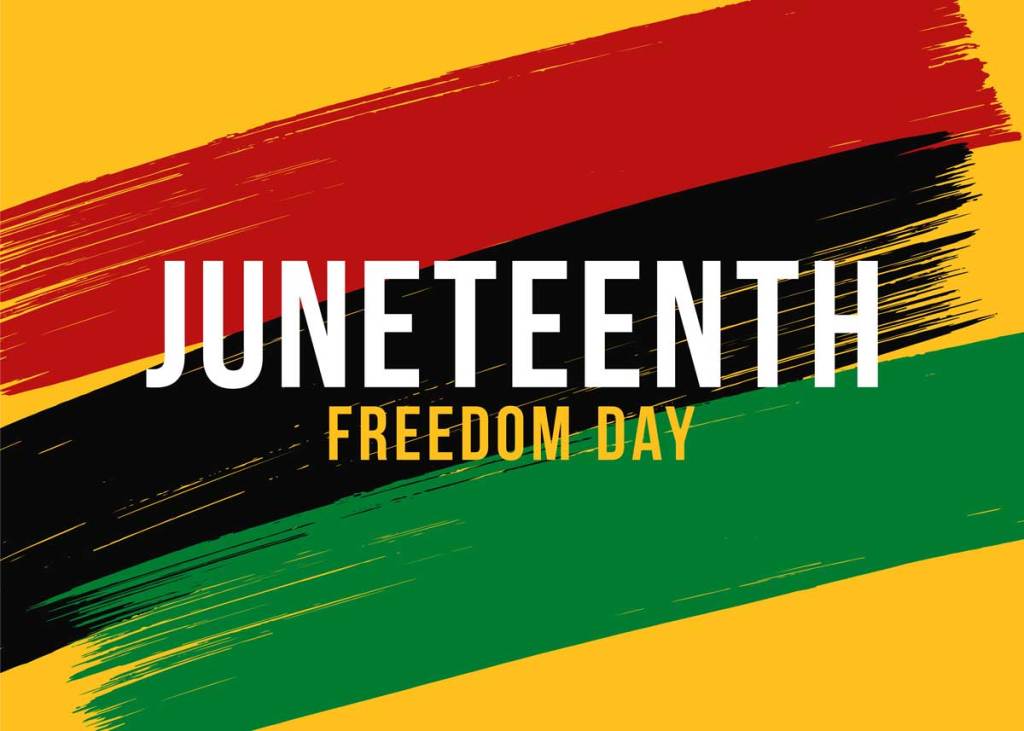
As we celebrate our newest national holiday, the day enslaved folk in Texas finally learned of their freedom, we recall our own history of slavery and abolition:
1754—A census of enslaved people in Massachusetts that year shows there were eight slaves above the age of 16 in Stoneham. They were among at least three dozen slaves in our town during the Colonial period—men like Cato, belonging to Deacon Green, and women like Dinah, a slave of the teacher James Toler, “who waited upon him to the end of his days” (Silas Dean). And they were children, like the unnamed 8-year-old mulatto purchased by Captain Peter Hay in 1744, the same year the Rev. James Osgood paid £75 for a woman named Phebe.
1775—Six Black men from Stoneham, three enslaved and three free, fight in the Battle of Bunker Hill, joining white colonists in the struggle for freedom from Great Britain.
1780—Four years after the Declaration of Independence, Massachusetts voters ratify the Massachusetts Constitution, authored mainly by John Adams.
1781—A slave called Mumbet (Elizabeth Freeman) and another named Brom sue their Sheffield owner for their freedom and win. This and other court cases bring about the eventual freedom of all slaves in Massachusetts based on the Massachusetts Constitution.
1790—The first federal census lists no enslaved people living in Stoneham.
1823—A former slave from Virginia named Randolph is seized in New Bedford. The state Supreme Judicial Court upholds the property rights of his owner, and he is returned to slavery.
1837—After an abolitionist meeting in Stoneham, a fight breaks out in the street, and a Stoneham man, Timothy Wheeler, is knifed and killed. He leaves a wife and four children.
1838-9—Sarah Richardson Gerry leads 27 women in founding the Female Anti-Slavery Society of Stoneham. The men also create a chapter.
1839—Church deacons pass a resolution calling on all ministers of the Gospel to “bear faithful witness against the sin of slavery.”
1850—A thirty-year-old minister of First Congregational Church, the Rev. William Whitcomb, preaches a fiery sermon against the federal Fugitive Slave Act, passed as part of the Compromise of 1850. He calls on his parishioners to aid all fugitives, even at the expense of their property and lives.
1850—Deacon Abijah Bryant’s home on Main Street becomes a station on the Underground Railroad, sheltering fugitive slaves and enabling their safe passage to Canada.
1854—Anthony Burns, a 20-year-old former slave from Virginia is arrested in Boston and brought to trial. Thousands of abolitionists attempt to free Burns from the courthouse, but fail. In a widely reported trial, Burns is convicted and ordered sent back to his owner. Thousands line the streets as Burns is led in shackles to the docks and shipped back to his owner.
1861—Hundreds of Stoneham men join Massachusetts regiments responding to President Lincoln’s call for a voluntary army to defend the Union.
1864—54 Stoneham men die in the War of Rebellion: 11 killed in battle, 9 from wounds, 9 while in Confederate prisons, 25 from disease. These include Col J. Parker Gould, with others buried in Lindenwood Cemetery.
1862—Rev. William Whitcomb, is commissioned as a chaplain in the Union Army. He serves in hospitals in North Carolina until his death from malaria.
Over time we have learned to extend the human rights we hold so dear, those spelled out so eloquently in the Constitution of the Commonwealth of Massachusetts, to everyone, regardless of race, ethnicity, religion or gender. From our Constitution we read:
“All men are born free and equal, and have certain natural, essential, and unalienable rights; among which may be reckoned the right of enjoying and defending their lives and liberties; that of acquiring, possessing, and protecting property; in fine, that of seeking and obtaining their safety and happiness.”
Stormtroopers holding German Christian propaganda during the Church Council elections on July 23, 1933, at St. Mary’s Church, Berlin.
By Ben Jacques
On a warm day in August, 1934, thousands of Baptists from around the world filed into the vast Tagungshalle in Berlin. From 70 countries, they were there for a week-long Congress of the Baptist World Alliance. Behind the podium was a portrait of three Baptist founders below a cross. To the right hung a red banner with a swastika.
At the conference the delegates were welcomed by the deputy mayor of Berlin, who stressed the good work the government was doing for children and the unemployed (Brown). They also received a greeting from Reichsbishof Ludwig Mueller, whom Hitler had appointed to head the consolidated Evangelical (Lutheran) Churches of Germany. An ardent supporter of Hitler’s “positive Christianity,” Mueller made no secret of his anti-Semitic stance.
The delegates also heard Paul Schmidt, director of the German Baptist Union, praise the good work of the new government, declaring that God had chosen Hitler to rescue the German nation (Norris).
On Tuesday the morning session was suspended so delegates could tune in to the funeral of German President von Hindenburg, whose death two days earlier had left Hitler in full control of the government. A wreathed portrait of von Hindenburg was placed on the stage. Wrote British delegate Eva Brown, “We listened to the chaplain of the German Army, to Hitler, to guns firing, and to a verse of ‘Ein feste Berg,’” Martin Luther’s famous hymn, “A Mighty Fortress.”
In days to follow the international body debated and passed resolutions calling for separation of church and state and freedom of religion. Another resolution deplored “all racial animosity, and every form of oppression or unfair discrimination toward the Jews, toward colored people, or toward subject races in any part of the world” (Resolution 1934.7).
Despite these sentiments, however, a number of delegates sympathized with the Germans’ anti-Semitic policies. M. E. Dodd, president of the Southern Baptist Convention, wrote that Jews, while only one percent of the population, were using their disproportionate influence in professions for “self-aggrandizement to the injury of the German people.”
Others expressed approval of the crackdown on immorality. John W. Bradbury, a Baptist pastor from Boston, wrote: “It was a great relief to be in a country where salacious sex literature cannot be sold; where putrid motion pictures and gangster films cannot be shown” Bradbury continued: “The new Germany has burned great masses of corrupting books and magazines along with its bonfires of Jewish and communistic libraries” (Allen, “How Baptists Assessed Hitler”).
Baptists weren’t the only ones to equate Nazi policies with Christian reforms. A year earlier, the president of the German Seventh-day Adventist Church, Adolph Minck, wrote: ‘A fresh, enlivening and renewing reformation spirit is blowing through our German lands…. The word of God and Christianity shall be restored to a place of honor” (Alomia).
Methodist Bishop Dr. Otto Melle, speaking at the Oxford World Conference in London in 1937, claimed that “God in his providence has sent a leader who was able to banish the danger of Bolshevism in Germany and rescue a nation of 67 million from the abyss of despair” (Manchester Guardian Weekly, July 30, 1937).
Although they comprised only a fraction of Germany’s Protestant population, Baptists, Methodists and Adventists came under enormous pressure to conform. Like the Lutherans and Catholics, they struggled with threats to their beliefs. With notable exceptions, however, most found it expedient to accommodate Nazi ideology. As Adventist minister and historian Harold Alomía would later write, “God’s bride danced with the Devil.”
What they got in return was the survival of their organizations, a chance to evangelize, and an opportunity to play a stronger role in society.
What they should have foreseen, however, was the moral stranglehold they would encounter. While allowed to operate, the churches were counted on to support Nazi ideology. They were also asked to become ambassadors abroad.
In March of 1933, within days after Hitler took control, Nazi Foreign Minister Konstantin von Neurth and Propaganda Minister Joseph Goebbels met with Bishop John L. Nuelsen, president of the Europe Central Conference of the Methodist Episcopal Church. Because he had ties with the large Methodist population in America, he and fellow clergy could be of great help in influencing public opinion abroad at a time when Hitler needed international good will (Blaich, “A Tale of Two Leaders”).
In response, writes historian Roland Blaich, Bishop Nuelsen “joined General Superintendent Hans Dibelius of the Evangelical Church in a short-wave broadcast assuring the outside world that all was well in Germany.” Methodist leaders also sent telegrams to the press in England and the United States “protesting reports of alleged atrocities” (Blaich, “A Tale of Two Leaders”).
The Nazis also reached out to the Baptists and Adventists. What followed were numerous trips by church leaders to the United States. Speaking at church, academic and cultural associations, they praised the achievements of the Nazi government and countered criticism of its treatment of Jews.
The Seventh-day Adventist Church in Germany sent the director of its reputable social service agency, Hulda Jost. Although the Adventist Church had been declared illegal in 1933, it had appealed, stressing its support for the government and its upholding of family values and healthy living. Within weeks, it was reinstated (Blaich, “Selling Nazi Germany Abroad”).
In 1936, on her way to a church world conference in San Francisco, Jost spoke to organizations across the country. Quoted in a Chicago Daily News article, she claimed that “Hitler does not want war.” When asked about persecution of the Jews, she said “Hitler has merely wanted to take leadership away from the Jews, but he doesn’t want to hurt them.” (Schroder, “Seventh Day Adventists”).
Meanwhile, Christians in Germany were being tested. In April 1933, the Nazis introduced the Prevention of Offspring with Hereditary Diseases Act. This law mandated forcible sterilization for nine disabilities and disorders. As a result, 400,000 Germans were sterilized in Nazi Germany.
In 1935 came the Nuremburg Laws, stripping Jews of citizenship and prohibiting racial intermarriage. Later came euthanasia, or “mercy killing,” which accounted for an estimated 250,000 deaths. “A curious path led from caritas, the caring for the less fortunate and weak, to elimination of the weak, as the work of God,” Blaich writes.
Churches were also told to purge their members of Jews. This spelled particular trouble for the Seventh-day Adventists. Because Adventists kept Saturday as Sabbath, and had similar dietary practices, they were sometimes associated with Judaism. Eager to show they were Christian, Adventists started calling Saturday “Rest Day,” rather than the Sabbath. Across Germany and occupied countries, signs appeared on church doors prohibiting Jews from entering.
There are several accounts of Christians with Jewish heritage being expelled and shunned. Some disappeared. Others died in concentration camps (Heinz, “Painful Rememberance”).
Not all churches in Germany made peace with the Third Reich. Some, like the Confessing Church, were outlawed, and many of their members persecuted or killed. Others fared even worse. Approximately 1,500 Jehovah’s Witnesses died or were killed in concentration camps.
While a majority of German Christians found a way to accommodate the Nazi agenda, there were also individuals, Protestants and Catholics, who risked or gave their lives to protect Jews and others. Their stories are a precious testament to the capacity of the human heart for courage and compassion.
From Christians who went along with the Nazis, however, we see how treacherous is the mix of religion and nationalism and how lethal when race hatred is added. From their tragic experience, we have much to learn.
Brown, Eva. “The Baptist World Conference in Berlin.” Baptist Quarterly, October 1934.
Brumley, Jeff. “What Happens When Church and State Merge? Look to Nazi Germany for Answers.” Baptist Press, Jan. 30, 2023.
“Church’s Relations with the State: The Oxford Conference and the German Delegates,” The Manchester Guardian Weekly, 30 July 1937. The official report on the Oxford Conference is found in J. H. Oldham, The Oxford Conference (New York: Clark, 1937.)
Dodd, M. E. “My Impressions of the Baptist World Congress.” Baptist and Reflector, Sept. 13, 1934.
Heinz, Daniel. “Painful Remembrance: Adventists and Jews in The Third Reich.” Shabbat Shalom Magazine, Viewpoint 28 December 2017. This article appeared originally in German in Adventecho, May 2001, pp. 12-14. Translation by Martin Pröbstle.
King, Christian Elizabeth. The Nazi State and the New Religions. E Mellon Press, London: 1982.
Norris, Kristopher. “Baptists under Nazism and Baptists amid America’s current political crisis: a call to ‘disruption’” Baptist News, Nov. 21, 2019.
Roach, David. “Baptists ‘humbled’ by failure to oppose Nazis.” Baptist Press, Sept. 18, 2014.
Schroder, Corrie. “Seventh Day Adventists,” Oral History Project, University of California at Santa Barbara, 2002.






 Ben Jacques Stories